
10h red – development of field 91 of plate IV
The 10h red (POFIS no. 5) was, together with the 5h light green (3), the first stamp of newly founded Czechoslovakia, issued 18 December 1918 (printing began 16 December 1918). More than 110 million were printed; only 1 % of the printing was officially perforated 11½ (D, line perforation).
Because of the letterpress technology – where practically every field of a 100-stamp sheet is an original – a great number of flaws occur. Some of the striking plate flaws were selected by Dr. Kubát for the 1968 Monograph of Czechoslovak Stamps; we call these Monograph flaws.
One of them is the popular “clock” at field 91 of the 10h red. It is a negative flaw – from the first phase of plate production – so the “clock” is found on all 4 plates of this value.
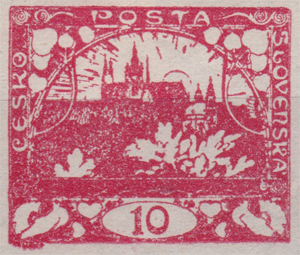
During printing it was decided to retouch this white spot on all 4 plates. The Monograph says the depression on the first plate was filled with metal; on the second and third it was partly filled and levelled by squeezing the two towers. This article describes the development of the retouch on plate IV. Dr. Kubát writes the flaw was removed only by strong squeezing of the towers, deforming them into a scissor shape.
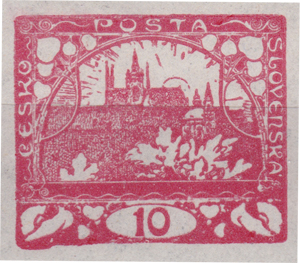
In my view this procedure is impossible – around the first two towers there is not enough metal to create the scissor effect; there is nothing to squeeze. I believe the whole area of the first two towers was cut out and a new piece with the fork – the retouch – was inserted. I am led to this also by the clearly visible fact that in the fork variant the rays left of and above the first tower are markedly shorter and do not touch the towers; the space around the towers is empty. Stamps with the plate flaw and with the fork retouch occur relatively commonly.


Unlike the Monograph, the POFIS catalogue lists 2 retouch variants without further explanation; the fork is retouch no. 2. This is what retouch no. 1 (“the hoe”) looks like according to that catalogue:
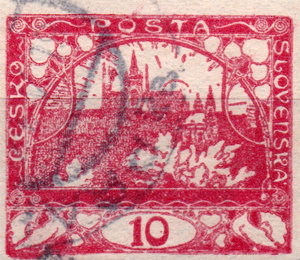
Stamps with this variant are very rare. But is it a repair – a retouch – at all? Is it not rather damage to the original fork retouch? Details of the first two towers from several copies:


The development of the whole area around the first two towers is clearly visible. In my view this is not another retouch but a development phase of the original fork – the only retouch made at 91/IV. The development continued: as the plate was stressed during printing, part of the inserted piece broke off and deformed:
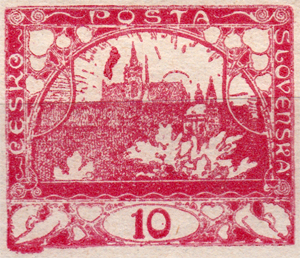
So far I have seen only three copies with this form of damage. I believe it belongs to the printing of the final quantity of sheets. Stamps may also exist from a phase where the inserted piece broke off completely and the towers are missing from the print.


All development phases of the area of the first and second cathedral towers at 91/IV:
I will be grateful for constructive comments and other scenarios of how this interesting stamp may have developed.