
Collecting Hradčany
A site about the first Czechoslovak stamp issue — its five designs, twenty-six values, printing plates and everything that befell them in the making between 1918 and 1920. The 15h value has its own, more detailed specialised site.
From the history of the issue
A good many stories circulate about the first Czechoslovak stamps, and repetition has carried some of them a long way from the facts. More than a century has passed since they appeared; what follows is what is documented.
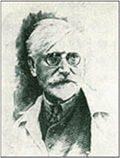 According to the records of the Czech Philatelic Club, on 8 November 1918 its board approached professor Alfons Mucha with a request for designs for the first Czechoslovak stamps.
Yet by the recollection of the senior postal official Jaroslav Lešetický, as early as 29 October 1918 the postal director Maxmilián Fatka charged him with obtaining a design for an overprint reading “Provisional Government 28 Oct 1918” for use on Austrian stamps. That proposal was rejected and the overprint officially abandoned. The very next day Lešetický was given a second task — to find designs for provisional stamps.
On 1 November 1918, walking back from the Unie printing works, ministerial counsellor Viliam Elias suggested to Lešetický that Prague Castle (Hradčany) be the motif of the first stamps. The postal presidium approved it, and the next day Mucha was commissioned to draw the Castle. Printing was entrusted to the Czech Graphic Union in Prague — a firm formed in 1903 by the merger of the Czech Graphic Society Unie with Jan Vilím’s reproduction workshop.
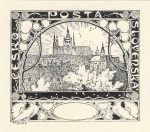
On 3 November Mucha handed in designs showing the Castle, a Hussite, a falcon and a girl in folk costume. The first Hradčany stamps — the 5 h light green and the 10 h red — appeared on 18 December 1918, a date that became the commemorative day of Czechoslovak philately. The values did not then appear in order of face value but out of sequence; the last of them, the 30 h light violet, only on 12 April 1920.
The postal validity of the whole issue ended on 30 April 1921; from 1 May 1921 the Hradčany were no longer supposed to pay for mail. Stamps with a later cancellation date nevertheless occur — most often a misset year in the canceller or a tolerant post office; examples are collected in a separate article.
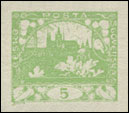
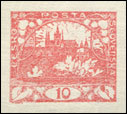
The issue as a whole comprises five different designs and 26 values, fourteen of which also appeared perforated.
The five designs
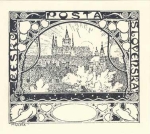
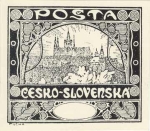
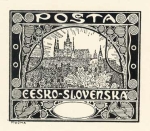
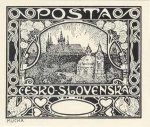
My favourite value — the 15h
Of the whole issue it is the 15 h brick red I work on systematically. It is the most varied stamp of the issue and more rewarding to a specialist than any other: seven printing plates, five catalogued shades, eight groups of official perforation plus two exceptional ones — and it is the only value represented in all eight groups.
That is why it has a site of its own. There you will find reconstructions of all seven plates with their hundred fields, a field comparator, statistics from an analysis of over 21,000 stamps, a cancellation map, an account of letterpress printing, a section on production flaws, and proofs.
How the stamps were made
The making of the first Czechoslovak stamps bears the marks of post-war disorder. The Czech Graphic Union works was not equipped for stamp production and its letterpress machines were out of date. The result was a wealth of printing flaws and varieties — and with them a paradise for the specialist.
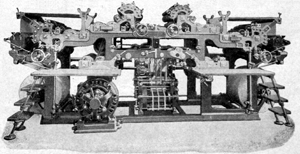
Mucha’s drawing first had to be turned into a printing relief. From the finished element a printing forme of one hundred stamp fields was assembled — a hundred individual images side by side, not one image a hundred times over. The whole of today’s specialisation grows from that: whatever differs among those hundred elements differs always, and in the same place.
From this comes the division that runs through the whole site. A deviation tied to a particular stamp field is a plate variety — it recurs on every sheet from that plate and serves to identify both position and plate. A deviation tied to one particular sheet or one pass through the machine is a production flaw — random, and non-recurring.
How letterpress works, what deviations it produces and why that is a gift to the collector rather than a nuisance is set out on the Letterpress page of the 15h site. The technical description of plate making draws on the Monograph of Czechoslovak Stamps No. 1.