Cancellations dated outside the Hradčany’s validity period
The 15 h value was issued on 7 June 1919, and the postal validity of the whole Hradčany issue ended on 30 April 1921. Even so, a used stamp with a cancellation dated outside that period turns up from time to time — usually after its end, exceptionally even before the stamp was issued. The most common explanation is a misset date wheel in the canceller. This page collects such finds and will be extended as further pieces appear.
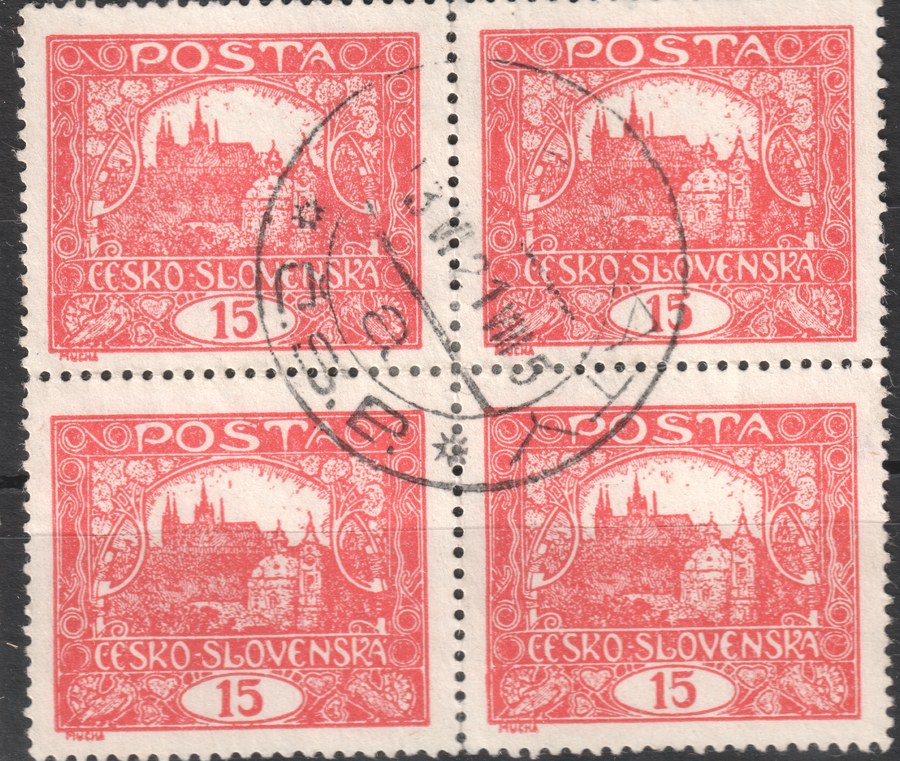
A block of four 15 h from plate 6, perforation C — “13. VI. 21”
The first documented piece: a block of four 15 h from plate 6 (fields 48, 49, 58 and 59), line perforation C. The cancel with a star and the Č.S.P. mark — the office name is illegible — carries the date 13. VI. 21, i.e. 13 June 1921, more than a month after validity ended.
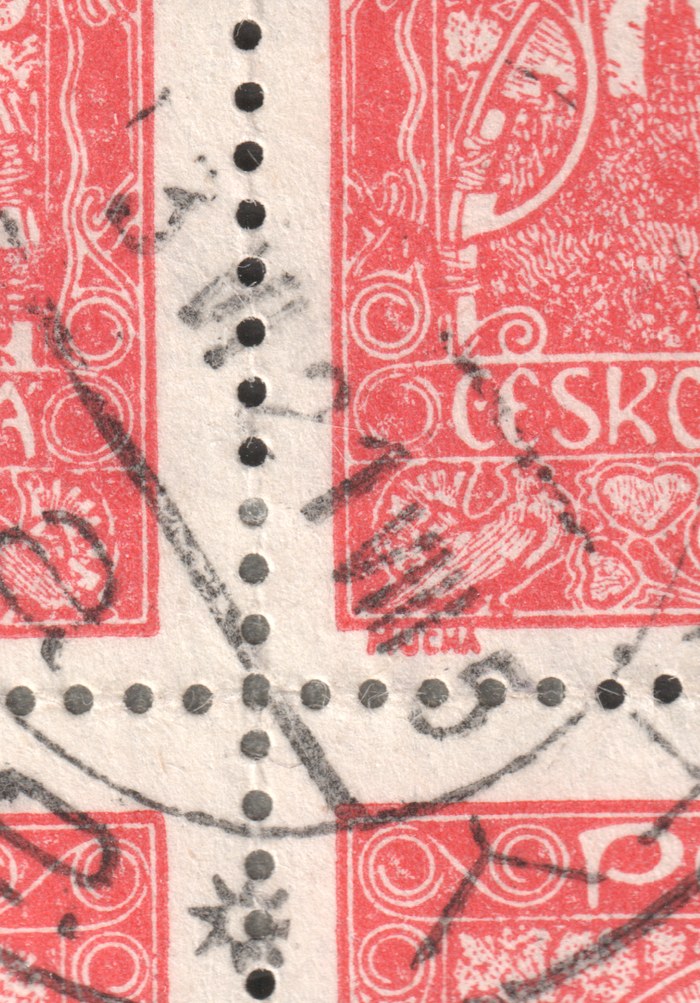
How should such a piece be read? The most likely explanation is a wrongly set date wheel in the canceller — the postal clerk turned the year one step too far. Such slips are known from other issues too, and on a loose stamp without its cover they can be neither excluded nor confirmed. Other possibilities are a late cancellation of an item franked while the stamps were still valid, and simple tolerance by the post office, which still accepted the old stamp. As a rule only a cover can decide between them — from its contents, the rate paid and the arrival postmark.
In the records this block is treated as a misset date, i.e. filed under the year 1920 (June); the period covered by the dated-cancellation records ends in April 1921 in any case.
Four more pieces — Karlovy Vary, Terezín, Ústí nad Labem, Krompach
The same material yielded four single 15 h stamps, this time in line perforations A and B. All four carry the year “21” on the date wheel, and all four therefore fall after the end of validity:
- Position 56 / plate V, perforation B, cancellation KARLSBAD dated 4. V. 21 — a mere four days after the end of validity.
- Position 27 / plate III, perforation B, cancellation TEREZÍN dated 20. V. 21.
- Position 13 / plate V, perforation B, cancellation ÚSTÍ N. LABEM 2 (Č.S.P.) with the month X. 21; the day is illegible.
- Position 31 / plate VI, perforation A, cancellation KROMBACH (Krompach, Č.S.P.) dated 26. VII. 21 — the latest date in our records so far.
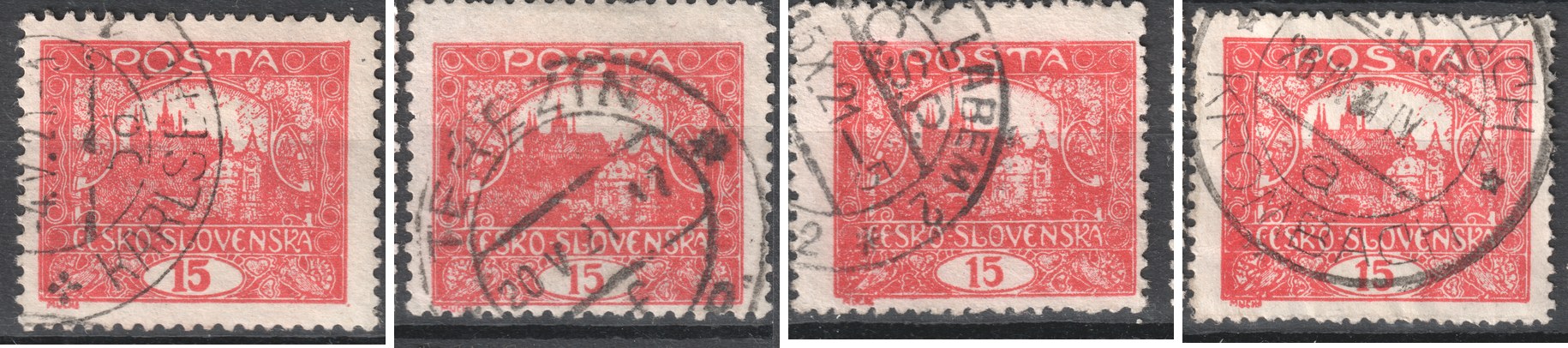
The same applies to them as to the block of four above: without a cover it cannot be decided whether the date wheel was misset or the stamp really was used late; for the Karlovy Vary cancellation, only days after 30 April, tolerance by the post office is quite conceivable. In the records they are treated like the block, i.e. filed under the year 1920, and Terezín and Krompach are entered in the cancellation map on the same basis. Further pieces dated after 30 April 1921 will be added here as they are found.
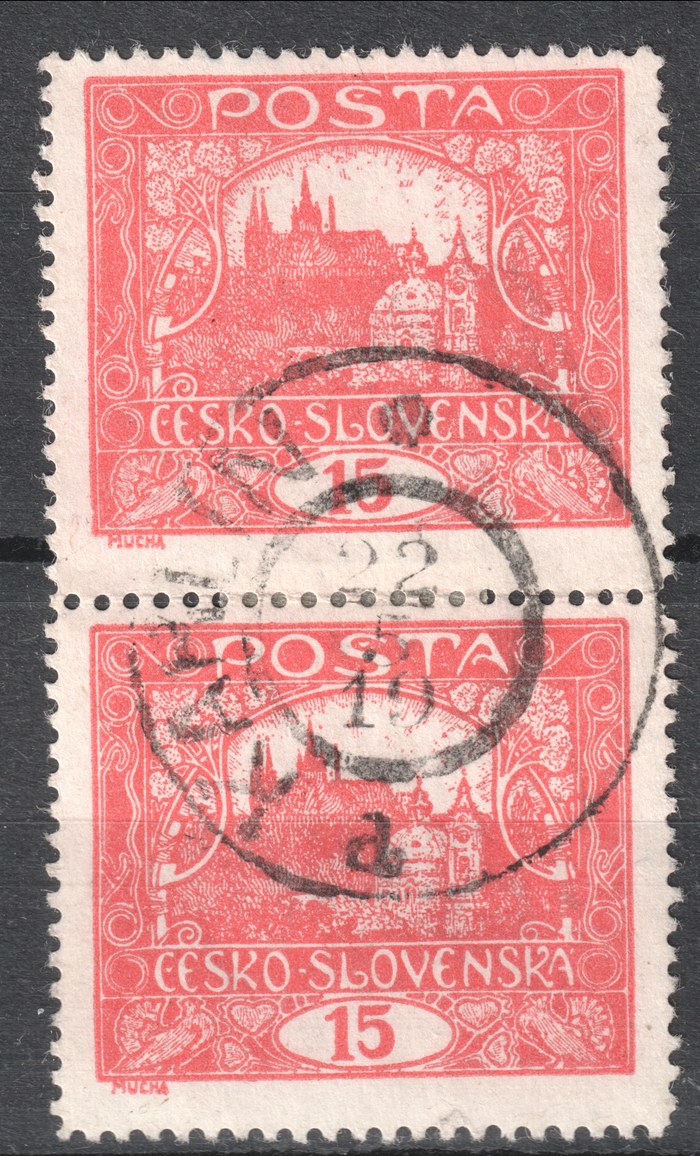
The opposite case: a date before the stamp was issued — Karlín “22. V. 19”
A misset date wheel can move the date the other way too. A vertical pair of 15 h from plate 5 (positions 18 and 28), line perforation C, carries a KARLÍN cancellation (distinguishing letter “d”) dated 22. V. 19. But the 15 h value only reached the counters in June 1919 (the earliest documented use is 24 June 1919, on an imperforate stamp from plates 1–2), and perforation C on plates 5 and 6 is not documented before February 1920. The date thus lies more than a year before the first possible use, and a misset wheel is the only explanation here — the real date will be 22 May 1920, and that is how the pair is entered in the records.