 1
1Postal use of the 15h
The 15 h covered common rates of 1919–1920 (e.g. a 4 × 15 h franking for a letter of the 4th tariff period). Recording cancellations of the scarcer perforations B, C and E maps where these stamps were actually used.
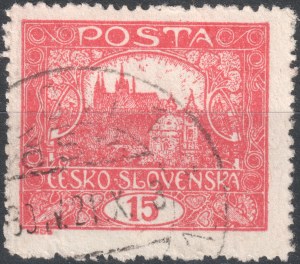
The value was issued on 7 June 1919 — less than a month after the tariff change of 15 May 1919 that opened the 2nd tariff period and raised the domestic postcard rate to exactly 15 h. The new stamp could thus cover the most common item of mail, the postcard, with a single stamp from the outset. It was printed from three original plates (plates 1, 2 and 7 — brick red and its shades), later joined by plates 3–6 for the carmine and vermilion shades; the print run exceeded 112.5 million copies, making it one of the most widely used values of the whole issue. A general overview of the tariffs and postal rates in force while the Hradčany stamps were current can be found on the issue-wide page; this 15h site follows its specific postal use — railway post offices, post-office lists and commemorative postmarks.
Railway post (TPO)
Documented travelling post offices on 15 h stamps of the scarcer perforations:
Note: All usage data below – railway post offices and post-office lists – relate exclusively to stamps from printing plates 1 and 2.
| Perforation | Train no. | From | To |
|---|---|---|---|
| E | 516 | Brno | Znojmo |
| E | 681 | Prostějov | Česká Třebová |
| E | 47 | Turnov | Praha |
| E | 398 | Ostroměř | Hradec Králové |
| E | Liberec | Pardubice | |
| E | 360 | Smržovka | Josefův Důl |
| E | 384 | Hroby, Radenín | Praha |
| E | 394 | Bratislava | Veselí nad Moravou |
| E | Štíty | Králíky | |
| E | České Budějovice | Planá nad Lužnicí | |
| E | Dobříš | Vrané nad Vltavou | |
| E | Praha | Brno | |
| E | Kaštice | Doupov | |
| B | 352 | Kaštice | Doupov |
| B | 113 | Broumov | Choceň |
| E | Praha | Budějovice * | |
| E | 19x | Jilemnice | Rokytnice nad Jizerou |
| C | 2xx | Vejprty | Chomutov |
| E | 622 | Velké Karlovice | Hranice |
* provisional cancel
Post offices documented on perforation B (11¾, plates 1–2) — 60
- Andělská Hora
- Benešov
- Beroun
- Brandýs nad Labem
- Brno
- Český Krumlov
- Domažlice
- Doubravka
- Heřmanův Městec
- Horní Jindřichov
- Horní Slavkov
- Hostinné
- Chomutov
- Jablonec nad Nisou (2×)
- Jablonné v Podještědí (2×)
- Jáchymov
- Jindřichův Hradec
- Karlovy Vary (2×)
- Klatovy
- Krásná Lípa (4×)
- Kutná Hora
- Liberec
- Loučeň
- Loučeň
- Loučná pod Klínovcem
- Mariánské Lázně
- Mikulášovice
- Mohelnice
- Moravská Ostrava
- Netvořice
- Nový Bor
- Nusle
- Ostrov
- Písek
- Plzeň
- Poděbrady (3×)
- Podmokly
- Podmokly
- Pozorka
- Praha (2×)
- Prachatice
- Roudnice nad Labem
- Rumburk
- Schenkenhahn
- Slaný
- Smíchov
- Staré Křečany
- Šluknov (3×)
- Tábor
- Teplice
- Teplice - Šanov
- Ústí nad Orlicí
- Varnsdorf
- Velký Šenov
- Vinohrady (2×)
- Víska
- Vlcice u Trutnova
- Výprachtice
- Železná Ruda
- Žižkov
Post offices documented on perforation E (11½:10¾, plates 1–2) — 163
- Adamov
- Albrechtice v Jizerských horách
- Aš
- Benátky nad Jizerou
- Benešov
- Bílý Kostel nad Nisou (2×)
- Bohatá
- Bohosudov
- Bratislava
- Březno (2×)
- Butovice
- Cítoliby (2×)
- Častolovice
- Červená Řečice
- Česká Kamenice
- Česká Lípa (3×)
- České Budějovice
- Děčín
- Dolany
- Dolné Semerovce
- Dolní Řasnice
- Dolní Vltavice
- Duchcov
- Dvorce
- Dvůr Králové nad Labem
- Ervěnice
- Hejčín - Repčín
- Hlohovec
- Hluboká
- Holešov
- Hoštka
- Hrabětice
- Hranice
- Hustopeče u Brna
- Cheb
- Choceň
- Chomutov
- Chotětov
- Jablonec nad Nisou
- Jaroslavice
- Jemnice
- Jimramov
- Jirkov
- Jiříkov
- Kadaň
- Kardašova Řečice
- Karlovy Vary
- Kařez
- Kladno
- Klatovy
- Kojetice
- Kojetice na Moravě
- Kolín
- Kostelec na Hané
- Kostelec nad Černými lesy (3×)
- Kožlany
- Králíky
- Krásná
- Krč
- Krucemburk
- Křešice
- Kuřivody
- Kuzmice
- Lenora
- Liberec
- Liběšice
- Libuň
- Liptovský Mikuláš
- Litoměřice
- Litovel
- Loket
- Loučim
- Louny
- Luby u Chebu
- Malá Morávka (2×)
- Mariánské Radčice
- Mělník
- Mimoň
- Mirotice
- Mladotice
- Mníšek
- Moravské Prusy
- Moravský Svätý Ján
- Most
- Nebočady
- Nitra
- Nový Jičín
- Nusle
- Nýřany
- Olomouc
- Opava
- Osek u Rokycan
- Ostroměř
- Ostrov
- Pardubice
- Peruc
- Piešťany (2×)
- Plumlov
- Plzeň
- Pocinovice
- Podbořany
- Podmokly
- Praha
- Prácheň
- Předmostí
- Přelouč
- Příbram
- Přísečnice
- Přívoz
- Račiněves
- Radiměř
- Radonice
- Roudnice nad Labem
- Roudno
- Rybáře
- Rychnov nad Malší
- Řevnice
- Sadská
- Sedlčany
- Schenkenhahn
- Slaný
- Slavičín
- Smíchov
- Staňkov
- Stará Ľubovňa
- Strážnice
- Střezimíř
- Šahy
- Šluknov
- Tatenice
- Tekovské Lužany
- Teplice - Šanov (2×)
- Topoľčianky
- Trenčianske Teplice
- Trnovany
- Tuchoměřice
- Turnov
- Uherský Ostroh
- Uničov
- Ústí nad Labem
- Valeč
- Vápenný Podol
- Varnsdorf
- Velemín
- Velká Losenice
- Velký Dřevíč
- Vlasatice
- Vratislavice nad Nisou
- Vrdy
- Vrchlabí
- Vrkoslavice
- Vroutek
- Všetaty
- Výsluní
- Zábřeh
- Zahají
- Zákupy
- Zlaté Hory
- Žarnovica
- Žďár u Doupova
- Žihobce
- Žilina
- Žlutice
Post offices documented on perforation C (13¾, plates 1–2) — 14
- Benešov
- Březno
- Fulnek
- Horní Růžodol
- Choceň
- Kadaň (4×)
- Litoměřice
- Praha (2×)
- Praha 1
- Prunéřov
- Soběslav
- Teplice-Šanov
- Vršovice
- Vysoké Mýto
Post offices documented on perforation G (11½:13¾, plates 1–2) — 1
Perforation G (7 copies with the field attributed: fields 55, 53, 34, 17, 92 of plate I; 42, 75 of plate II): the Praha 1 cancel is documented on six stamps, with legible dates 18 Feb 1920, 25 Feb 1920, 21 Apr 1920 and Apr 1920 (month only).
- Praha 1 (6×)
Post offices documented on perforation H (13¾:10¾, plates 1–2) — 3
Perforation H (7 copies: the 97+98/I pair, a second pair, field 84/I and two loose copies added in October 2026): three legible cancels — Turnov, 15 March 1920 (a horizontal pair, so far the earliest recorded use of perforation H), Hradec Králové, 27 April 1921 (84/I) and Liberec 1 (no legible date); the 97+98/I pair bears machine wavy-line strikes without a legible office.
- Hradec Králové
- Liberec 1
- Turnov (2×)
Imperforate plates 5 and 6 postally used — 16
Rare records of postally used imperforate stamps from the late plates:
- Brezovka — 7. VII. 1920 (field 35/VI)
- Košice 2 — 26. VI. 1920 (field 29/V)
- Košice 2 — 13. VII. 1920 (field 34/VI, article on the find)
- Košice 3 — no legible date (field 49/V)
- Košice 4 — 1. IX. 1920 (vertical pair, fields 6+16/V)
- Košice — 5. VII. 1920 (field 100/VI)
- Lučenec — 2. X. 1920 (field 62/VI)
- Malý Lipník — 30. V. 1920 (field 77/V)
- Plešivec — 1. VI. 1920 (field 47/VI)
- Rimavská Sobota — 7. VI. 1920 (field 100/V)
- Rimavská Sobota — no legible date (field 1/VI)
- Štitáre — no legible date (field 80/VI)
- office illegible — 24 July 1920 (field 90/VI)
Two further imperforate copies carry cancels with neither a legible office nor a legible date: fields 36/VI and 57/V.
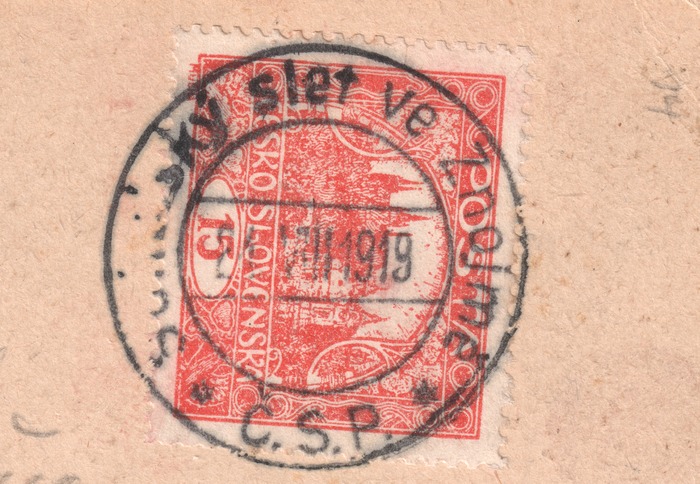
The earliest commemorative postmark — the Znojmo rally, 24 Aug 1919
A postcard sent from Znojmo to Štramberk carries the circular commemorative postmark for the Sokol regional rally in Znojmo, dated 24 August 1919 — according to the records so far, the earliest documented use of a Czechoslovak commemorative postmark on the Hradčany issue. It is franked with an imperforate 15 h (field 73/II); a second copy with perforation A (field 57/II) has also been found.
The last day of validity — 30 April 1921
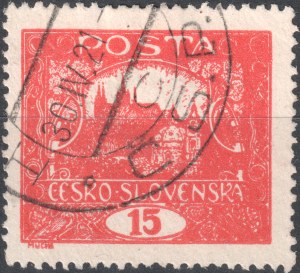
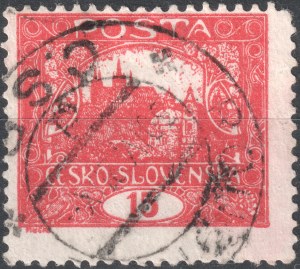
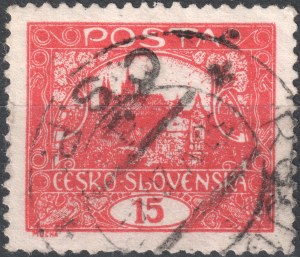
The postal validity of the Hradčany issue ended on 30 April 1921. Stamps cancelled on that very day are therefore an interesting record of the last moment of their service — and on the 15 h all three main perforations of the later plates meet in it. The collection so far holds four pieces dated 30 IV 1921: field 64/IV in perforation A, fields 99/IV and 46/IV in perforation B, and field 16/V in perforation C (machine cancel). The post office is not legible on the loose stamps. Pieces with cancellations dated after this day are summarised in the separate article below.
1field 64/IV, perforation A
 2
2field 99/IV, perforation B
 3
3field 46/IV, perforation B
 4
4field 16/V, perforation C, machine cancel
Cancellations dated outside the Hradčany’s validity period
The postal validity of the Hradčany issue ended on 30 April 1921, yet a used stamp with a later cancellation date turns up now and then — and exceptionally one dated before the stamp was even issued. The page collects such finds: a block of four 15 h from plate VI (fields 48/49/58/59) dated 13. VI. 21, four single stamps with the year “21” (Karlovy Vary, Terezín, Ústí nad Labem, Krompach) and a pair from Karlín dated 22. V. 19. In every case a misset date wheel is the most likely explanation.
→ Gallery of postal usage examples: envelopes, postcards and postal forms franked with the 15 h