Perforation
The 15h has the richest range of official perforations of the whole issue — eight varieties besides the imperforate form. An explanation of both perforating methods is below. The shares below are based on an analysis of 21,353 stamps (J. Matoušek’s collection).
| Code | Gauge and kind | Documented on plates | Share in statistics |
|---|---|---|---|
| — | imperforate | Plates I, II, V, VI, VII | 21,2 % |
| A | 13¾ : 13½ comb | Plates I–VII | 16,1 % |
| B | 11¾ comb | Plates I–VI | 25,7 % |
| C | 13¾ line | Plates I, II, V, VI | 22,2 % |
| D | 11½ line | Plates I, II | 3,5 % |
| E | 11½ : 10¾ line | Plates I, II | 1,0 % |
| F | 13¾ : 11½ line | Plates I, II | 10,3 % |
| G | 11½ : 13¾ line | Plates I, II | — |
| H | 13¾ : 10¾ line | Plates I, II | — |
The scarce perforations G (11½:13¾) and H (13¾:10¾) occur only on plates I and II; the records now hold 7 copies of G (incl. fields 55, 53, 34, 17, 92/I and 42, 75/II) and 5 copies of H (the 97+98/I pair, a newly found pair cancelled Turnov, and 84/I).
Irregularities in the position of the perforation relative to the design — including copies where the perforation runs through the design — are covered in the Perforation shifts section on the Production flaws page.
How perforation is made — line and comb
Perforation is a row of holes punched into the sheet where the stamps are to be separated. Two different perforating methods were used for the Hradčany issue, and the difference between them shows above all at the corners of the stamp.
Line perforation
- The machine has a single row of pins and punches one straight line across the whole sheet at a time.
- The sheet is advanced line by line in one direction; then it is turned and the other direction is done the same way.
- Horizontal and vertical lines are made independently, so they do not meet at the corners — holes miss each other, double up, or are missing at the corner.
- The two directions can have different gauges, because a different tool or machine made them — hence combinations such as 13¾ : 11½ and its reversed form 11½ : 13¾.
- The number of teeth on the same side therefore varies from copy to copy, and the outermost tooth is often incomplete.
On the 15h: C, D, E, F, G, H — the earlier method, plates I, II, V, VI
Comb perforation
- The tool is shaped like a comb: one long horizontal row of pins with short perpendicular prongs that reach between the individual stamps.
- A single stroke therefore perforates three sides of a whole row of stamps at once — the top line and all the vertical divisions below it.
- The sheet advances by one row and the stroke is repeated; the last stroke closes the bottom edge.
- Because horizontal and vertical perforation are made by the same stroke, a single shared hole sits at the corner and the corner is clean.
- The tooth count is the same on every stamp in the row and the gauge is constant.
On the 15h: A (13¾ : 13½) and B (11¾) — the later method, plates I–VII
How to tell them apart on a stamp
- The corner decides. One regular hole exactly at the corner = comb. A ragged corner with two overlapping holes, or with a hole missing, = line.
- Compare opposite sides. With comb perforation every stamp in a row has the same tooth count; with line perforation both the count and the position of the teeth shift from copy to copy.
- Measure the gauge with a perforation gauge. The figure gives the number of teeth per 2 cm; the first value applies to the horizontal sides, the second to the vertical ones. Where only one is given, both sides are the same.
- A pair or strip helps. On a multiple you see a whole run of corners at once, and the difference between a regular and an irregular course is unmistakable.
A common trap: two adjacent comb strokes can also be slightly out of register. The irregularity then lies only at the boundary between two rows, while the corners within the row stay clean — whereas with line perforation every corner is irregular.
How the Pofis catalogue records the perforations
The specialised catalogue sorts the stamps of the issue into perforation groups marked with capital letters. A catalogue number combines the basic number of the value with the group letter; the 15h has the basic number 7, so its perforated varieties run from 7A to 7H. Shades are lettered a), b), c), d) within each entry.
- HZ (hřebenové zoubkování) — comb perforation
- ŘZ (řádkové zoubkování) — line perforation
- OHZ — inverted comb perforation, i.e. the comb working from the bottom upwards instead of the usual top-down direction. It is not listed for the 15h; the catalogue records it at other values (5h, 20h, 25h, 30h).
- The gauge is written as horizontal : vertical. Where a single figure is given, both pairs of sides have the same gauge.
| Cat. no. | Group | Catalogue notation | Kind |
|---|---|---|---|
| 7A | A | HZ 13¾ : 13½ | comb |
| 7B | B | HZ 11¾ | comb |
| 7C | C | ŘZ 13¾ | line |
| 7D | D | ŘZ 11½ | line |
| 7E | E | ŘZ 11½ : 10¾ | line |
| 7F | F | ŘZ 13¾ : 11½ | line |
| 7G | G | ŘZ 11½ : 13¾ | line |
| 7H | H | ŘZ 13¾ : 10¾ | line |
The letters A–H in the table at the top of this page are exactly these catalogue groups, so the notation used on this site agrees with the catalogue. The 15h is the only stamp of the issue represented in all eight groups A–H; besides the 15h, group G holds only the 30h and group H only the 25h.
Exceptional perforations (I and L)
Beyond the eight ordinary groups the catalogue keeps a separate section, Exceptional perforations. These are copies where two different perforating operations met — the sheet was partly perforated with one tool and finished with another, so the sides of one and the same stamp carry different perforations. Two of them concern the 15h: groups I and L. Further exceptional perforations (groups J and K) are listed only under the 30h of the fifth drawing, which lies outside this site.
| Group | Catalogue notation | Type | Stamp |
|---|---|---|---|
| I | ŘZ 13¾ : 11½ + 10¾ | mixed | 7I — 15h brick red |
| L | ŘZ 13¾ + 11½ : 11½ | compound | 7L — 15h brick red |
Compound and mixed — the difference
The difference follows straight from the notation. In a compound perforation (L), two different perforations meet on one stamp — on the 15h, two different gauges of the same kind, 13¾ and 11½ on the opposite horizontal sides. In a mixed perforation (I), three different gauges meet on a single stamp: 13¾ horizontally, and 11½ on one vertical side against 10¾ on the other.
Both 15h varieties belong to the line perforation of the early plates I–II, where the gauges 13¾, 11½ and 10¾ met most often within a sheet — the same production situation that lies behind the scarce perforations G and H.
Private roulettes and pin-perforations
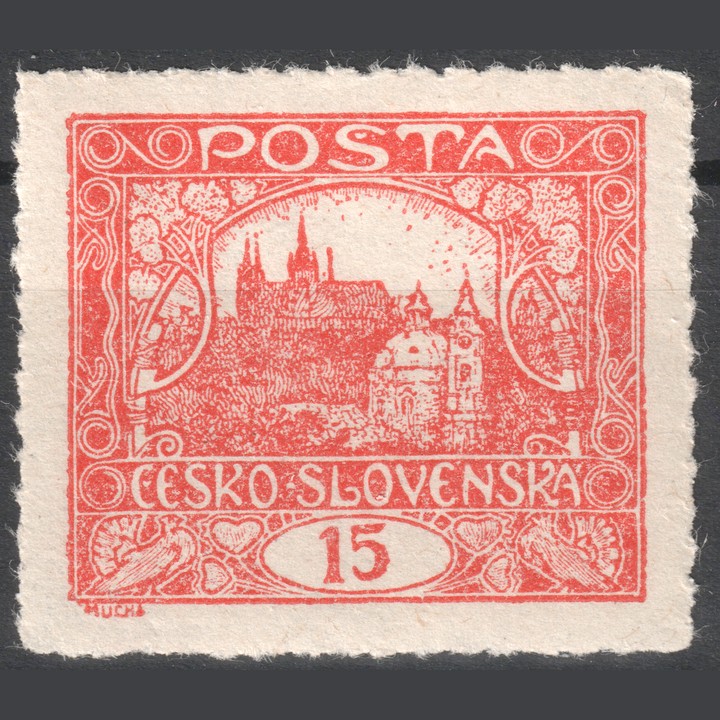
The issue appeared imperforate first, and stamps had to be cut from the sheet with scissors. Where they were handled in quantity, people sometimes helped themselves: they cut or pricked a separation line between the stamps so these could be torn apart. Such a separation is private — it has nothing to do with the manufacture of the stamp, and the catalogue does not list it among the perforations.
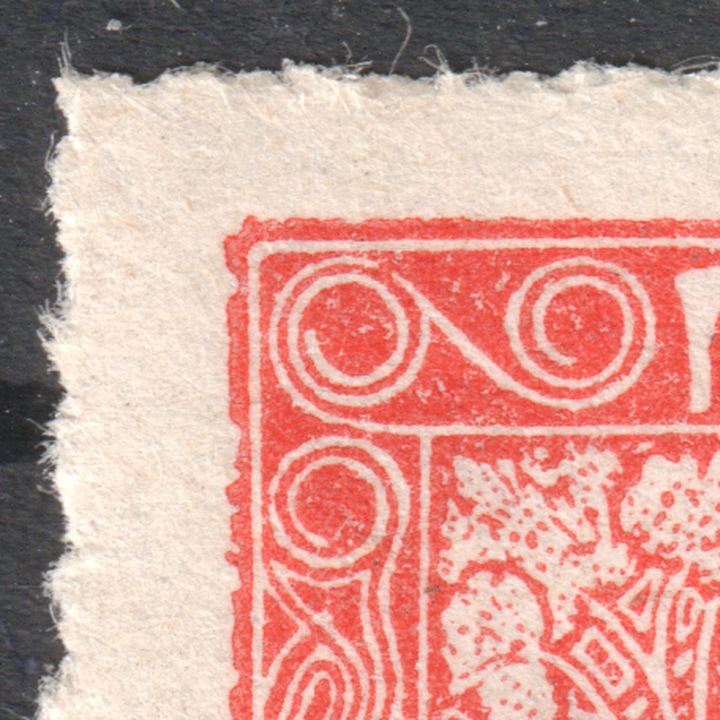
A roulette is a cut: a blade — straight, wavy or serrated — passes through the paper and takes none of it away. A pin-perforation is a row of small pricks made with a needle or a spiked wheel. Neither of them makes a hole, and so tearing leaves no teeth with round bites out of them, but a wavy or saw-toothed edge with frayed fibres, or a line of short slits.
How to tell it from a genuine perforation
- No round holes. A perforating pin punches the paper out and the disc falls away; a roulette or a pin-perforation only divides the paper, so no material is missing between the teeth.
- The edge is fibrous. The teeth are shallow and of uneven height, and wisps of paper are left along the edge — the sheet finished tearing along the cut.
- The gauge matches no group. A perforation gauge gives an in-between reading, and one that varies from copy to copy and even from side to side.
- The line is hand-guided. It is often on some sides only, wanders slightly off the vertical or fails to meet at the corner — a machine would run it straight and across the whole sheet at once.
The stamp stays imperforate. A private roulette or pin-perforation is a curiosity, not a catalogue variety, and it does not count towards the perforation statistics. And since it can be made at any time, even today, the copies that carry weight are those where contemporary use vouches for the separation — a cover, or a cancellation running across the edge.
Perforation flaws
Besides the catalogue groups there are copies where perforating did not go to plan — the tool passed through one and the same gap twice (double perforation), or a row was left out entirely and the stamps had to be separated with scissors (missing perforation). These are not perforations of their own but production flaws: the gauge stays the same and the stamp is identified from the row that corresponds to the proper pass. Both flaws, the specimens illustrating them and the part on the shift of the perforation against the design are on the Production flaws page.
Earliest documented usages
From 8,005 legibly dated cancellations. The sequence shows production moving from line perforations D/E/F on the early plates to comb perforations A/B on the later ones.
| Perforation (plate) | Earliest date |
|---|---|
| D (plates 1–2) | 30. 6. 1919 |
| E (plates 1–2) | 8. 8. 1919 |
| F (plates 1–2) | 12. 9. 1919 |
| C (plates 1–2) | 9. 11. 1919 |
| B (plates 1–2) | 30. 12. 1919 |
| C (plates 5–6) | 1. 2. 1920 |
| B (plates 5–6) | 8. 2. 1920 |
| G (plates 1–2) | 18. 2. 1920 (Praha 1) |
| A (plate 7) | 1. 3. 1920 |
| H (plates 1–2) | 15. 3. 1920 (Turnov) |
| B (plate 4) | 23. 3. 1920 |
| A (plates 5–6) | 25. 3. 1920 |
| A (plates 1–2) | 2. 4. 1920 |
| B (plate 3) | 19. 4. 1920 |
| A (plate 3) | 27. 4. 1920 |
| A (plate 4) | 8. 6. 1920 |
Comparison of three collections
Perforation shares differ between large collections and the Monograph data — see the statistics.