
500h – identifying stamps with spiral type I from plate II
The impulse for this article was the fact that at stamp fairs I repeatedly encountered incorrectly attributed spiral type I stamps of the 500 heller value, declared to come from plate II. Specialist literature is scarce, and even available sources give imprecise, distorted illustrations, which makes identification difficult. This article aims to give collectors comprehensive information for the precise attribution of the fields with spiral type I of the 500h coming from plate II.
A few facts to begin with
In the basic type classification, most fifth-design Hradčany stamps occur with two spiral types – specifically the 5h blue-green, 15h brick red, 25h violet, 75h grey-green and 500h brown.
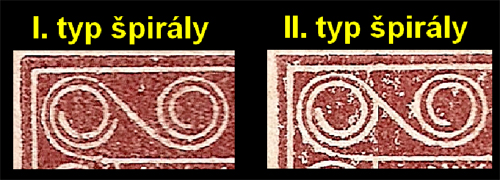
On some plates both spiral types occur together, forming so-called combined spiral types (STs) in pairs or blocks. The 500h brown was printed from two plates. While all 100 stamps of plate I have spiral type I, on plate II 98 stamps have type II and only 2 stamps are type I – at fields 32 and 35:
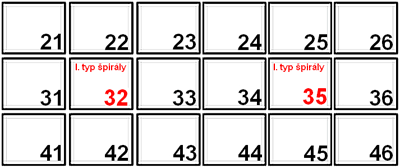
Cancelled type I stamps from plate I are common. Stamps with spiral type I from plate II have a much higher catalogue record; mint examples are sold at auction.
Identification marks of field 32 (plate II)
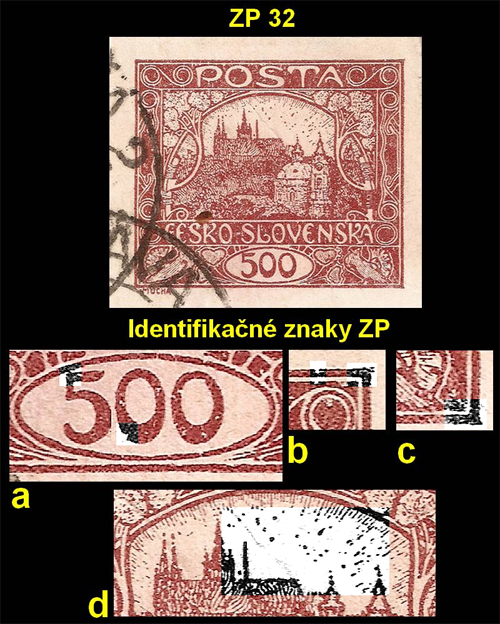
- a) the upper corner of the numeral 5 touches the edge of the value tablet; a wedge-shaped notch in the lower part of the first zero
- b) a cut into the frame above the upper-right corner spiral; protruding upper-right corner
- c) protruding upper-left corner
- d) characteristic grouping of dots above the cathedral
Identification marks of field 35 (plate II)
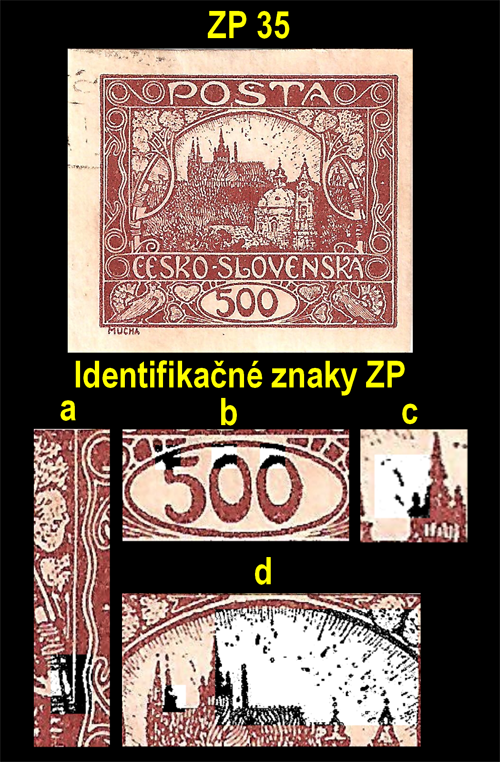
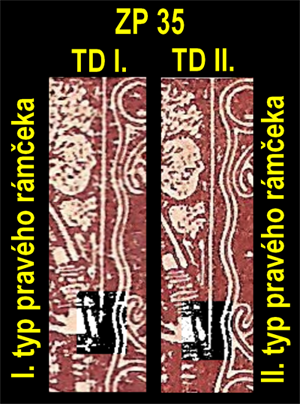
- a) type II of the right framelet (the framelet extends into the binding)
- b) the upper corner of the numeral 5 touches the edge of the value tablet with a characteristic deformation
- c) both zeros have coloured protrusions in their upper parts
- d) at the left side of the third tower two rays one above the other with two dots above the upper ray; a cut into the second tower from the right; characteristic grouping of dots above the cathedral
Plate II was made from the same materials as plate I, so some control marks of field 35 coincide on both plates. It happens that a field-35 stamp from plate I is mistakenly attributed to plate II.
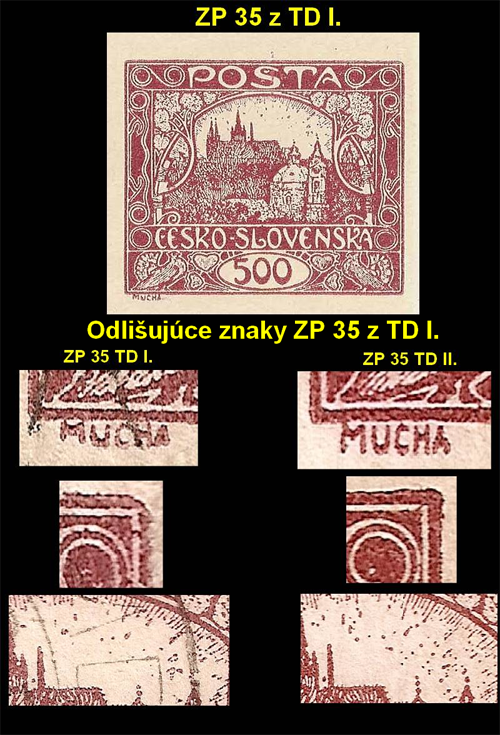
Identifying field 35 from plate II is nevertheless simple: if the stamp matches the illustration, just check the type of the right framelet. A plate I stamp has type I (the framelet does not reach the binding); a plate II stamp has type II (the framelet extends into the binding).
| Field 35, plate I | Field 35, plate II |
|---|---|
| Type I right framelet (does not reach the binding) | Type II right framelet (extends into the binding) |
| Letter M of MUCHA has shorter legs, letter A a shorter left leg | MUCHA without visible damage or deformation |
| Upper-right corner of the stamp blunted (bevelled) | Upper-right corner without bevel, slightly deformed |
| Different grouping of dots above the cathedral | Grouping of dots above the cathedral characteristic of this field |
Even so, it is always best to submit finds to federation experts, who will confirm or refute them.
Literature: Karásek – Hradčany (1986) · Hamr, Škaloud – Handbook for Hradčany Collectors (1998) · www.knihtisk.org