
5h blue-green – retouch at 100/I and the (non-)Monograph flaw at 90/II and 100/II
The 5h blue-green (Pof. no. 4) is a very interesting value. Almost 119 million stamps were printed – the most of the whole Hradčany issue – requiring 8 printing plates (again the most of all values). Unlike the 15h or 25h, the 5h has only a few fields of the spiral or crossbar types, but great variability comes from the combination of 8 plates, 3 catalogued shades and, besides the imperforate form, 6 officially used perforations.
While studying and reconstructing the first and second plates I came across very interesting deviations at field 100 of both plates and at field 90 of the second plate.
100/I
During printing, this field of the first plate was retouched – the whole right edge of the design was reworked. The original edge, disproportionately robust, was ground down. The correction was not entirely successful: the lower right corner was ground considerably more, and its damage is clearly visible in the design.
From the Monograph we know that plates I and II were used for imperforate stamps, comb perforation 13¾ : 13½ (A) and line perforations 11½ (D) and 11½ : 10¾ (E). For lack of material I cannot document the variants in perforation D. The table below shows that in perforation E only the original, unmodified design occurs.
| variant 1 strong edge | variant 2 ground-down edge | |
|---|---|---|
| imperforate | ✔ | ✔ |
| A | ✔ | ✔ |
| E | ✔ | — |
In practice, stamps after the correction (variant 2, with the ground edge) are considerably scarcer imperforate than before the correction (variant 1); in perforation A it is the other way round.
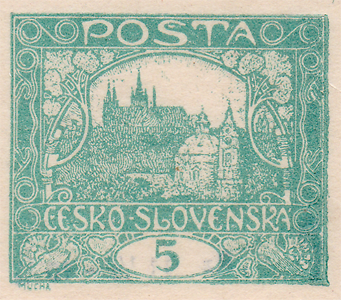


variant 1 · variant 2
90 and 100/II
If you know the Monograph plate flaws – negative flaws listed by Dr. Kubát in his 1968 Monograph of Czechoslovak Stamps – you will know these fields are listed with the flaws “right frame chipped at bottom” and “right frame chipped in the middle”.
I can state that neither flaw is a negative flaw: stamps of both fields exist without the damage. Both chips were therefore caused by improper handling of the plate during printing. The occurrence of both states in the various perforations is shown in the table; so far I have not found variant 1 in perforation A.
| variant 1 undamaged edge | variant 2 damaged edge | |
|---|---|---|
| imperforate | ✔ | ✔ |
| A | — | ✔ |
| E | ✔ | — |
At field 90/II I found two states – undamaged and damaged edge:
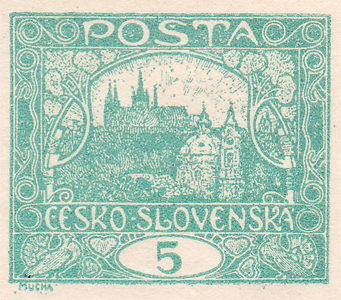


variant 1 · variant 2
At field 100/II the design occurs undamaged (variant 1) and with progressively developing damage (variants 2a and 2b) – the breaking-off of the lower edge of the cut into the frame is visible:
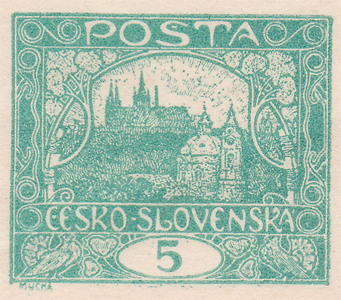



variant 1 · variant 2a · variant 2b
Naturally, within one sheet either only variant 1 of fields 90 and 100 occurs, or only variant 2. I am still mapping the frequency of both states.
A closing theory: both tables show that in perforation E only one state ever occurs. I conclude that the retouch on plate I and the damage on plate II may have happened at the same time – during plate cleaning. This theory, however, cannot be proven with certainty.