
Závoje a skvrny na známkách emise Hradčany
Závoje a skvrny se řadí mezi tiskové vady. Všechny tiskové vady mají příčinu v nesprávném ovládání a manipulaci tiskových strojů – jsou tedy nahodilé a neřadíme je do skupiny vad deskových.
Závoje a světliny jsou způsobené cizím předmětem, který se v průběhu tisku dostal na tiskovou desku. Na desce se ale neudržel a po odpadnutí s sebou odnesl i nános barvy – na daném místě archu se objevilo místo s bledým a nevýrazným tiskem.
Bílé nebo barevné skvrny vznikají, když se cizí předmět na tiskové desce uchytí. Tlakem stroje se zatlačí do desky a začne překrývat část kresby, případně odpuzovat tiskovou barvu.
První Monografie československých známek zmiňuje tyto barevné a bílé skvrny:
- 1h – v pravé holubici – 98/1
- 1h – mezi SKO–SLO – 10/2
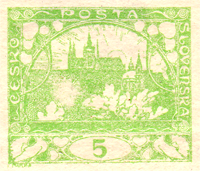
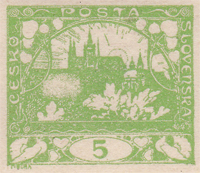
- 5h (sv. zelená) – nad keřem na výšku – 46/1 (tzv. „hrozen“)
- 5h (sv. zelená) – nad keřem podélná – 27/2 (tzv. „zepelín“)
- 5h (sv. zelená) – za číslicí 5 – 61/1, 71/1
- 30h (žlutoolivová) – spodkem štítku – 91/2
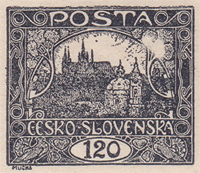
- 120h – v pravých listech – 6/2
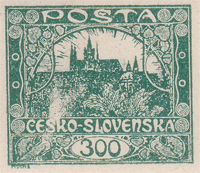
- 300h – větvovitě keřem – 97/1
- 400h – na báni chrámu – 6/1
- 400h – nad keřem – 58/1
- 400h – vlevo pod štítkem – 36/2
A co v Monografii nenajdete: 100h – ve štítku a nad keřem – 60/2.
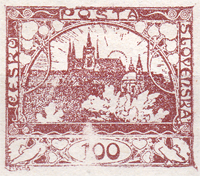
V rámci studia známek při rekonstrukcích tiskových desek jsem narazil na velké množství větších či menších světlin. Postupně bych rád na webu umístil jejich popis. Začal jsem mou oblíbenou hodnotou 15h (POFIS č. 7), kde jsou zejména první a druhá tisková deska zlatým dolem světlin.
Hromovky!
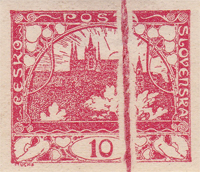
Hledané jsou také známky, kdy se na tiskovou desku dostaly různé tkanice a provázky. Těmto vadám se říká „hromovka“ nebo „provázek“.
Použitá literatura: Monografie československých známek č. 1
Smears and spots on Hradčany stamps
Smears (light patches) and spots belong among printing flaws. All printing flaws are caused by improper operation and handling of the printing machines – they are random, and we do not class them with plate flaws.
Smears and light patches are caused by a foreign object that got onto the printing plate during printing. The object did not stay on the plate, and when it fell off it took the layer of ink with it – leaving a pale, weak print at that place on the sheet.
White or coloured spots arise when a foreign object sticks to the plate. The press forces it into the plate, where it covers part of the design or repels the ink applied during printing.
The first Monograph of Czechoslovak Stamps lists these coloured and white spots:
- 1h – in the right dove – 98/1
- 1h – between SKO–SLO – 10/2
- 5h (light green) – above the bush, vertical – 46/1 (the “grape cluster”)
- 5h (light green) – above the bush, horizontal – 27/2 (the “zeppelin”)
- 5h (light green) – behind the numeral 5 – 61/1, 71/1
- 30h (yellow-olive) – along the bottom of the tablet – 91/2
- 120h – in the right leaves – 6/2
- 300h – branch-like through the bush – 97/1
- 400h – on the cathedral dome – 6/1
- 400h – above the bush – 58/1
- 400h – left below the tablet – 36/2
And what you will not find in the Monograph: 100h – in the tablet and above the bush – 60/2.
While studying stamps during plate reconstructions I came across a great number of larger and smaller light patches, which I would like to describe here over time. I started with my favourite value, the 15h (POFIS no. 7), where the first and second plates in particular are a gold mine of light patches.
“Thunderbolts”!
Also sought after are stamps where laces and strings got onto the plate. These flaws are called “hromovka” (thunderbolt) or “provázek” (string).
Literature: Monograph of Czechoslovak Stamps No. 1