15h cover – a treasure for a song
Today, after a long time, the moment has finally come to take up the keyboard again and share my joy with you. To introduce the subject I must briefly go back in time.
The whole second half of last year was devoted to my study of the 15 heller value. The positive pressure of my “Hradčany circle” finally bore fruit, and I spent the rest of the year studying and processing this value. Seven printing plates, eight variations of official perforations, five catalogued shades, a wealth of types and plate flaws – all this cost me hundreds of hours at the monitor, microscope, magnifier and perforation gauge. The result of this painstaking work was a 130-page album devoted solely to the 15 heller.
Back to my visit to the stamp fair. Looking through a box of covers I found an envelope of an ordinary letter franked with Hradčany stamps, sent from Smíchov to Pavlice in southern Moravia – or rather to Grešlové Mýto near Znojmo, since Pavlice had no post office then. The cover is from the 4th tariff period, and the 60-heller rate for an ordinary letter up to 20 g was paid with four 15-heller stamps.
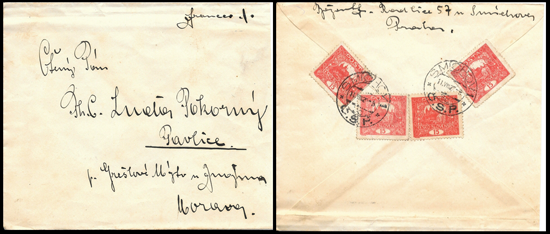
I liked the multiple franking, so I bought it. In the evening, going through my new acquisitions, I first noted with disappointment that the very first stamp had its right vertical perforation cut off. On closer inspection, however, I found that while the first stamp comes from plate III, the second comes from plate V. Checking the perforations, two stamps have comb perforation B–11¾ and the other two line perforation C–13¾. That spurred me to attribute the exact fields – and with surprise and delight I found that each of the four stamps comes from a different printing plate: from left to right B – 67/III, C – 30/V, B – 34/IV and C – 70/VI.
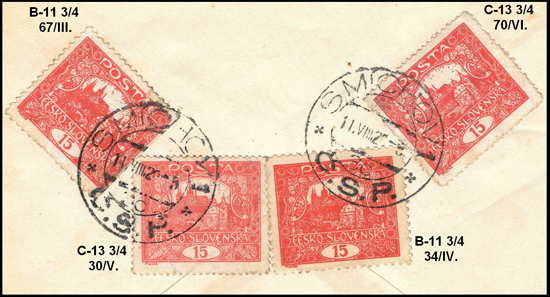
How could stamps from four different plates end up on an evidently non-philatelic cover? The answer was given by the first stamp with the cut-off perforation: in my opinion this is a case of re-use of stamps soaked off covers on which they had not been properly cancelled. This was most likely a practice surviving from the monarchy into the post-war years. The sender who stuck these four stamps on in August 1920, meaning only to save money, had no idea what a rarity he was creating and what joy he would give a collector 96 years later.
One closing remark: even seemingly ordinary material hides the chance of finding interesting and unique items that can become beautiful additions to a collection. Besides luck, though, it is essential to devote time to study and money to literature – without proper knowledge you will never reach them.