 1
1Zkusmé tiskyProofs
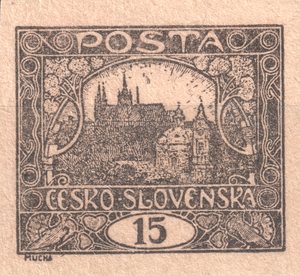
Než se z tiskové formy začaly tisknout známky pro poštu, dělaly se z ní zkušební otisky. Sloužily k posouzení kresby, barvy a přítlaku — tiskly se proto zpravidla v jiné barvě než definitivní vydání a na lepší papír, aby bylo vidět, co forma umí, a ne co dovolí papír. Pro dnešní studium desek mají zvláštní cenu: zachycují formu ve stavu, do kterého ještě nezasáhlo opotřebení, a někdy i dřív, než se na ní udělaly poslední úpravy.Before a printing forme began turning out stamps for the post, trial impressions were taken from it. They served to judge the drawing, the colour and the impression — and so were usually printed in a colour other than the definitive one and on better paper, to show what the forme could do rather than what the paper allowed. For the study of the plates they have a particular value: they capture the forme in a state that wear has not yet touched, and sometimes before the last alterations were made to it.
ZP 96/I — modrý zkusmý tisk na křídovém papířeField 96/I — a blue proof on coated paper
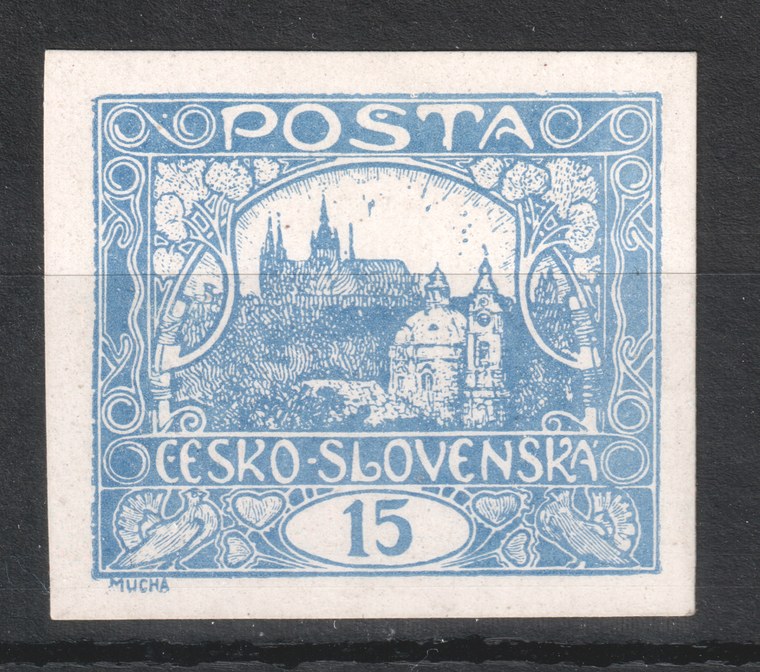
| BarvaShade | modrá — barva, ve které známka nikdy nevyšlablue — a colour in which the stamp never appeared |
|---|---|
| PapírPaper | křídový, hladký a bílý; proti hrubému papíru běžného nákladu udrží podstatně jemnější kresbucoated, smooth and white; against the rough paper of the ordinary printing it holds a far finer image |
| ÚpravaFormat | nezoubkovaný, se širokými okrajiimperforate, with wide margins |
| Známkové poleStamp field | 96 / TD I96 / plate I |
| Stav deskyState of the plate | tisk je ostrý po celé ploše — deska ještě nebyla opotřebovanáthe impression is sharp throughout — the plate was not yet worn |
Rozdíl proti běžné známce je vidět na první pohled. Na hrubém papíru běžného nákladu splývají jemné šrafy stromů a střech do plochy, na křídovém papíře zůstávají oddělené. Totéž platí pro obrysové linky ornamentu: na produkčních kusech bývají rozšířené nebo přerušené, tady jsou tenké a souvislé. Zkusmý tisk proto neslouží jen jako sběratelská rarita, ale jako referenční obraz — ukazuje, jak kresba vypadala, než ji začaly ubírat opotřebení desky a vlastnosti papíru.The difference from an ordinary stamp is obvious at once. On the rough paper of the ordinary printing the fine hatching of the trees and roofs merges into solid areas; on coated paper it stays separated. The same holds for the outlines of the ornament: on production copies they tend to be thickened or broken, here they are thin and continuous. The proof therefore serves not merely as a collector's rarity but as a reference image — it shows what the drawing looked like before plate wear and the qualities of the paper began to take from it.
Srovnání s produkčním ZP 96/ICompared with the production field 96/I
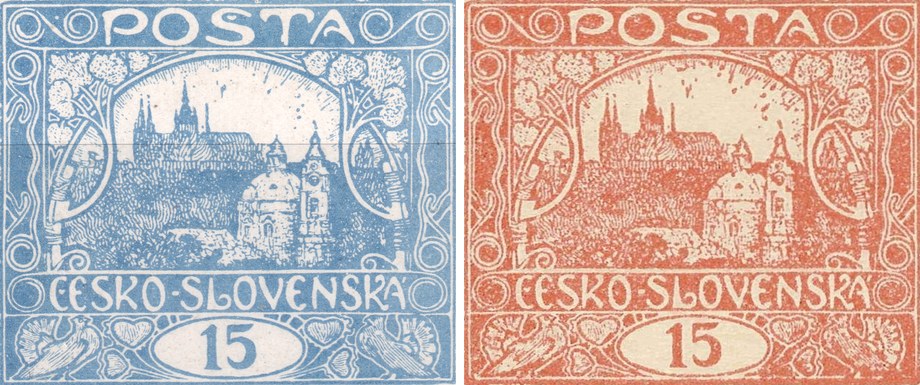
Mezi zkusmým tiskem a produkcí se na tomto poli zasahovalo do kresby. Nejde tedy jen o rozdíl v ostrosti: forma se mezi oběma otisky ještě upravovala. Doloženy jsou dvě změny.Between the proof and the production run the design of this field was worked on. The difference is therefore not one of sharpness alone: the forme was still being altered between the two impressions. Two changes are recorded.
1 · Retuš spirály — z Is na IIs1 · Retouch of the spiral — from Is to IIs
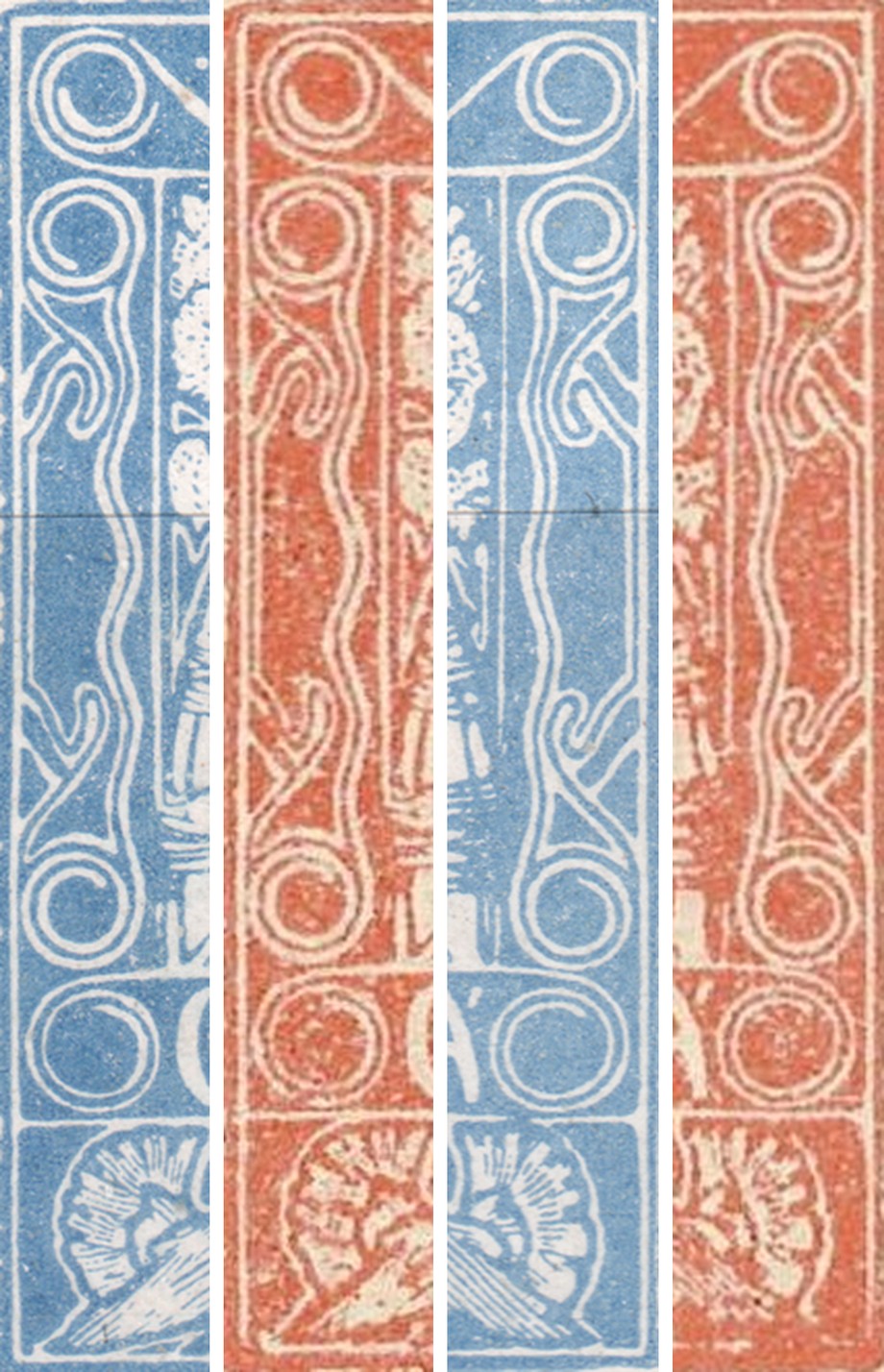
Rozhodující spirála leží v levém horním rohu kresby — je to levá z dvojice spirál v rohovém ornamentu, táž, kterou jako typovou popisuje stránka Typy páté kresbyFifth-design types. Na zkusmém tisku je otevřená (Is): vnitřní závit dojede a skončí volně. V produkci je zavřená (IIs) — závit se uzavírá do plného kroužku. Spirálový typ tedy u tohoto pole není vlastností původního štočku, ale výsledkem pozdější úpravy — a to je pro čtení typů na první a druhé desce podstatné. Přehled polí a obou typů je na stránce Typy páté kresbyFifth-design types.The deciding spiral is in the top left corner of the design — the left one of the pair in the corner ornament, the same one the Fifth-design types page describes as the type feature. On the proof it is open (Is): the inner coil runs round and ends free. In production it is closed (IIs) — the coil shuts into a full ring. On this field, then, the spiral type is not a property of the original cliché but the result of a later alteration — which matters for how the types on plates I and II are read. An overview of the fields and of both types is on the Fifth-design types page.
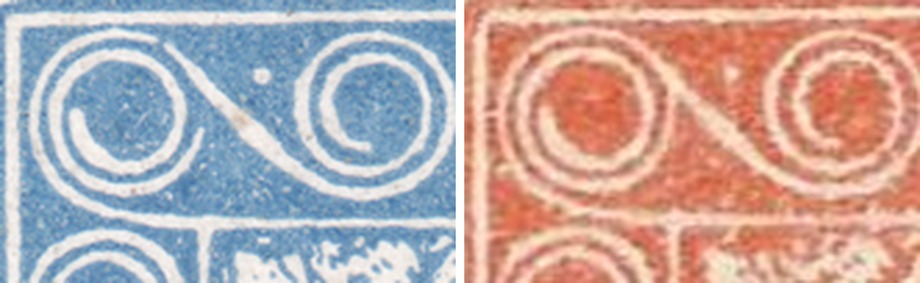
Z toho plyne otázka, na kterou zatím nemáme odpověď: je devět polí TD I, která mají otevřenou spirálu i v produkci (2, 21, 22, 23, 49, 83, 91, 92, 94), právě těmi poli, kterými tato úprava neprošla? Odpovědět by mohly další zkusmé tisky z téže desky.A question follows that we cannot yet answer: are the nine fields of plate I that carry the open spiral in production as well (2, 21, 22, 23, 49, 83, 91, 92, 94) precisely the fields that this alteration passed by? Further proofs from the same plate could answer it.
2 · Úprava vějíře u pravé holubice2 · Alteration of the fan at the right-hand dove
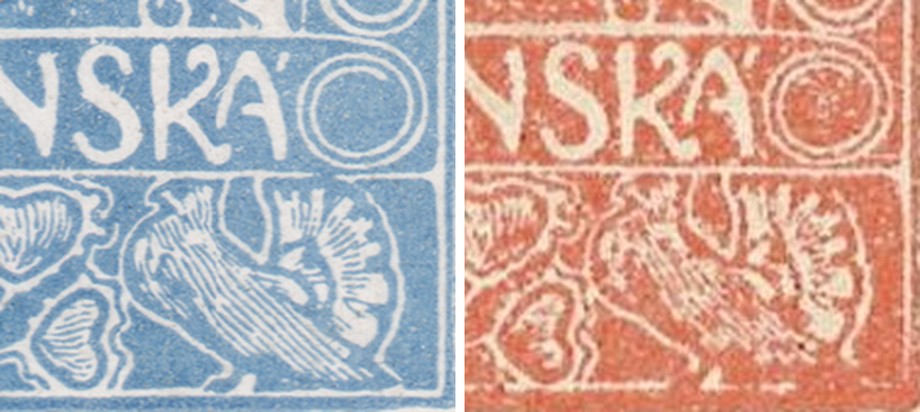
Druhý zásah se týká vějíře vpravo od pravé holubice. Na zkusmém tisku jsou paprsky vějíře delší a od sebe zřetelně oddělené; v produkci je kresba vějíře jiná. Část rozdílu jde na vrub papíru a opotřebení, ale obrys vějíře se liší i tam, kde je otisk v produkci ještě čitelný.The second alteration concerns the fan to the right of the right-hand dove. On the proof the rays of the fan are longer and clearly separated from one another; in production the fan is drawn differently. Part of the difference is down to the paper and to wear, but the outline of the fan differs even where the production impression is still legible.
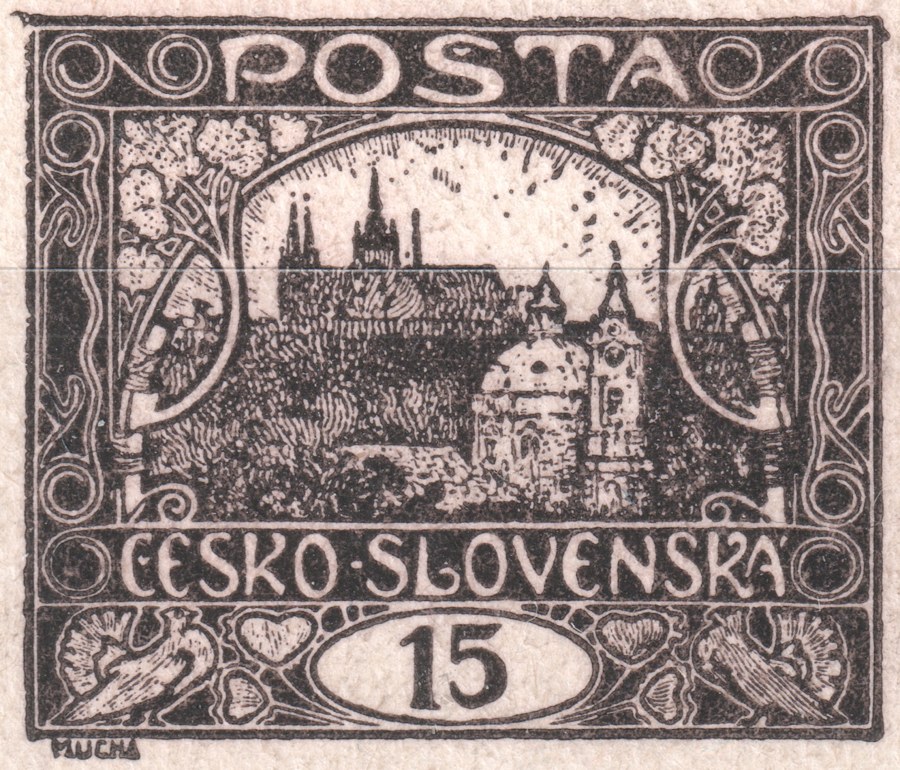
ZP 68/I — černý zkusmý tisk, definitivní stav kresbyField 68/I — a black proof, the design's final state
| BarvaShade | černá — barva, ve které známka nikdy nevyšlablack — a colour in which the stamp never appeared |
|---|---|
| PapírPaper | krémový, jemně strukturovanýcream, finely textured |
| ÚpravaFormat | nezoubkovanýimperforate |
| Známkové poleStamp field | 68 / TD I68 / plate I |
| Stav deskyState of the plate | shoduje se s produkčním tiskem — žádná pozdější úprava kresbymatches the production printing — no later alteration to the design |
Na rozdíl od pole 96/I je tohle pole opačným příkladem. Ve srovnání s produkčním otiskem téhož pole (evidenční sada pozic desky I) je kresba shodná do posledního detailu — včetně drobné nepravidelnosti v levém horním rohu rámečku, kterou má pole 68 jako svůj identifikační znak na všech tiskových deskách. Ta je vidět stejně na zkusmém tisku i na produkčním kuse, takže tu mezi oběma otisky k žádnému zásahu do formy nedošlo.Unlike field 96/I, this field is the opposite case. Set beside the production impression of the same field (from the reference set of plate I positions), the drawing matches down to the last detail — including a small irregularity in the top left corner of the frame that field 68 carries as its identifying mark on every printing plate. It appears identically on both the proof and the production copy, so no alteration was made to the forme between the two impressions.
Pole 68/I tak doplňuje pole 96/I z opačné strany: na 96/I zkusmý tisk zachytil formu ještě před dvěma úpravami, na 68/I byla forma v době tohoto otisku už definitivní. Ne všechna pole desky I se tedy v době zkusmých tisků nacházela ve stejném stavu rozpracování.Field 68/I complements field 96/I from the opposite side: on 96/I the proof caught the forme before two alterations, on 68/I the forme was already definitive at the time of this impression. Not every field of plate I, then, was at the same stage of completion when the proofs were pulled.
Celý arch v černé barvě — kontrolní číslaA full black pane — the control numbers
Vedle jednotlivých zkusmých tisků se dochoval i celý arch (10×10 polí) POFIS 7 (15h) vytištěný celý v černé barvě, nezoubkovaný — stejný účel jako u ostatních zkusmých tisků, tentokrát ale na úrovni celého archu místo jediného pole. Rozmezí let 1918–1920 odpovídá období, kdy se na arších tohoto vydání tiskla takzvaná kontrolní čísla.Besides the individual proofs, a full pane (10×10 fields) of POFIS 7 (the 15h) has also survived, printed entirely in black and imperforate — the same purpose as the other proofs, but at the level of a whole pane rather than a single field. The span 1918–1920 corresponds to the period in which this issue's sheets carried what are called control numbers.
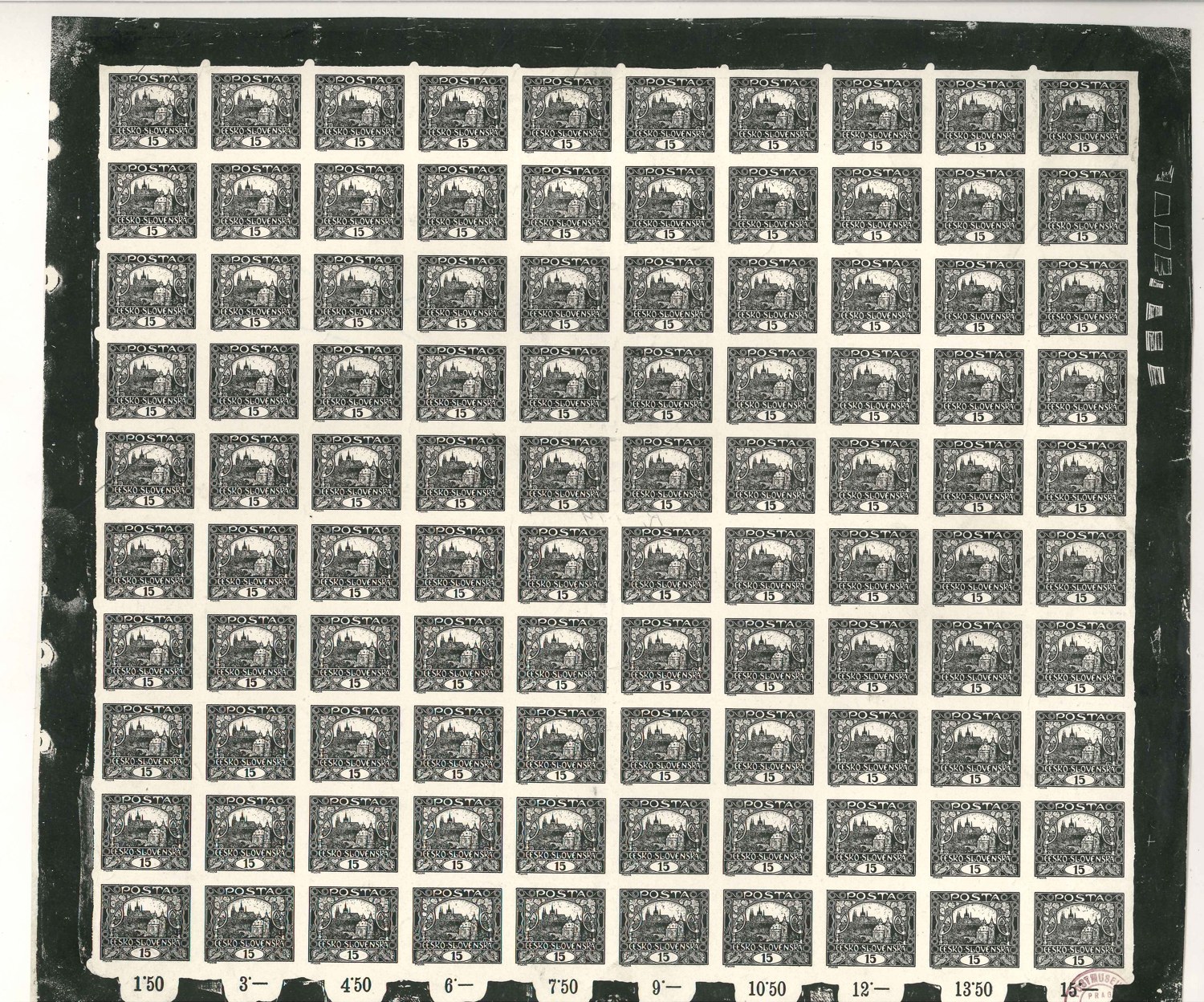
Kontrolní čísla jsou postupně rostoucí částky vytištěné pod každým sloupcem deseti známek — 1.50, 3.-, 4.50, 6.-, 7.50, 9.-, 10.50, 12.-, 13.50, až 15.- Kč za celý arch (10 × 15 h = 1,50 Kč na sloupec). Poštovní úředník tak mohl ověřit, že v archu nechybí žádná známka, jen porovnáním posledního vytištěného čísla s cenou celého archu, bez nutnosti počítat jednotlivé kusy.The control numbers are running totals printed beneath each column of ten stamps — 1.50, 3.-, 4.50, 6.-, 7.50, 9.-, 10.50, 12.-, 13.50, up to 15.- Kč for the whole pane (10 × 15h = 1.50 Kč per column). A post-office clerk could therefore confirm that no stamp was missing from the sheet simply by checking the last printed figure against the price of the full pane, without having to count the individual stamps.

| KatalogCatalogues | POFIS 7 (15h)POFIS 7 (the 15h) |
|---|---|
| Tisková deskaPrinting plate | VIVI |
| ObdobíPeriod | 1918–1920 |
| BarvaShade | černá — barva, ve které známka nikdy nevyšlablack — a colour in which the stamp never appeared |
| ÚpravaFormat | nezoubkovaný arch, 10×10 políimperforate pane, 10×10 fields |
Barevné zkusmé tiskyColour trials
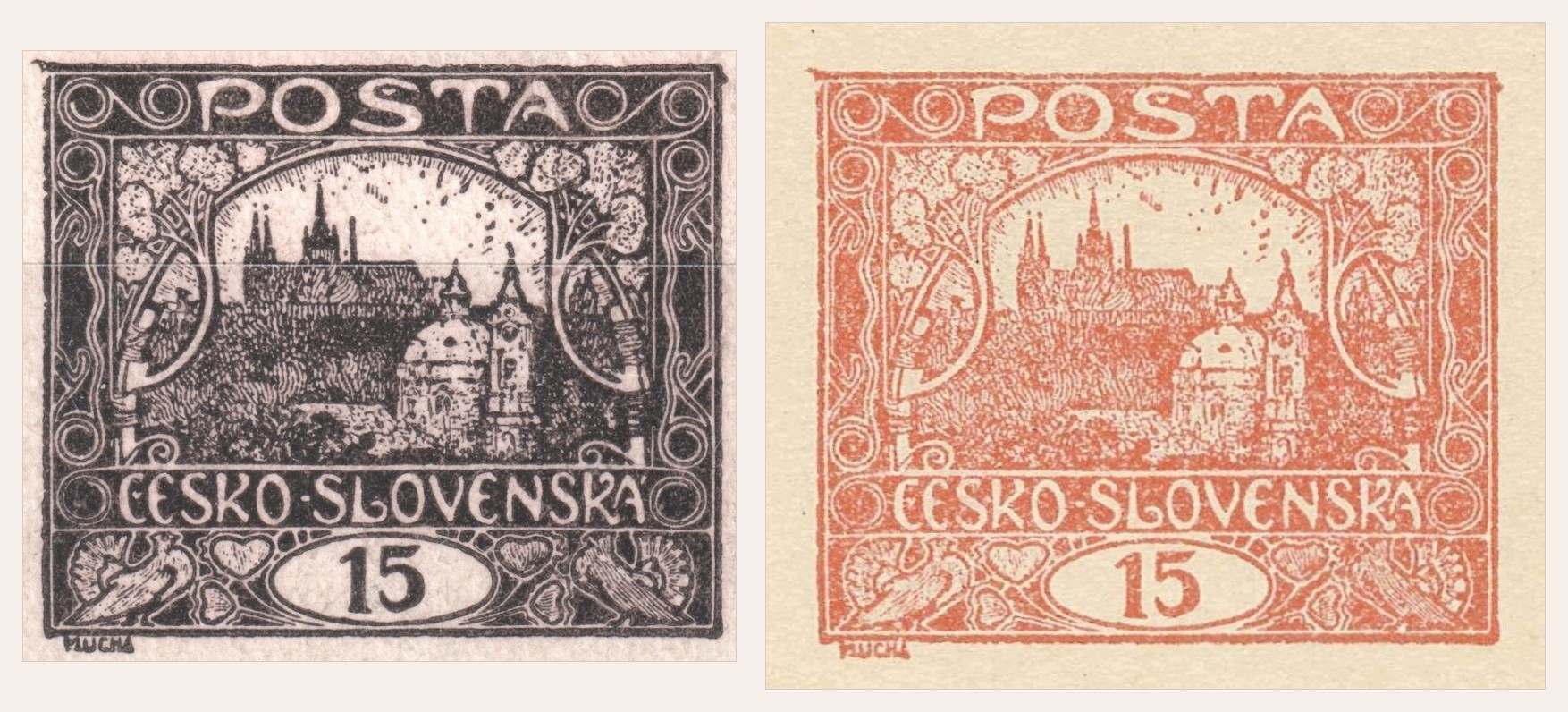
Než se rozhodlo, v jaké barvě a na jakém papíře se bude tisknout, otiskla se táž forma několikrát nanečisto. Následující kusy jsou z takové řady: stejná kresba, pokaždé jiná barva nebo jiný podklad. Vedle černé a hnědočerné je tu modrá i několik odstínů červené a dva otisky na narůžovělém papíře.Before it was decided in what colour and on what paper the stamp would be printed, the same forme was pulled several times as a trial. The pieces below come from such a series: the same design, each time in a different colour or on a different stock. Besides black and brown-black there is a blue, several shades of red, and two impressions on pinkish paper.
Pro studium desek jsou tyto otisky cenné právě proto, že jsou čisté — nezoubkované, nerazítkované a tištěné pečlivěji než produkce. Kresba je na nich čitelná do posledního tahu, takže se dá porovnávat s produkčními známkami stejného známkového pole.For the study of the plates these impressions are valuable precisely because they are clean — imperforate, uncancelled and printed more carefully than the production run. The design is legible down to the last stroke, so it can be compared with production stamps of the same sheet position.
1Hnědočerný zkusmý tisk na nažloutlém papíře, nezoubkovaný — známkové pole 7/II.A brown-black proof on yellowish paper, imperforate — sheet position 7/II.
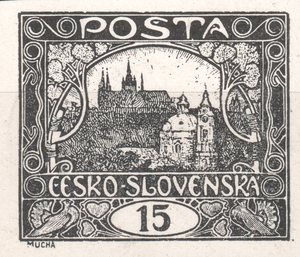 2
2Sytě černý zkusmý tisk na bílém papíře, nezoubkovaný — známkové pole 40/I. Nejostřejší otisk sestavy; drží i nejjemnější rytinu šrafování oblohy.A deep black proof on white paper, imperforate — sheet position 40/I. The sharpest impression of the group; it holds even the finest engraving of the sky hatching.
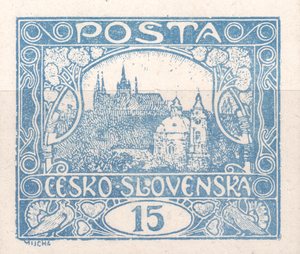 3
3Modrý zkusmý tisk, nezoubkovaný — známkové pole 6/I. Odstín je chladnější a papír bělejší než u modrého zkusmého tisku ZP 96/I výše.A blue proof, imperforate — sheet position 6/I. The shade is cooler and the paper whiter than on the blue proof of field 96/I above.
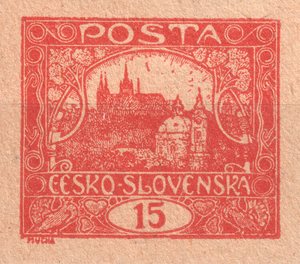 4
4Červený zkusmý tisk na nažloutlém papíře, nezoubkovaný — známkové pole 70/I.A red proof on yellowish paper, imperforate — sheet position 70/I.
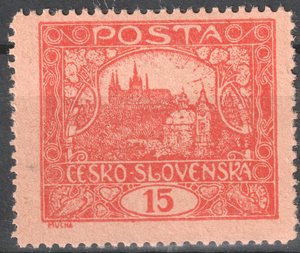 6
6Červenooranžový odstín — známkové pole 40/II. Na rozdíl od ostatních kusů sestavy je zoubkovaný.A red-orange shade — sheet position 40/II. Unlike the other pieces in the group it is perforated.
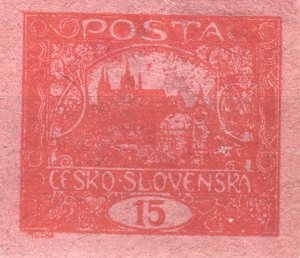 7
7Červený tisk na narůžovělém papíře, nezoubkovaný — známkové pole 90/IV; zkouška podkladu, ne barvy.A red print on pinkish paper, imperforate — sheet position 90/IV; a trial of the stock, not of the ink.
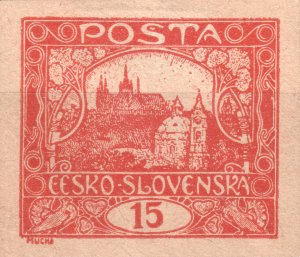 8
8Červenooranžový zkusmý tisk na narůžovělém papíře, nezoubkovaný — známkové pole 82/I. Druhý otisk sestavy na růžovém podkladu (srov. ZT 7), tentokrát z první desky; širší okraje než u ostatních kusů.A red-orange proof on pinkish paper, imperforate — sheet position 82/I. The second impression of the group on pink stock (cf. ZT 7), this time from the first plate; wider margins than the other pieces.
Kliknutím se ukázka zvětší. U všech kusů je známkové pole i tisková deska určeno porovnáním s rekonstruovanými deskami. Stojí za pozornost, že sestava nepochází jen z první desky: jsou v ní kusy z desky I, II i IV, zkoušelo se tedy i v pozdější fázi výroby, ne pouze před jejím začátkem.Click a specimen to enlarge it. For every piece the sheet position and the plate have been determined by comparison with the reconstructed plates. It is worth noting that the group does not come from the first plate alone: it contains pieces from plates I, II and IV, so trials were pulled at a later stage of production too, not only before it began.
Makulaturní tiskWaste print
Makulatura je papír, který se při tisku znehodnotil a nikdy neměl opustit tiskárnu. Vzniká hlavně při rozjezdu stroje, než se seřídí přítlak a nanášení barvy. Jednou znehodnocený arch už ale nebyl k ničemu jinému než k dalšímu zkoušení — a právě to je na tomto kusu vidět.Waste is paper spoiled during printing that was never meant to leave the works. It arises mainly while the press is being run up, before the pressure and the inking are set. Once spoiled, however, a sheet was good for nothing but further trials — and that is exactly what this piece shows.
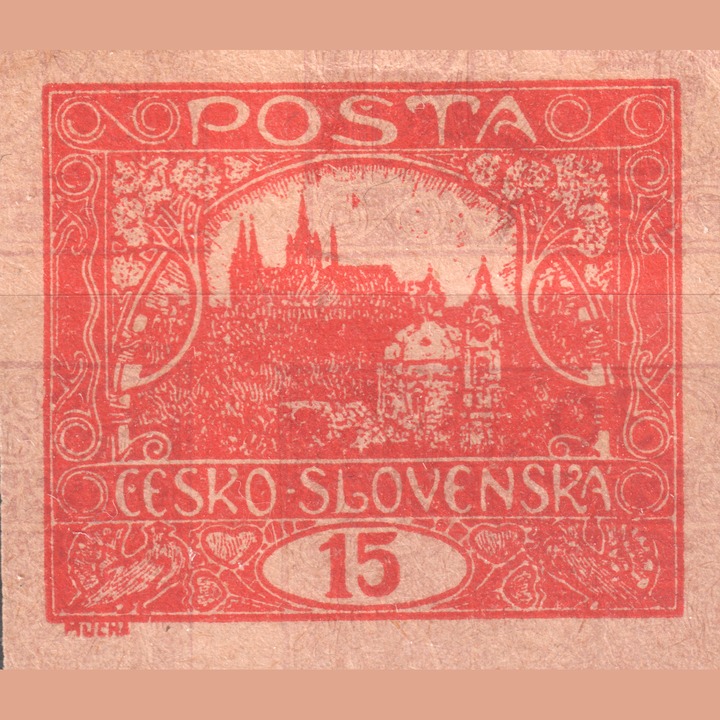
Kresba 15h pochází ze známkového pole 46 čtvrté tiskové desky. Přes ni ale leží ještě druhý, slabší otisk — a ten nepatří patnáctihaléřové známce: na témž archu se zkoušela tisková deska hodnoty 500 h téže emise. Arch tedy prošel strojem dvakrát, pokaždé s jinou formou.The 15h design comes from sheet position 46 of the fourth plate. Over it, however, lies a second, fainter impression — and that one does not belong to the 15h: the printing plate of the 500 h value of the same issue was being tried on the very same sheet. The sheet therefore went through the press twice, each time with a different forme.
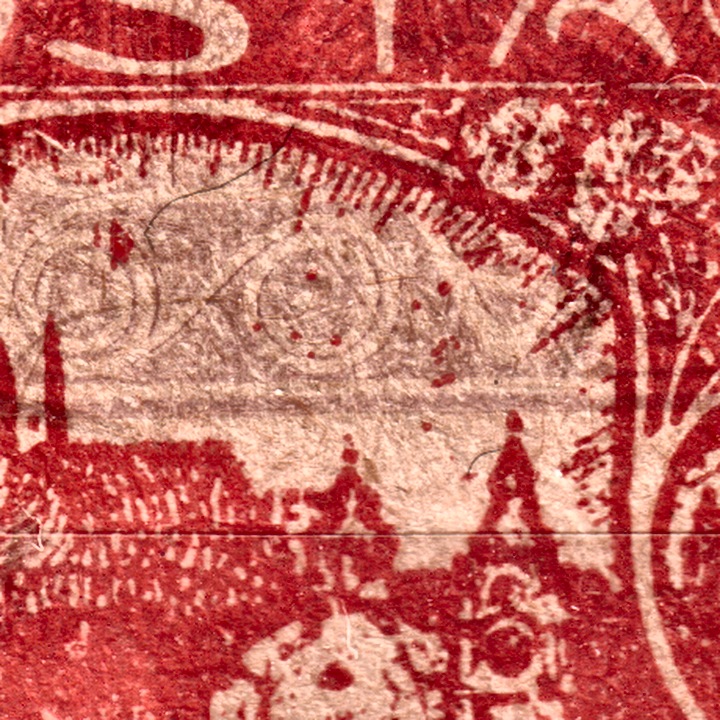
Jak cizí otisk poznatHow to spot the foreign impression
Je to obtížnější, než by se čekalo, protože 500 h má tentýž obraz Hradčan jako 15 h — liší se hodnotou v oválu a ozdobami rámu. Oba otisky se tedy z větší části překrývají a splývají v jednu rozmazanou plochu. Prozradí je až ozdoby: v obloze nad hradem, kde patnáctihaléřová kresba nechává papír světlý, se objevují soustředné spirály, které v ní nemají co dělat. Druhý otisk je navíc slabší a mimo soutisk, takže ani nesedí na rám.This is harder than one might expect, because the 500 h carries the same view of Hradčany as the 15h — it differs in the value in the oval and in the ornaments of the frame. The two impressions therefore largely coincide and merge into one blurred surface. It is the ornaments that give it away: in the sky above the castle, where the 15h design leaves the paper light, concentric spirals appear that have no business being there. The second impression is also fainter and out of register, so it does not line up with the frame either.
Čím se liší od slitého a dvojitého tiskuHow it differs from a blurred and from a double print
Slitý tisk je jediná známka s přebytkem barvy na jinak řádném archu. Dvojitý tisk je druhý otisk téže formy, jen posunutý. Tady je druhý otisk z úplně jiné tiskové desky, a dokonce jiné hodnoty — to se na archu určeném k vydání stát nemůže. Právě tahle kombinace je nejjistější známkou toho, že šlo o makulaturu: s papírem, který už byl odepsaný, se dalo zkoušet cokoli.A blurred print is a single stamp with excess ink on an otherwise proper sheet. A double print is a second impression of the same forme, merely displaced. Here the second impression comes from an entirely different plate, and of a different value — something that cannot happen on a sheet meant for issue. That combination is the surest sign that this was waste: with paper already written off, anything could be tried.
Makulatura není katalogová varianta. Nevydávala se, nemá poštovní platnost a její cena je dokumentární — ukazuje výrobu ve chvíli, kdy ještě nebyla v pořádku, a v tomto případě i to, že se tytéž archy používaly ke zkoušení několika desek za sebou. U nabízených kusů je proto namístě ptát se po původu.Waste is not a catalogue variety. It was not issued, has no postal validity, and its value is documentary — it shows production at a moment when it was not yet right and, in this case, that the same sheets were used to try one plate after another. With pieces offered for sale it is therefore worth asking about provenance.
Proč jsou zkusmé tisky pro studium desek cennéWhy proofs matter for the study of the plates
- Referenční stav. Ukazují kresbu dřív, než ji začalo ubírat opotřebení. Cokoli, co na produkčním kusu chybí nebo je rozšířené, se dá poměřit proti nim.A reference state. They show the design before wear began to take from it. Anything missing or thickened on a production copy can be measured against them.
- Odliší retuš od opotřebení. Když se objekt na zkusmém tisku a v produkci liší tvarem, nejde o opotřebení — deska se mezitím upravovala. To je přesně případ spirály na tomto poli.They separate retouch from wear. When an element differs in shape between proof and production, wear is not the explanation — the plate was altered in between. That is exactly the case of the spiral on this field.
- Datují vývoj desky. Zkusmý tisk je pevný bod před začátkem produkce. Fáze deskových vad, které web sleduje u praskliny na 11/IIthe crack at 11/II nebo u světlinthe white spots, se od něj dají odvíjet.They date the development of the plate. A proof is a fixed point before production began. The stages of the plate flaws the site follows at prasklině 11/IIthe crack at 11/II or among the světlinamiwhite spots can be reckoned from it.
- Ověří, co je původní. U sporné odchylky odpovědí na otázku, jestli byla v desce od začátku, nebo do ní přibyla až za provozu.They establish what is original. For a disputed deviation they answer whether it was in the plate from the outset or appeared during use.
Sekce poroste. Každý další zkusmý tisk dostane vlastní oddíl se stejnou stavbou: popis kusu, srovnání s odpovídajícím produkčním známkovým polem a rozbor toho, co se mezi oběma otisky s deskou stalo.This section will grow. Every further proof will get a part of its own with the same structure: a description of the item, a comparison with the corresponding production field, and an account of what happened to the plate between the two impressions.