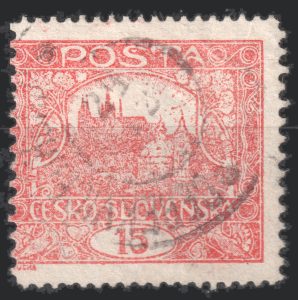
 1
1Výrobní vadyProduction flaws
Emise Hradčany vznikala v roce 1919 ve spěchu, na provizorním vybavení a z papíru, jaký byl zrovna po ruce. Stopy toho spěchu jsou na známkách dodnes vidět. Tato stránka shromažďuje výrobní vady hodnoty 15h — tedy odchylky, které vznikly během výroby archu, ne poškozením po vydání. Řadí se podle výrobní fáze: papír → tisk → perforace. Jak celý postup probíhal a proč plodí právě tyhle odchylky, vysvětluje stránka KnihtiskLetterpress.The Hradčany stamps were produced in 1919 in haste, on makeshift equipment and on whatever paper was at hand. The traces of that haste are still visible on the stamps. This page collects the production flaws of the 15h value — deviations that arose while the sheet was being made, not damage suffered after issue. They are arranged by production stage: paper → printing → perforation. How that process ran, and why it produces these particular deviations, is explained on the KnihtiskLetterpress page.
Výrobní vada není totéž co katalogová varianta. Skupiny zoubkování A–H, typy kresby nebo odstíny popisují, čím a jak byl arch vyroben, a jsou pravidelné. Vada je porucha téhož postupu — u většiny druhů náhodná, u některých (světliny) vázaná na konkrétní místo desky. Konstantní deskové vady, které se opakují na témž známkovém poli, patří k rekonstrukci desek — najdete je v galerii pozicposition gallery.A production flaw is not the same as a catalogue variety. The perforation groups A–H, the drawing types or the shades describe with what and how a sheet was made, and they are regular. A flaw is a disturbance of that same process — random in most kinds, tied to a particular place on the plate in some (white spots). Constant plate varieties, which recur on the same stamp field, belong to plate reconstruction — see the galerie pozicposition gallery.
- Vady perforacePerforation flawsDvojitá perforaceDouble perforationVynechaná perforaceMissing perforationPosun zoubkováníPerforation shifts
- Vady tiskuPrinting flawsČástečně zdvojený tiskPartly doubled printDvojitý a vícenásobný tiskDouble and multiple printBludné kroužkyWandering ringsZávojeSmearsBílé skvrnyBlank spotsŘídký tisk se skvrnamiThin print with ink spotsSlitý tiskFilled-in printTisk a obtisk na lepuPrint and set-off on the gumOdtržená barvaTorn-off ink
- Poškození tiskové deskyDamage to the printing platePrasklá tisková deska — 11/IICracked plate — 11/IIPoškozený rám — 60/VIDamaged frame — 60/VI
- Vady papíruPaper flawsZvrásnění papíruCreased paperDřívko v papíruSplinter in the paper
Vady perforacePerforation flaws
Zoubkování bylo poslední operací a zároveň nejnáchylnější k chybě. U řádkového zoubkováníline perforation se každá řada otvorů přikládala samostatně, takže celý arch vznikl z desítek úderů, jejichž přesnost stála na obsluze. Odtud pramení dvě protilehlé vady: řada navíc a řada, která chybí.Perforating was the last operation and at the same time the one most prone to error. In řádkové zoubkováníline perforation every row of holes was applied separately, so a whole sheet was built from dozens of strikes whose accuracy rested on the operator. Hence two opposite flaws: a row too many, and a row missing.
Dvojitá perforaceDouble perforation
Samostatnou kapitolou jsou kusy, u nichž perforační nástroj prošel toutéž mezerou dvakrát. Podle toho, jak daleko od sebe oba údery dopadly, vypadá výsledek úplně jinak: při malém posunu se otvory překrývají a zoubky zůstanou roztřepené, při větším vzniknou dvě zřetelně oddělené řady a mezi nimi pruh papíru. Obě podoby jsou ve sbírce doloženy.A chapter of its own are copies where the perforating tool passed through one and the same gap twice. Depending on how far apart the two strikes fell, the result looks entirely different: with a small offset the holes overlap and the teeth are left ragged, with a larger one two clearly separated rows appear with a band of paper between them. Both forms are recorded in the collection.
Vzorek 1 — dva těsně posunuté úderySpecimen 1 — two closely offset strikes
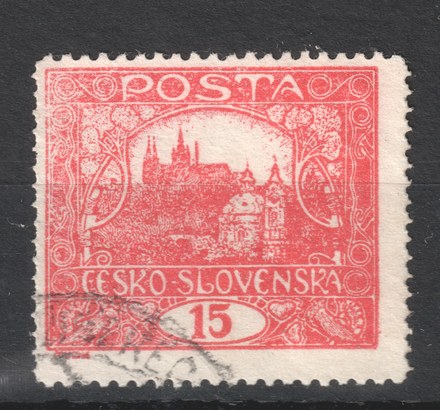
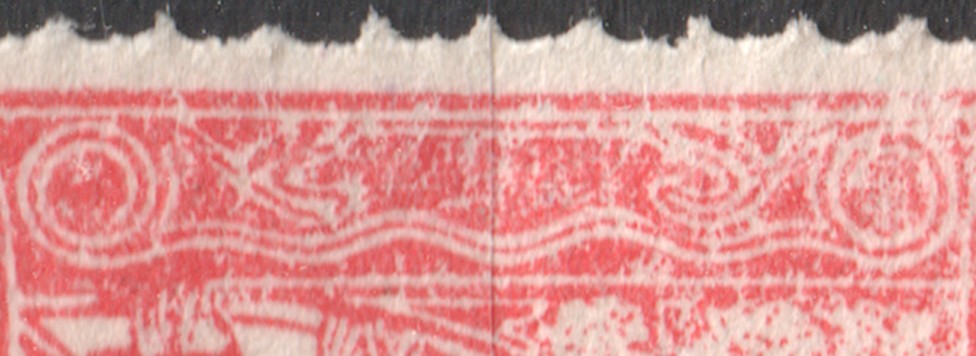
Na tomto kuse se druhý úder trefil na obě svislé strany a od prvního ho dělí jen zlomek rozteče. Řady se proto nekryjí jen o kousek: otvory se místy překrývají a mezi nimi zůstávají úzké, roztřepené zoubky. Podél strany se střídají normálně široké zoubky s nápadně tenkými a hloubka zářezů kolísá; ve zvětšeném detailu je vidět, jak dvojici těsně sousedících otvorů odděluje jen tenký proužek papíru.On this copy the second strike caught both vertical sides, and only a fraction of the gauge separates it from the first. The rows are therefore out of register by a little: the holes partly overlap and the teeth left between them are narrow and ragged. Along the side, teeth of normal width alternate with conspicuously thin ones and the depth of the cuts varies; in the enlarged detail one can see pairs of closely adjacent holes separated by nothing but a thin strip of paper.
Vzorek 2 — dvě oddělené řady na dolní straněSpecimen 2 — two separate rows along the bottom
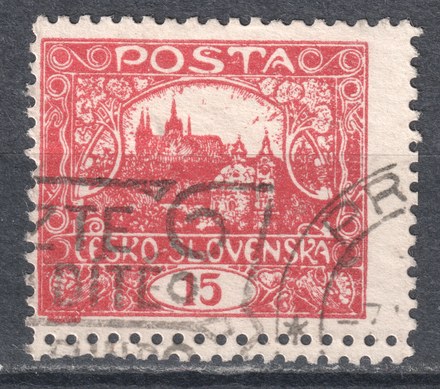
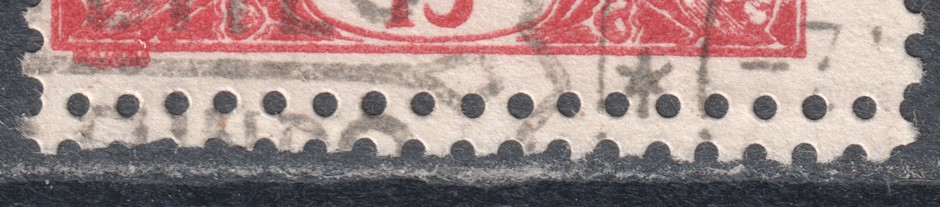
Kus je určen jako známkové pole 100 třetí tiskové desky — pravý dolní roh archu, tedy poslední řada. Dolní stranu tu proděrovaly dvě samostatné řady otvorů nad sebou, posunuté vůči sobě o méně než jednu rozteč, takže se nepromíchaly a leží vedle sebe jako dvě rovnoběžky. Známka se oddělila po dolní z nich — ta má běžný zoubkovaný profil — kdežto horní řada zůstala celá: leží nedotčená v okraji jako souvislý sled kulatých dírek, protože se po ní netrhalo. Právě to je na kuse nejcennější. Neporušená řada otvorů uvnitř okraje nemůže vzniknout ničím jiným než druhým průchodem nástroje, takže vadu dokládá sama o sobě — na rozdíl od roztřepených zoubků, které jdou zaměnit za nešetrné roztržení.The copy is identified as field 100 of the third printing plate — the bottom right corner of the sheet, that is, the last row. Here the bottom side was punched by two separate rows of holes one above the other, offset by less than one hole spacing, so that they did not interleave but lie side by side as two parallels. The stamp was separated along the lower of them — that one has the ordinary toothed profile — while the upper row stayed whole: it lies untouched in the margin as a continuous line of round holes, because nothing was torn along it. That is what makes the copy valuable. An unbroken row of holes inside the margin can arise from nothing but a second pass of the tool, so the flaw evidences itself — unlike ragged teeth, which can be mistaken for careless separation.
Vzorek 3 — druhá řada zasahuje do kresbySpecimen 3 — the second row cuts into the design
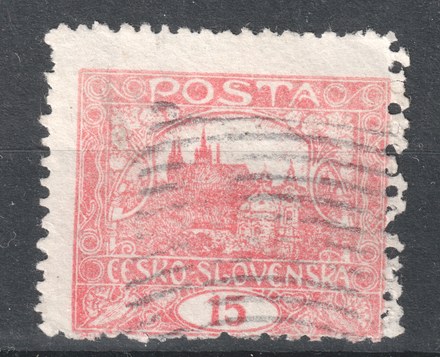
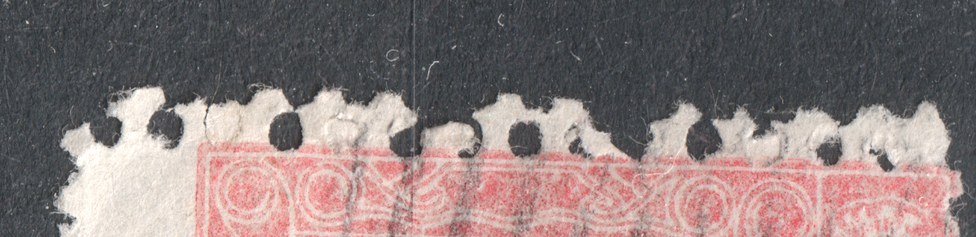
Třetí kus, určený jako známkové pole 38 druhé tiskové desky, spojuje obě předchozí podoby. Zdvojená je jen pravá svislá strana: vnější řada je ta, po níž se známka oddělila, a má běžný zoubkovaný profil; vnitřní řada leží o necelý milimetr blíž ke středu a zůstala celá — souvislý sled kulatých otvorů, který nakusuje pravý rámeček kresby. Posun obou úderů je tedy větší než u vzorku 1 (otvory se nepřekrývají) a menší než u vzorku 2 (mezi řadami nezůstal pruh čistého papíru). Že druhá řada zasáhla až do tisku, souvisí s celkovým posunem kresby na tomto kuse doleva: pravý okraj je nezvykle široký a řada, která měla dopadnout doprostřed mezery, dopadla do obrazu. Rozteč obou řad je řádková, 11½, tedy zoubkování D — a protože je zdvojená strana svislá, jde opět o dvojí přiložení řádkového perforátoru, stejně jako u vzorku 1.The third copy, identified as field 38 of the second plate, combines the two earlier forms. Only the right vertical side is doubled: the outer row is the one along which the stamp was separated and has the usual perforated profile; the inner row lies just under a millimetre closer to the centre and stayed intact — an unbroken run of round holes that bites into the right frame of the design. The offset of the two strikes is therefore larger than on specimen 1 (the holes do not overlap) and smaller than on specimen 2 (no strip of clean paper was left between the rows). That the second row reached into the print is connected with the overall leftward shift of the design on this copy: the right margin is unusually wide, and a row meant to fall in the middle of the gutter landed in the picture. The gauge of both rows is the line gauge 11½, i.e. perforation D — and since the doubled side is vertical, this is once more a double application of the line perforator, as on specimen 1.
Jak vada vzniklaHow the flaw arose
Podstata je u obou vzorků táž: jedna a tatáž mezera dostala dva údery. Stát se to může oběma nástroji, jimiž se emise děrovala, ale každý k tomu má jinou cestu — a oba vzorky na této stránce ukazují právě ty dvě různé cesty.The essence is the same on both specimens: one and the same gutter received two strikes. This can happen with either of the tools used on the issue, but each gets there by a different route — and the two specimens on this page show precisely those two routes.
- Řádkový perforátor prorazí vždy jednu přímou řadu otvorů přes celý arch; arch se pak posune o rozměr známky a nástroj udeří znovu. Celý arch tak vzniká z desítek samostatných úderů a přesnost stojí na obsluze. Když se arch smekl, byl přiložen podruhé nebo obsluha ztratila přehled, kterou mezeru už proděravěla, dostane táž mezera úder navíc — a protože se svislé a vodorovné řady dělaly v samostatných průchodech, může jít o kteroukoli z nich. Tomu odpovídá vzorek 1: zdvojené jsou obě svislé strany a posun je tak malý, že se otvory překrývají. Stejnou cestou vznikl i vzorek 3 — tam úder navíc dopadl jen na pravou svislou stranu a o kus blíž ke kresbě.A line perforator punches one straight row of holes across the whole sheet; the sheet is then advanced by the size of one stamp and the tool strikes again. A whole sheet is thus built from dozens of separate strikes and the accuracy rests on the operator. If the sheet slipped, was laid in a second time, or the operator lost track of which gutter had already been punched, that gutter receives an extra strike — and since the vertical and horizontal rows were done in separate passes, it can be any of them. This fits specimen 1: both vertical sides are doubled and the offset is so small that the holes overlap. Specimen 3 arose the same way — there the extra strike caught only the right vertical side, a little closer to the design.
- Hřebenový perforátor proděraví jedním zdvihem tři strany celé řady známek a arch se pak posune o jednu řadu. Selže-li ten posun — arch se posune málo nebo se smekne — dopadne vodorovná část hřebenu do mezery, kterou předchozí zdvih už proděravěl. Vznikne tak zdvojená vodorovná řada, zatímco svislé strany zůstanou v pořádku, protože ty dělají svislé zuby hřebenu. Přesně to ukazuje vzorek 2: dvě řady nad sebou na dolní straně a nedotčené strany svislé. U něj navíc sedí i poloha v archu. Vzorek je z poslední řady, a spodní okraj poslední řady uzavírá hřeben samostatným závěrečným zdvihem — je to jediná mezera, kterou zdvih pouze dovírá, místo aby jí zároveň otevíral řadu následující. Opakování právě tohoto zdvihu se proto projeví přesně tam, kde je vidět.A comb perforator punches three sides of a whole row of stamps in one stroke, after which the sheet advances by one row. If that advance fails — the sheet moves too little, or slips — the horizontal part of the comb lands in a gutter the previous stroke has already punched. A doubled horizontal row results, while the vertical sides stay sound, because those are made by the vertical prongs of the comb. That is exactly what specimen 2 shows: two rows one above the other along the bottom, and the vertical sides untouched. Its place in the sheet fits as well. The specimen comes from the last row, and the bottom edge of the last row is closed by a separate final stroke of the comb — the one gutter a stroke merely closes instead of opening the next row at the same time. A repeat of that particular stroke therefore shows exactly where it is seen.
Směr zdvojení proto sám o sobě napovídá, jakým nástrojem se pracovalo. Zdvojená svislá strana ukazuje na řádkové zoubkování; zdvojená vodorovná řada při nedotčených svislých stranách odpovídá selhání posuvu u hřebene. U vzorku 2 to potvrzuje i rozteč: je hrubší než u vzorku 1 a odpovídá hřebenovému zoubkování B. Určení kusu na ZP 100/III to uzavírá — hřeben tam udeřil dvakrát s velmi malým posunem.The direction of the doubling therefore hints in itself at which tool was at work. A doubled vertical side points to line perforation; a doubled horizontal row with the vertical sides untouched matches a failure of the advance under a comb. On specimen 2 the gauge confirms it: it is coarser than on specimen 1 and matches comb perforation B. Identifying the copy as field 100 of plate III settles it — the comb struck twice there, with a very small offset.
Dvojitá perforace není samostatné katalogové zoubkování. Skupiny A–H popisují druh nástroje a rozteč, tedy čím byl arch proděrován — opakovaný průchod týmž nástrojem rozteč nemění a známka se určuje podle té řady, která odpovídá řádnému průchodu. Vede se jako perforační odchylka: sběratelsky vyhledávaná, ale mimo katalogové členění. Od výjimečných zoubkování I a L se rozliší snadno — tam má každá strana jednu řadu otvorů, jen s jinou roztečí než strana protilehlá, kdežto u dvojité perforace má táž strana řady dvě.A double perforation is not a catalogue perforation of its own. Groups A–H describe the kind of tool and the gauge, that is, what the sheet was punched with — a repeated pass of the same tool does not change the gauge, and the stamp is identified from the row that corresponds to the proper pass. It is recorded as a perforation deviation: sought after by collectors, but outside the catalogue arrangement. It is easy to tell apart from the exceptional perforations I and L — there each side carries a single row of holes, merely at a different gauge from the opposite side, whereas in a double perforation one and the same side carries two rows.
Vynechaná perforaceMissing perforation
Opakem dvojitého úderu je průchod, který se vůbec neuskutečnil. Mezi dvěma řadami známek pak zůstane souvislý pás papíru a arch nelze v tom místě roztrhnout. Známky se musely oddělit nůžkami nebo roztržením, takže hotový kus má jednu či více stran hladkých, bez zoubků — a zbývající strany zoubkované normálně.The opposite of a double strike is a pass that never happened at all. An unbroken band of paper is then left between two rows of stamps and the sheet cannot be torn there. The stamps had to be separated with scissors or by tearing, so the finished copy has one or more sides that are smooth, without teeth — and the remaining sides perforated as usual.
Vzorek 1 — chybějící vodorovné zoubkováníSpecimen 1 — horizontal perforation missing
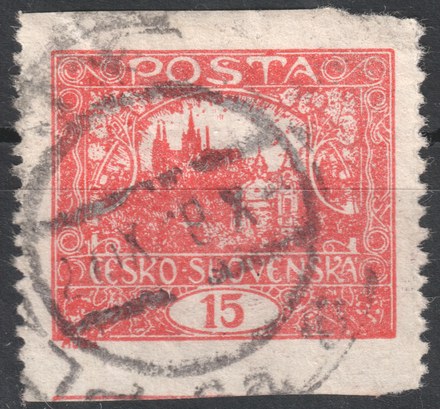

Chybí obě vodorovná zoubkování: horní i dolní strana je oddělena střihem, svislé strany mají zoubkování normální. Že řez vedl mezi dvěma známkami, prozrazuje dolní okraj — je na něm ještě vidět kousek rámečku sousední známky. Vynechaly se tedy dvě po sobě jdoucí vodorovné řady, což u řádkového perforátoru znamená, že arch prošel bez úderu hned dvakrát za sebou.Both horizontal perforations are missing: the top and the bottom side were separated with scissors, while the vertical sides are perforated normally. That the cut ran between two stamps is betrayed by the bottom edge — a piece of the neighbouring stamp's frame is still visible on it. Two consecutive horizontal rows were therefore skipped, which with a line perforator means the sheet passed through without a strike twice in a row.
Vzorek 2 — chybějící svislé zoubkováníSpecimen 2 — vertical perforation missing
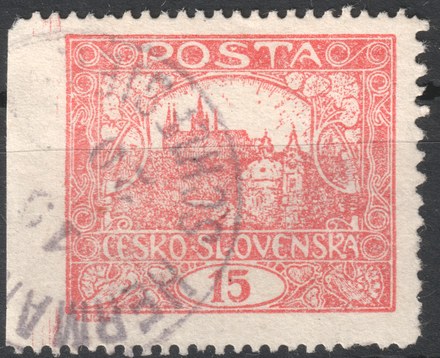
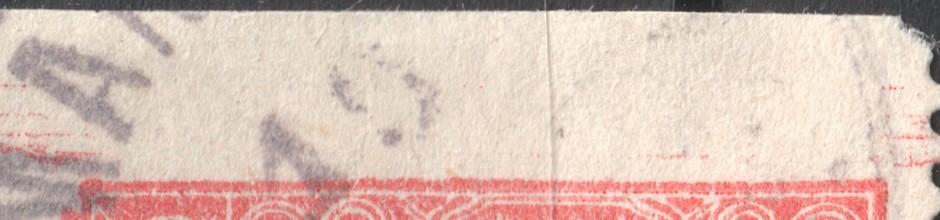
Zde chybí jediná svislá řada — levá strana. Horní, dolní i pravá strana zoubkování mají. Široký hladký okraj vlevo nese slabé stopy červené barvy ze sousední známky, takže i tady vedl řez volným polem mezi dvěma známkami. Kus je tím pádem doložitelný sám o sobě: kdyby byl okraj jen ostřižený, chyběl by na něm papír, ne přebýval.Here a single vertical row is missing — the left side. The top, bottom and right sides are perforated. The wide smooth margin on the left carries faint traces of red ink from the neighbouring stamp, so here too the cut ran through the open gutter between two stamps. That makes the copy self-evidencing: had the margin merely been trimmed, paper would be missing from it, not left over.
Vzorek 3 — chybějící horní zoubkováníSpecimen 3 — top perforation missing
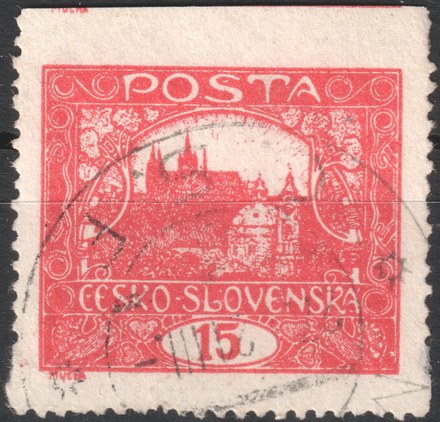

Třetí kus je nejnázornější z celé trojice. Chybí horní vodorovná řada; levá, pravá i dolní strana zoubkování mají. V širokém horním okraji zůstal rámeček a zbytek písma sousední známky — řez tedy nevedl středem mezery, ale zasáhl do kresby známky nad ní. Takový okraj je zároveň nejlepším důkazem pravosti: papír navíc s cizím tiskem nelze získat ostříháním zoubků, jen tak, že perforace v tom místě opravdu chyběla.The third copy is the most telling of the three. The top horizontal row is missing; the left, right and bottom sides are perforated. The wide top margin retains the frame and part of the lettering of the neighbouring stamp — the cut therefore did not run down the middle of the gutter but reached into the design of the stamp above. Such a margin is at the same time the best proof of genuineness: extra paper carrying someone else's print cannot be obtained by trimming teeth away, only by the perforation genuinely having been absent there.
Pozor na záměnu. Emise vyšla i jako nezoubkovaná, a tam jsou hladké všechny čtyři strany — u vynechané perforace musí zůstat alespoň jedna strana zoubkovaná. Vadu lze také předstírat ostříháním zoubků, proto se u každého kusu posuzuje šířka okraje: střižený okraj je proti normálu užší a bývají na něm patrné zbytky otvorů. U dražších kombinací (chybí perforace na více stranách) je namístě atest.Beware of confusion. The issue also appeared imperforate, and there all four sides are smooth — with a missing perforation at least one side must remain perforated. The flaw can also be faked by trimming the teeth away, so the width of the margin is judged on every copy: a trimmed edge is narrower than normal and traces of the holes tend to remain. For the more valuable combinations (perforation missing on several sides) a certificate is in order.
Příbuzné téma: posun zoubkování vůči kresbě. Není to porucha nástroje, ale nepřesnost při zakládání archu — u této emise tak běžná, že má vlastní oddíl: Posun zoubkováníPerforation shifts.A related topic: the shift of the perforation against the design. It is not a failure of the tool but an inaccuracy in laying the sheet — so common on the Hradčany issue that it has a part of its own: Posun zoubkováníPerforation shifts.
Posun zoubkováníPerforation shifts
Perforace se do archu proděrovala až po tisku, samostatným pracovním krokem a na jiném stroji. Poloha děrovací mřížky vůči vytištěné kresbě proto nikdy nebyla pevně dána a u hradčanské emise se od ideálu odchyluje neobvykle často. Ukázky níže pocházejí z jedné sbírky — 29 kusů, celkem 30 známek — a pokrývají celou škálu od sotva znatelně nestejných okrajů až po kusy, na nichž zoubkování prochází kresbou a na okraji zůstal proužek sousední známky.Perforation was punched into the sheet only after printing, as a separate operation on a different machine. The position of the perforating grid relative to the printed design was therefore never fixed, and on the Hradčany issue it departs from the ideal unusually often. The specimens below come from a single collection — 29 items, 30 stamps in all — and cover the whole range, from barely noticeable unequal margins to copies where the perforation runs through the design and a strip of the neighbouring stamp remains at the edge.
Proč posun vznikáWhy shifts happen
- Arch se do stroje zakládal ručně proti dorazům. Každá nepřesnost při založení posune celou děrovací mřížku najednou — proto bývají všechny známky téhož archu posunuty stejným směrem.The sheet was laid into the machine by hand against stops. Any inaccuracy in laying it shifts the whole perforating grid at once — which is why all the stamps of one sheet tend to be shifted the same way.
- U řádkového zoubkování se každá linka děruje zvlášť a arch se mezi nimi posouvá. Chyba jednoho posuvu se přičítá k předchozím, takže odchylka narůstá směrem k protilehlému okraji archu; oba směry se navíc dělaly v samostatných průchodech.With line perforation each line is punched separately and the sheet is advanced between them. The error of one advance adds to the previous ones, so the deviation grows towards the opposite edge of the sheet; and the two directions were done in separate passes.
- U hřebenového zoubkování připadá jeden zdvih na celou řadu, takže uvnitř řady je posun u všech deseti známek stejný. Nepravidelnost se objeví jen na rozhraní dvou řad, kde se dva zdvihy nesešly.With comb perforation one stroke serves a whole row, so within the row all ten stamps are shifted alike. Irregularity appears only at the boundary between two rows, where two strokes failed to meet.
- Ani samotná kresba neleží v archu vždy stejně. Poloha sazby v tiskové formě se mohla nepatrně lišit a takový posun tisku vůči okraji archu se pak sečte s posunem perforace.Nor is the design itself always in the same place on the sheet. The position of the forme could vary slightly, and such a displacement of the print relative to the sheet edge then adds to that of the perforation.
- Emise vznikala v letech 1919–1920 za provizorních poměrů, ve spěchu a na několika různých strojích. Nedokonale seřízený nebo opotřebovaný nástroj a rychlá práce jsou důvod, proč jsou posuny u Hradčan podstatně běžnější než u pozdějších emisí.The issue was produced in 1919–1920 under makeshift conditions, in haste and on several different machines. An imperfectly set or worn tool and fast working are why shifts are considerably more common on the Hradčany issue than on later ones.
Stupně posunuDegrees of shift
- Mírný — okraje jsou nestejně široké, rámeček zůstává celý. Nejběžnější stav; jde spíš o otázku centráže než o zajímavou odchylku.Slight — the margins are of unequal width but the frame stays intact. The commonest state; a question of centring rather than an interesting variety.
- Střední — perforace zasahuje do rámečku nebo jím prochází. Kresba je porušena, ze sousední známky ale ještě nic nezůstalo.Medium — the perforation reaches into the frame or runs through it. The design is damaged, but nothing of the neighbouring stamp is yet present.
- Silný — na okraji zůstal pruh papíru se zbytkem tisku sousední známky, případně naopak část vlastní kresby chybí. Takové kusy jsou nejnázornější, protože přímo ukazují, o kolik se mřížka minula.Strong — a strip of paper with part of the neighbouring stamp's print remains at the edge, or conversely part of the stamp's own design is missing. Such copies are the most telling, since they show directly by how much the grid missed.
Posun není desková vada. Nevzniká v tiskové desce, ale až při děrování, a proto se na téže známkové pozici neopakuje — k určení desky ani polohy v archu ho použít nelze. Při měření zoubkování naopak dobře poslouží: na posunutém kusu je vidět, jak daleko od rámečku řada leží, a na páru nebo pruhu i to, zda jde o zoubkování řádkové, či hřebenové.A shift is not a plate flaw. It does not arise in the printing plate but during perforating, and therefore does not repeat on the same sheet position — it cannot be used to identify a plate or a position in the sheet. For gauging, however, it is useful: on a shifted copy you can see how far from the frame the row lies, and on a pair or strip whether the perforation is line or comb.
Opatrnost u výrazných kusů. Silný posun zvyšuje sběratelskou přitažlivost, a je proto namístě ověřit, že perforace je původní: porovnat rozteč s doloženým typem téže desky a zkontrolovat, zda tvar a délka zubů odpovídají ostatním stranám známky.Care with striking copies. A strong shift adds collector appeal, so it is worth checking that the perforation is original: compare the gauge with a documented type of the same plate, and check that the shape and length of the teeth match the stamp's other sides.
Ukázky ze sbírkySpecimens from the collection
Směr je vždy uveden jako posun děrovací mřížky vůči kresbě: posun doprava znamená, že perforace leží více vpravo, takže vlevo zůstal úzký a vpravo široký okraj. Kliknutím se ukázka zvětší.The direction is always given as the displacement of the perforating grid relative to the design: shift to the right means the perforation lies further right, leaving a narrow margin on the left and a wide one on the right. Click a specimen to enlarge it.
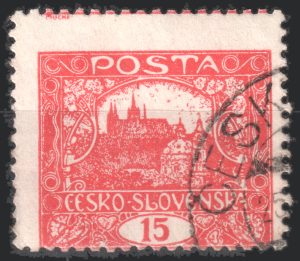
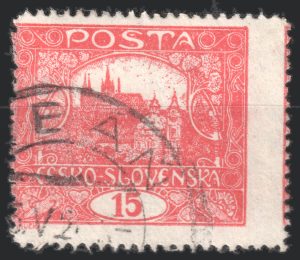
1Zoubkování posunuto doprava — vlevo probíhá řada těsně u rámečku, vpravo zůstal široký okraj.Perforation shifted to the right — on the left the row runs hard against the frame, on the right a wide margin remains.
 2
2Vodorovná řada nad známkou byla proděrována vysoko, uvnitř sousední známky: nahoře přebývá pruh papíru se zbytkem jejího tisku. Vodorovně posun doleva.The horizontal row above was punched high, inside the neighbouring stamp: an extra strip of paper with a trace of its print remains at the top. Horizontally the shift is to the left.
 3
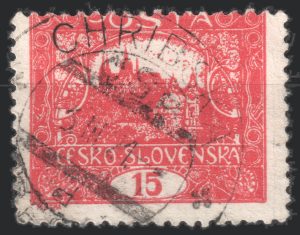
3Výrazný posun doprava a dolů — vlevo zasahuje perforace až k rámečku, vpravo i dole zůstal velmi široký okraj.Marked shift to the right and downwards — on the left the perforation reaches the frame, on the right and below a very wide margin remains.
 4
4Posun dolů — horní řada leží těsně nad rámečkem, dole zbyl široký okraj.Shift downwards — the top row lies right above the frame, a wide margin remains at the bottom.
 5
5Šikmý posun doprava a dolů, na obou směrech přibližně stejnou měrou.Diagonal shift to the right and downwards, by roughly the same amount in both directions.
 6
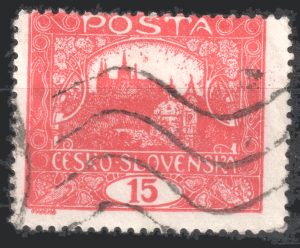
6Posun doprava a dolů; horní řada prochází těsně u rámečku, dolní okraj je naopak široký.Shift to the right and downwards; the top row passes right at the frame, while the bottom margin is wide.
 7
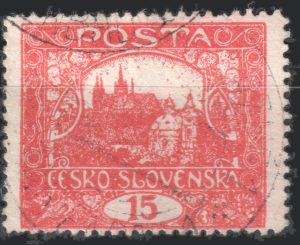
7Vodorovně vystředěná známka, ale obě vodorovné řady leží těsně u rámečku — mezi nimi je nezvykle málo místa.Horizontally well centred, but both horizontal rows lie close to the frame — there is unusually little room between them.
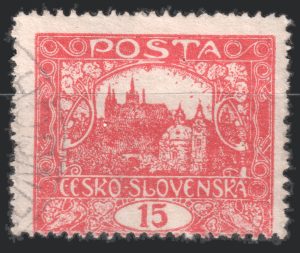 8
8Posun doleva a nahoru — dolní řada zasahuje až k rámečku.Shift to the left and upwards — the bottom row reaches the frame.
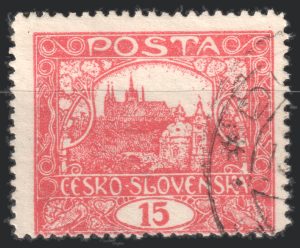 9
9Posun doleva a nahoru; dole je perforace téměř na rámečku, vlevo i nahoře zůstal okraj.Shift to the left and upwards; below, the perforation almost touches the frame, while margins remain at the left and top.
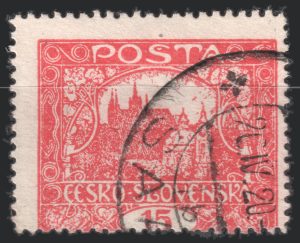 10
10Silný šikmý posun doleva a nahoru — vpravo i dole prochází perforace těsně u rámečku.Strong diagonal shift to the left and upwards — on the right and below the perforation passes hard against the frame.
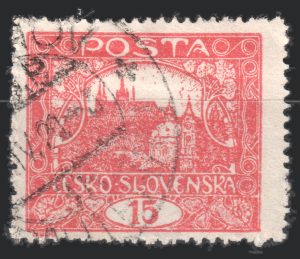 11
11Posun doprava, svisle jen mírný — vpravo široký okraj, vlevo úzký.Shift to the right, only slight vertically — a wide margin at the right, a narrow one at the left.
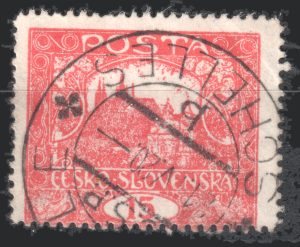 12
12Posun doprava a nahoru; dolní řada leží těsně pod rámečkem.Shift to the right and upwards; the bottom row lies right below the frame.
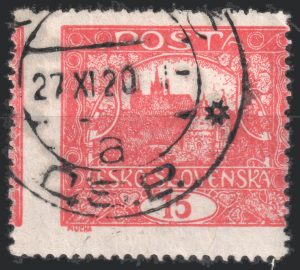 13
13Silný posun doleva — vpravo prochází perforace rámečkem, vlevo zůstal na okraji proužek sousední známky.Strong shift to the left — on the right the perforation runs through the frame, on the left a strip of the neighbouring stamp remains at the edge.
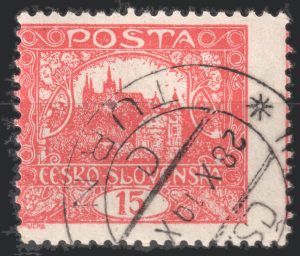 14
14Silný posun doprava — vlevo je rámeček naříznut, vpravo zůstal proužek tisku sousední známky.Strong shift to the right — the frame is cut on the left, and a strip of the neighbouring stamp's print remains on the right.
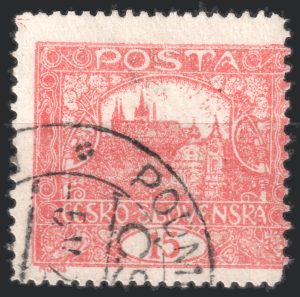 15
15Posun doleva a nahoru — vpravo prochází perforace rámečkem, nahoře i vlevo zůstal okraj.Shift to the left and upwards — on the right the perforation runs through the frame, margins remain at the top and left.
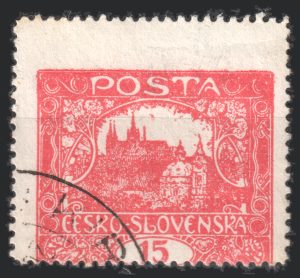 16
16Velmi silný posun nahoru — nad kresbou přebývá široký pruh prázdného papíru, dolní řada leží těsně u rámečku.Very strong shift upwards — a wide strip of blank paper above the design, the bottom row lying hard against the frame.
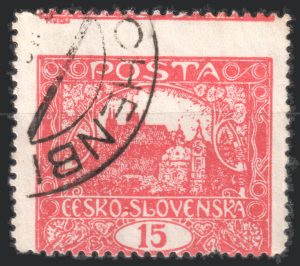 17
17Silný posun nahoru; u horního okraje je vidět stopa tisku sousední známky.Strong shift upwards; a trace of the neighbouring stamp's print is visible along the top edge.
 18
18Posun doleva a nahoru — dole perforace zasahuje k rámečku, nahoře zůstal široký okraj.Shift to the left and upwards — below, the perforation reaches the frame, above a wide margin remains.
 19
19Vodorovný pár. Svislá řada mezi oběma známkami je posunuta doprava: levá známka má nezvykle široký pravý okraj, pravé je naříznut levý rámeček. Obě krajní svislé řady navíc probíhají těsně u rámečků.Horizontal pair. The vertical row between the two stamps is shifted to the right: the left stamp has an unusually wide right margin, while the right one has its left frame cut. Both outer vertical rows also run hard against the frames.
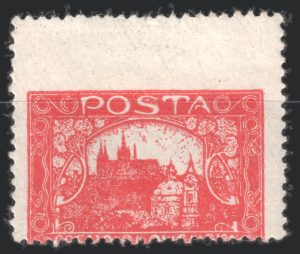 20
20Extrémní posun nahoru — nad kresbou zbývá téměř polovina prázdného papíru, dole prochází perforace kresbou.Extreme shift upwards — nearly half the paper above the design is blank, while below the perforation runs through the design.
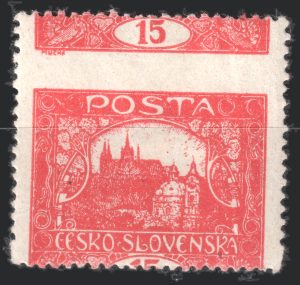 21
21Nejnázornější kus sestavy: vodorovná řada byla proděrována hluboko uvnitř sousední známky, takže nahoře zůstal celý její spodní okraj i s hodnotovým oválem 15. Vlastní kresba je dole naříznuta.The most telling item of the group: the horizontal row was punched deep inside the neighbouring stamp, so its entire lower edge — value oval 15 included — remains at the top. The stamp's own design is cut at the bottom.
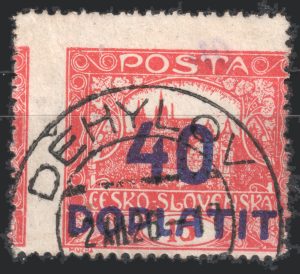 22
22Přetisk DOPLATIT 40 h. Silný posun doleva — vpravo je rámeček naříznut, vlevo zůstal proužek sousední známky.DOPLATIT 40 h surcharge. Strong shift to the left — the frame is cut on the right, a strip of the neighbouring stamp remains on the left.
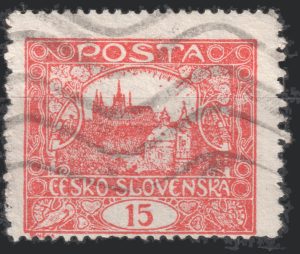 23
23Posun doprava a nahoru — vlevo i dole prochází perforace těsně u rámečku.Shift to the right and upwards — on the left and below the perforation passes hard against the frame.
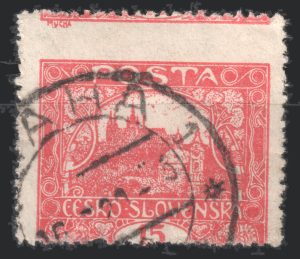 24
24Silný posun nahoru a doleva; u horního okraje je vidět stopa tisku sousední známky.Strong shift upwards and to the left; a trace of the neighbouring stamp's print is visible along the top edge.
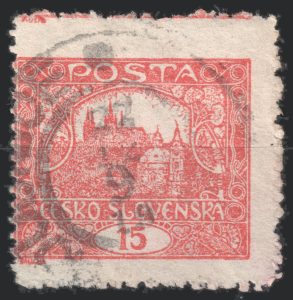 25
25Posun doprava a nahoru — vlevo prochází perforace těsně u rámečku, nahoře přebývá pruh papíru se stopou tisku sousední známky.Shift to the right and upwards — on the left the perforation passes hard against the frame, at the top an extra strip of paper carries a trace of the neighbouring stamp's print.
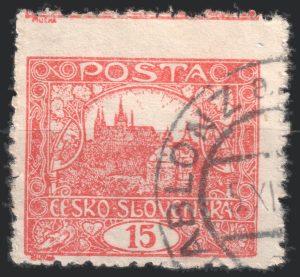 26
26Posun doprava a nahoru — vlevo zasahuje řada až k rámečku, nahoře zůstal široký okraj se stopou tisku sousední známky.Shift to the right and upwards — on the left the row reaches the frame, at the top a wide margin remains with a trace of the neighbouring stamp's print.
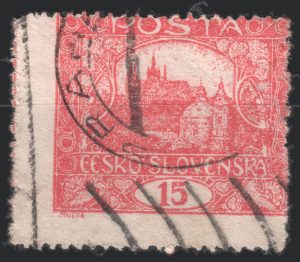 27
27Posun doleva a dolů — vpravo prochází perforace rámečkem, vlevo je na okraji stopa sousední známky.Shift to the left and downwards — on the right the perforation runs through the frame, on the left a trace of the neighbouring stamp shows at the edge.
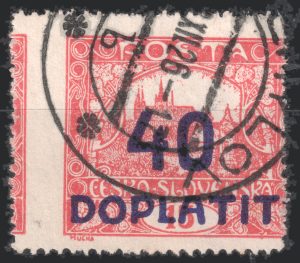 28
28Přetisk DOPLATIT 40 h. Silný posun doleva a nahoru — vlevo zůstal proužek sousední známky, vpravo je kresba naříznuta.DOPLATIT 40 h surcharge. Strong shift to the left and upwards — a strip of the neighbouring stamp remains on the left, the design is cut on the right.
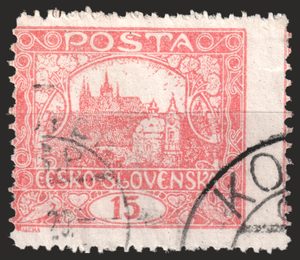 29
29Posun doprava — vlevo je kresba těsně u perforace, vpravo zůstal široký okraj se stopou sousední známky.Shift to the right — on the left the design sits hard against the perforation, on the right a wide margin remains with a trace of the neighbouring stamp.
Vady tiskuPrinting flaws
Částečně zdvojený tiskPartly doubled print
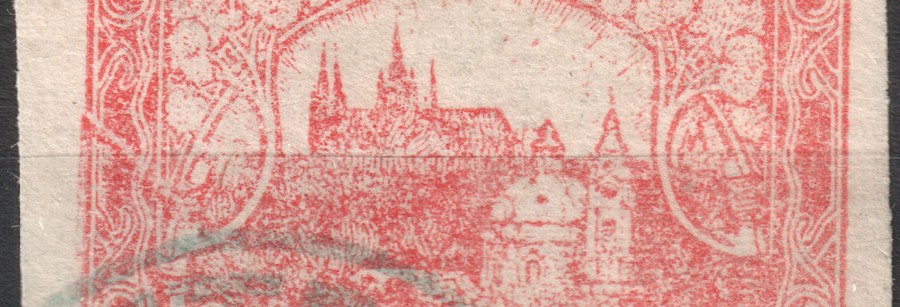
Na těchto známkách se kresba dělí na dvě části rovnou vodorovnou hranicí. Nad ní je otisk čistý a ostrý, pod ní těžší, rozmazaný a místy zdvojený — obrysy se opakují posunuté o zlomek milimetru. Hranice je pravítkově rovná, s kresbou nemá nic společného a pokračuje i do bočních okrajů známky. Na všech pěti doložených kusech leží přibližně ve stejné výšce.On these stamps the design is divided into two parts by a straight horizontal boundary. Above it the impression is clean and sharp, below it heavier, smeared and in places doubled — the outlines repeat, displaced by a fraction of a millimetre. The boundary is ruler-straight, has nothing to do with the design and continues into the side margins of the stamp. On all five recorded copies it lies at roughly the same height.
Jak vada vzniklaHow the flaw arose
Příčina leží pod archem, ne v tiskové desce. Při tisku se pod arch dostal cizí předmět — nejspíš další list papíru: podložka, makulatura nebo přeložený roh archu. Jeho rovná hrana nadzvedla část tiskové plochy a od té chvíle se arch tiskl ve dvou různých výškách.The cause lies under the sheet, not in the printing plate. During printing a foreign object found its way beneath the sheet — most likely another piece of paper: an underlay, a spoiled sheet, or a folded corner of the sheet itself. Its straight edge lifted part of the printing surface, and from that moment the sheet was printed at two different heights.
- Nadzvednutá část dosedla na formu dřív a s větším tlakem, než na jakou byl stroj seřízen.The raised part met the forme sooner and under greater pressure than the press was set for.
- Pod přetlakem se papír na formě nepatrně posunul a otisk se rozmazal až zdvojil — proto se obrysy opakují jen o zlomek milimetru vedle sebe.Under that excess pressure the paper shifted slightly on the forme and the impression smeared or doubled — which is why the outlines repeat only a fraction of a millimetre apart.
- Zbytek archu ležel v normální výšce a otiskl se čistě.The rest of the sheet lay at the normal height and printed cleanly.
- Přechod mezi obojím je proto rovný jako hrana listu, který nadzvednutí způsobil. Sleduje cizí předmět, ne kresbu — a právě proto prochází bez ohledu na to, co je pod ním vytištěno.The transition between the two is therefore as straight as the edge of the sheet that caused the lift. It follows the foreign object, not the design — which is exactly why it runs on regardless of what is printed beneath it.
- Že jde o jednorázovou situaci u lisu, podporuje i shodná výška hranice na všech čtyřech kusech: odpovídá známkám z jedné řady archu, kterou hrana podloženého listu protínala.That this was a one-off situation at the press is supported by the boundary lying at the same height on all four copies: it fits stamps from one row of the sheet, the row the edge of the underlying paper crossed.
Proč to není prasklá deskaWhy this is not a cracked plate
Kusy tohoto typu se objevují v nabídkách jako „prasklá tisková deska“. Je to omyl a rozlišit obojí je snadné:Copies of this kind turn up in offers as a “cracked printing plate”. That is a mistake, and the two are easy to tell apart:
- Prasklina přidává barvu. V trhlině desky se drží barva, takže se otiskne jako čára navíc. Tady žádná linka nepřibyla — kresba je na obou stranách hranice táž, liší se jen kvalita otisku.A crack adds ink. Ink collects in the fissure, so it prints as an extra line. Here nothing has been added — the design is the same on both sides of the boundary, only the quality of the impression differs.
- Prasklina je konstantní. Patří jednomu známkovému poli, opakuje se na každém dalším archu a v čase se zvětšuje, takže se dá rozfázovat. Rozmazaná plocha se nikde neopakuje — vznikla jedním konkrétním průchodem lisu.A crack is constant. It belongs to one stamp field, recurs on every further sheet and grows over time, so it can be divided into stages. A smeared area recurs nowhere — it arose in one particular pass of the press.
- Prasklina se drží desky, tahle hranice papíru. Předěl prochází napříč kresbou i okrajem známky a nedbá na to, co je pod ním; prasklina naopak vždy leží v konkrétním místě kresby.A crack belongs to the plate, this boundary to the paper. The division crosses design and margin alike and takes no notice of what lies beneath it; a crack, by contrast, always sits at a particular place in the design.
Jak vypadá skutečné poškození desky — s barevnou linkou, vázané na známkové pole a rozfázované v čase — ukazuje oddíl Poškození tiskové deskyDamage to the printing plate, kde je i prasklina na 11/II.What real damage to a plate looks like — a coloured line, tied to a stamp field and staged over time — is shown in the Poškození tiskové deskyDamage to the printing plate part, which includes the crack at 11/II.
Ukázky ze sbírkySpecimens from the collection
 1
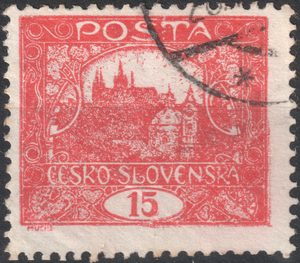
1Hranice probíhá přibližně středem známky. Nad ní je tisk čistý, pod ní těžší a s rozpitými obrysy.The boundary runs roughly through the middle of the stamp. Above it the print is clean, below it heavier and with blurred outlines.
 2
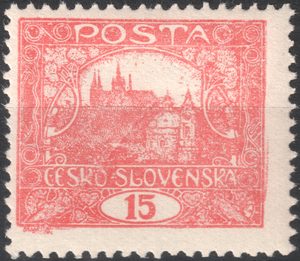
2Hranice ve výši úpatí Hradčan. Dolní část otisku je měkčí a světlejší, horní zůstala ostrá.The boundary at the level of the foot of the Castle. The lower part of the impression is softer and lighter, the upper part stayed sharp.
 3
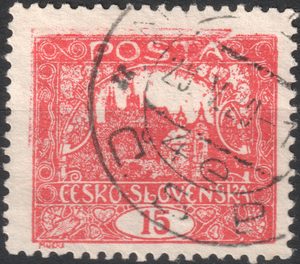
3Kus s hustým razítkem; hranici prozrazuje vodorovný předěl ve výši věží, nejlépe čitelný v pravé části známky.A heavily cancelled copy; the boundary shows as a horizontal division at the level of the towers, most legible in the right-hand part of the stamp.
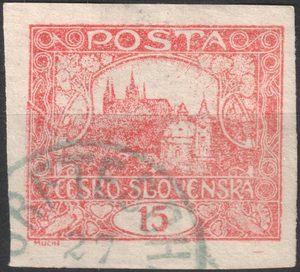 4
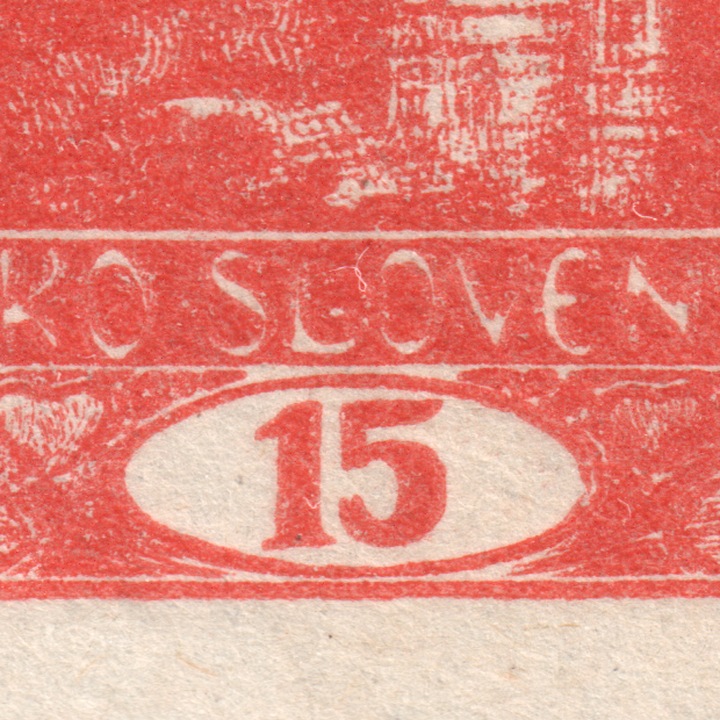
4Nejzřetelnější kus sestavy. Rovná hranice prochází napříč celou známkou a pokračuje i do bočních okrajů; pod ní jsou obrysy zdvojené. Z tohoto kusu je i výřez výše.The clearest item of the group. The straight boundary crosses the whole stamp and continues into the side margins; below it the outlines are doubled. The detail above is taken from this copy.
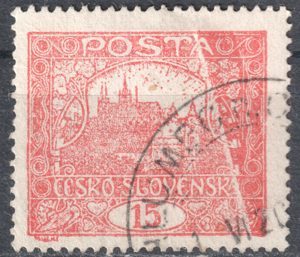 5
5Kus s čitelným razítkem 1. VI. 1920. Hranice probíhá těsně pod obloukem, ve výši horních věží Hradčan.A copy with a legible cancel of 1 June 1920. The boundary runs just below the arch, at the level of the upper towers of Hradčany.
Dvojitý a vícenásobný tiskDouble and multiple print
U těchto kusů dostal arch víc než jeden otisk. Celá kresba je vytištěná dvakrát — jednou slabě posunutá, takže má každá linka svého dvojníka, jindy posunutá o velký kus a pootočená, takže se do jedné známky vejdou části několika otisků najednou.On these copies the sheet received more than one impression. The whole design is printed twice — once only slightly displaced, so that every line has its twin, and elsewhere displaced by a long way and rotated, so that parts of several impressions end up inside a single stamp.
Jak vada vzniklaHow the flaw arose
Arch prošel strojem podruhé: buď se po prvním zdvihu nevyjmul, nebo se do stroje vrátil znovu. Mezi oběma otisky se posunul — o zlomek milimetru, když jen povolilo uložení, nebo o celý kus, když se arch založil úplně jinak. Protože tiskne táž forma, jsou obě kresby naprosto totožné co do velikosti i detailu; liší se jen polohou. To je také důvod, proč se dvojitý tisk pozná spolehlivě: posun má všude stejný směr a stejnou velikost.The sheet went through the press a second time: either it was not taken out after the first stroke, or it was fed back in. Between the two impressions it moved — by a fraction of a millimetre when the register merely slipped, or by a long way when the sheet was laid in quite differently. Because the same forme does the printing, the two images are exactly identical in size and in detail; they differ only in position. That is also why a double print can be recognised reliably: the displacement has the same direction and the same size everywhere.
StupněDegrees
- Dvojitý tisk — posun v řádu desetin milimetru. Kresba na první pohled vypadá jen rozmazaně; teprve zblízka je vidět, že každá linka, písmeno i obrys oválu má slabšího dvojníka.Double print — a displacement of tenths of a millimetre. At first glance the design merely looks blurred; only close up is it clear that every line, letter and outline of the oval has a fainter twin.
- Vícenásobný tisk — posun o milimetry až o celou šířku známky, často s pootočením. Do rámu jedné známky pak zasahují části sousedních známek a nápis POŠTA se objeví dvakrát v různé výšce.Multiple print — a displacement of millimetres up to a whole stamp width, often with a rotation. Parts of neighbouring stamps then reach inside one stamp’s frame and the word POŠTA appears twice at different heights.
- Na kusu s okrajem archu je to vidět nejlépe: přebytečný otisk leží na papíru, kde nemá být žádná kresba, hned vedle kontrolního čísla.On a piece with the sheet margin it shows best of all: the surplus impression lies on paper that should carry no design at all, right beside the control number.
Proč to není částečně zdvojený tiskWhy this is not a partly doubled print
U částečně zdvojeného tisku je zdvojená jen část známky a přechod k čistému otisku je rovná hranice — pod archem tam leželo cizí těleso, které jeho část nadzvedlo. Tady žádná hranice není: zdvojená je celá kresba až do rohů rámu, protože arch dostal celý druhý otisk.In a partly doubled print only part of the stamp is doubled and the change to the clean impression is a straight boundary — a foreign body under the sheet lifted that part of it. Here there is no boundary: the whole design is doubled right into the corners of the frame, because the sheet received a complete second impression.
Proč to není obtiskWhy this is not a set-off
Obtisk je přenos čerstvé barvy z jiného archu: leží na lepové straně a je zrcadlově obrácený. Oba otisky dvojitého tisku jsou na líci a oba se čtou správně.A set-off is a transfer of fresh ink from another sheet: it lies on the gummed side and is mirrored. Both impressions of a double print are on the face and both read the right way round.
Ukázky ze sbírkySpecimens from the collection
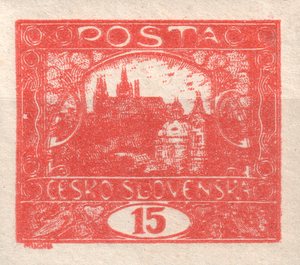 1
1Dvojitý tisk. Druhý otisk leží jen o zlomek milimetru vedle prvního, ale je znát na každé lince — nejlépe na nápisu a na hodnotovém oválu.Double print. The second impression lies only a fraction of a millimetre from the first, yet it shows on every line — best on the inscription and the value oval.
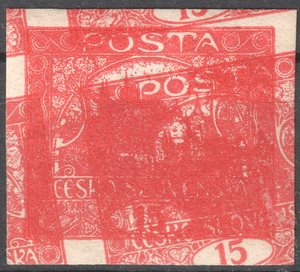 2
2Vícenásobný tisk. Otisky jsou posunuté o velký kus a pootočené, takže do rámu zasahují části sousedních známek a nápis POŠTA se objevuje dvakrát v různé výšce.Multiple print. The impressions are displaced by a long way and rotated, so parts of neighbouring stamps reach inside the frame and the word POŠTA appears twice at different heights.
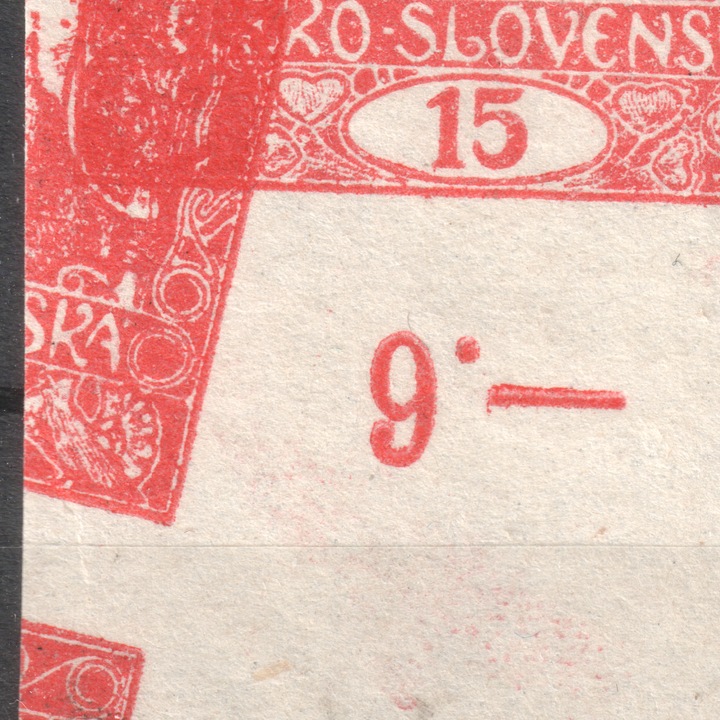
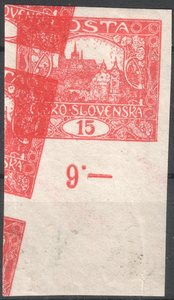 3
3Rohový kus s okrajem archu a kontrolním číslem 9. Šikmý druhý otisk přebíhá přes okraj, tedy přes papír, na kterém nemá být vůbec žádný tisk.A corner piece with the sheet margin and control number 9. The slanted second impression runs across the margin — across paper that should carry no print at all.
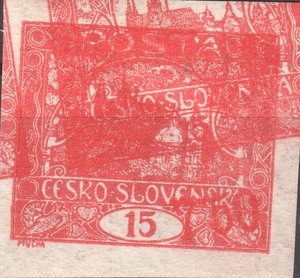 4
4Vícenásobný tisk s pootočením. Druhý otisk je posunutý nahoru a doprava a stočený o několik stupňů: jeho nápis ČESKO-SLOVENSKÁ přebíhá šikmo středem známky přes hradčanské panorama a nahoře zasahuje do rámu spodek známky z vyšší řady.Multiple print with rotation. The second impression is shifted up and to the right and turned by a few degrees: its inscription ČESKO-SLOVENSKÁ runs obliquely through the middle of the stamp across the Hradčany skyline, and at the top the bottom of a stamp from the row above reaches into the frame.
Pozor na záměnu s rozmazaným otiskem. Pohnul-li se arch pod tlakem, kresba se rozmázne do šmouhy, ale druhý obrys nevznikne. U dvojitého tisku je posunutá kopie úplná — má vlastní ostré linky a všude stejný odstup od té první.Beware of confusion with a smeared impression. If the sheet moved under pressure the design smears into a streak, but no second outline appears. In a double print the displaced copy is complete — it has sharp lines of its own and the same offset from the first everywhere.
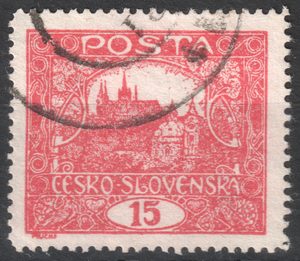
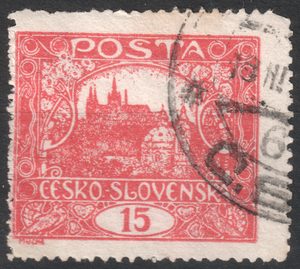
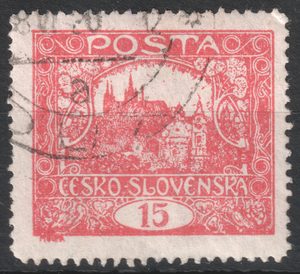
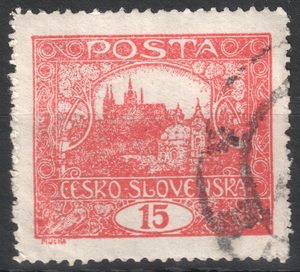
„Bludné kroužky““Wandering rings”
Drobná, ostře ohraničená tmavá skvrna nebo prstýnek se objeví v místě, kde má kresba zůstat čistě bílá — v mezeře mezi věžemi, v písmenu nápisu, pod ozdobným kroužkem rámu. Na rozdíl od deskové vady se poloha u jednotlivých kusů liší: neváže se na jedno známkové pole, ale mění se kus od kusu.A small, sharply-bounded dark spot or ring appears where the design should stay clean white — in a gap between the towers, inside a letter of the inscription, under an ornamental ring of the frame. Unlike a plate flaw, its position varies from copy to copy: it is not tied to one stamp field.
Jak vada vzniklaHow the flaw arose
Na inkovacím válci nebo přímo na tiskové formě ulpí smítko — kousek zaschlé barvy, nečistota nebo papírové vlákno napuštěné barvou. Otiskne se jen v tom jednom místě jednoho archu; zbytek tisku tím není dotčen. Podle tvaru a velikosti smítka vznikne buď plná skvrna, nebo — když se otiskl hlavně jeho obvod — prstýnek.A speck lodges on the inking roller or on the printing forme itself — a bit of dried ink, dirt, or a paper fibre soaked in ink. It prints only at that one spot on one sheet; the rest of the impression is unaffected. Depending on the speck's shape and size the result is either a solid spot, or — when mainly its rim made contact — a small ring.
Proč to není závojWhy this is not a smear (závoj)
Závoj vzniká celoplošným přebytkem barvy na válci nebo na formě a projevuje se jako rozlitá barva na větší ploše kresby. Bludný kroužek naopak vzniká jedním izolovaným smítkem na jednom konkrétním místě — proto je ostře ohraničený, malý a jeho poloha se u různých kusů liší, zatímco závoj se drží míst, kde je na desce nejvíc vyvýšené kresby.A smear (závoj) comes from a blanket excess of ink on the roller or forme and shows up as ink spreading over a larger area of the design. A wandering ring, by contrast, comes from one isolated speck at one particular spot — which is why it is sharply bounded, small, and its position differs from copy to copy, while a smear stays where the plate's raised design is thickest.
Ukázky ze sbírkySpecimens from the collection
 1
1V nápisu „ČESKO-SLOVENSKA“ vlevo.In the “ČESKO-SLOVENSKA” inscription, on the left.
 2
2V levé části siluety Hradčan.In the left part of the Hradčany skyline.
 3
3V levé části siluety Hradčan.In the left part of the Hradčany skyline.
 4
4Uprostřed siluety Hradčan.In the middle of the Hradčany skyline.
 5
5V levé části siluety Hradčan.In the left part of the Hradčany skyline.
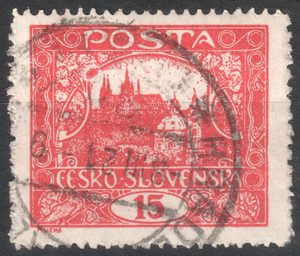 6
6V levé části siluety Hradčan.In the left part of the Hradčany skyline.
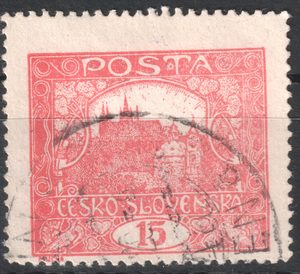 7
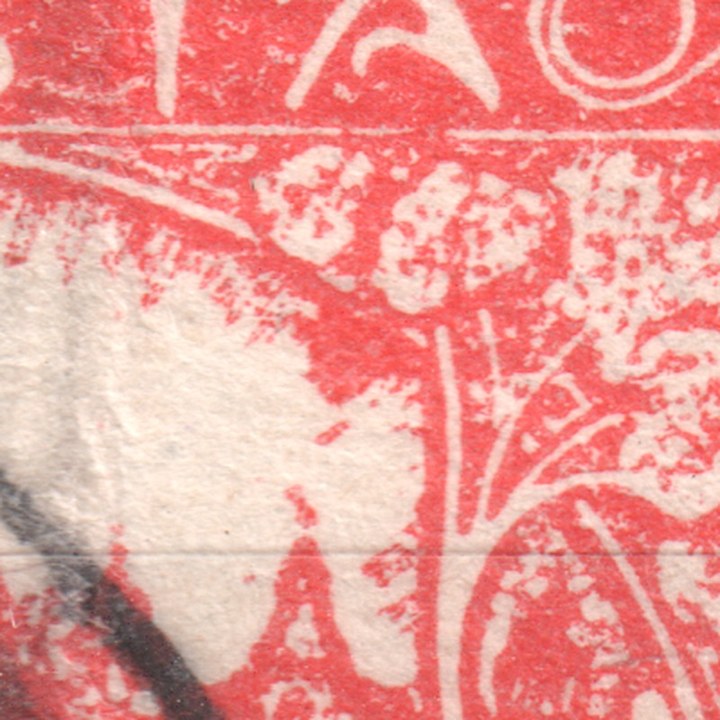
7Skutečný prstýnek v mezeře pod siluetou hradu — viz detail níže.A genuine ring below the castle skyline — see the detail below.
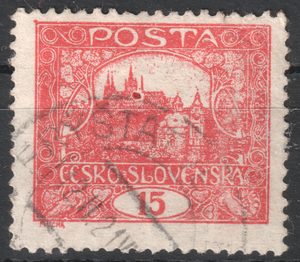 8
8Plná skvrna v mezeře mezi věžemi — viz detail níže.A solid spot in the gap between the towers — see the detail below.
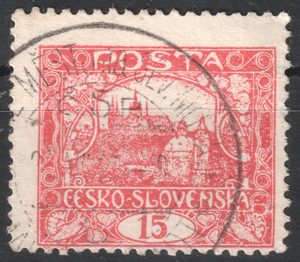 9
9V dolní ozdobě rámu vpravo od hodnotového oválu.In the lower ornament of the frame, right of the value oval.
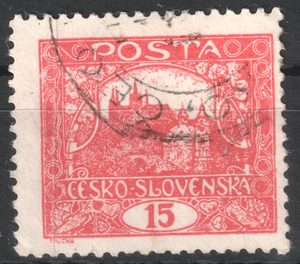 10
10V dolní ozdobě rámu vlevo od hodnotového oválu.In the lower ornament of the frame, left of the value oval.
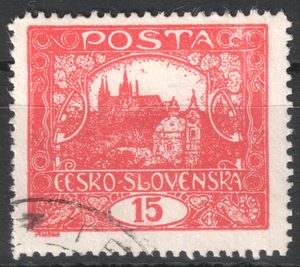 11
11V horní části kresby při pravém okraji, poblíž nápisu „POŠTA“.In the upper part of the design, right of the “POŠTA” inscription.
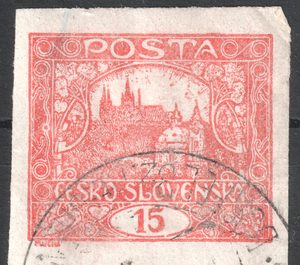 12
12V levé části siluety Hradčan.In the left part of the Hradčany skyline.
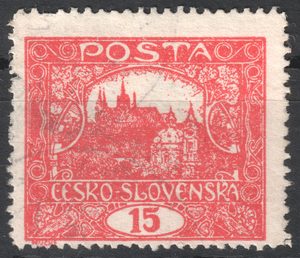 13
13V levé části siluety Hradčan.In the left part of the Hradčany skyline.
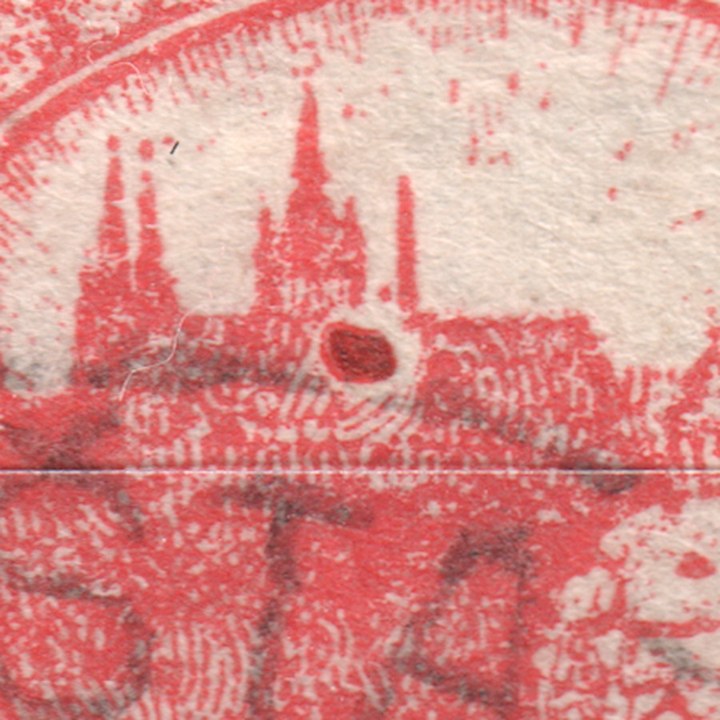
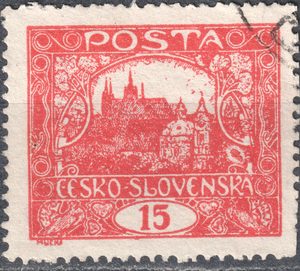 14
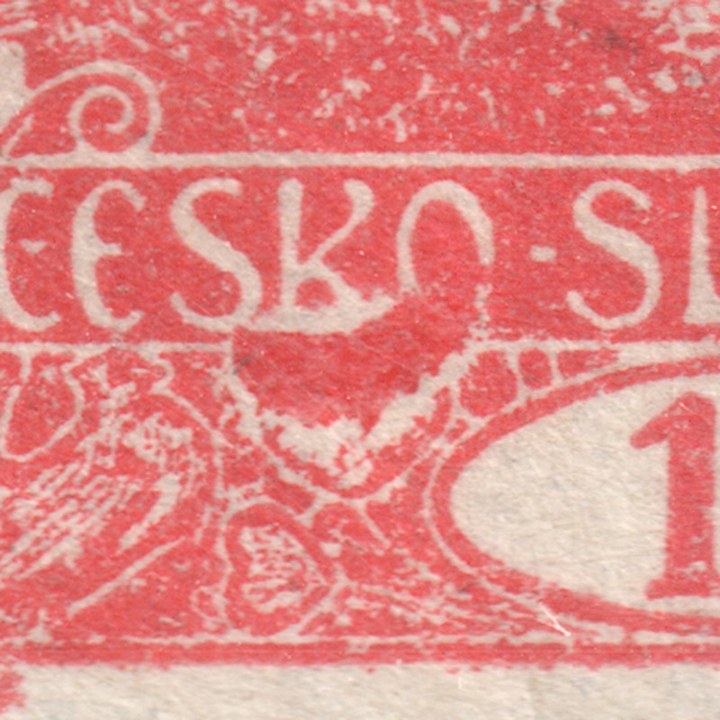
14Kroužek s tmavým jádrem a světlým dvorcem — při pravém okraji kresby, v porostu vpravo od kostelních věží, těsně nad lištou s nápisem.A ring with a dark core and a light halo — at the right edge of the design, in the foliage right of the church towers, just above the inscription band.
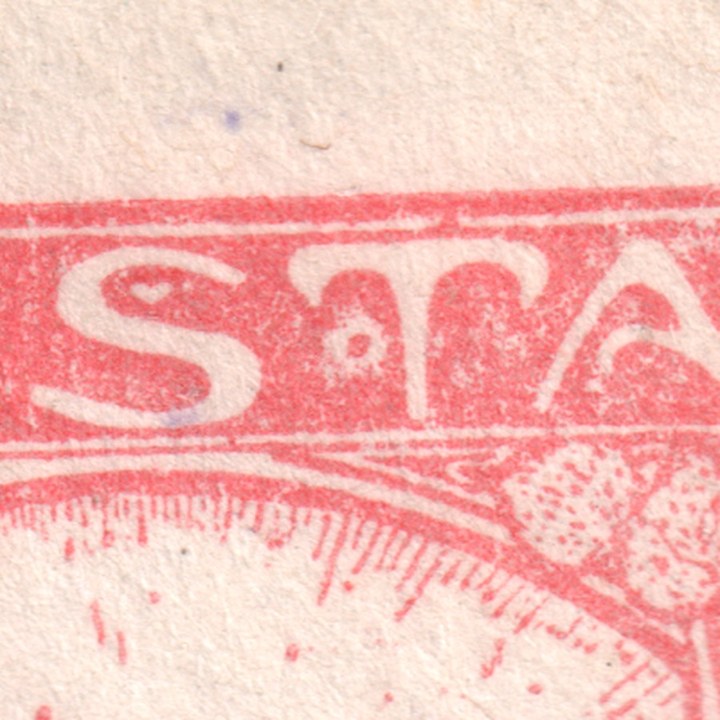
Závoje — přebytek barvySmears — excess ink
Místo ostrého okraje se tu barva rozlévá do měkké, neostré skvrny, která navazuje na tištěnou linku nebo obtéká hustý, vyvýšený prvek kresby — nejčastěji srdíčkovou ozdobu v rohu rámu. Skvrna nemá vlastní jasnou hranici, plynule slábne do bílé plochy.Instead of a sharp edge, the ink here spreads into a soft, blurred stain that runs on from a printed line or spills around a dense, raised element of the design — most often the small heart-shaped ornament in the corner of the frame. The stain has no clear boundary of its own; it fades gradually into the white.
Jak vada vzniklaHow the flaw arose
Mechanismus je stejný jako u světliny, jen na opačném konci škály — viz schéma na začátku této kapitoly. Přebytek barvy na vyvýšeném prvku formy nebo válce se při přítlaku roztéká do stran. Čím hustší a vyvýšenější je kresba v daném místě, tím víc barvy se tam drží a tím snáz se rozlije — proto se závoj objevuje skoro vždy u stejných typů míst: rohové ornamenty, silné linky rámu.The mechanism is the same as for a white spot, just at the opposite end of the scale — see the diagram at the start of this chapter. Excess ink on a raised element of the forme or roller spreads sideways under pressure. The denser and more raised the design is at a given spot, the more ink collects there and the more easily it spreads — which is why a smear turns up almost always at the same kinds of places: corner ornaments, heavy frame lines.
Proč to není bludný kroužekWhy this is not a wandering ring
Bludný kroužek vzniká jedním izolovaným smítkem a je proto malý, ostře ohraničený a leží samostatně v bílé ploše. Závoj naopak vzniká plošným přebytkem barvy na vyvýšené kresbě a vždy na ni navazuje nebo z ní vytéká — nikdy neleží izolovaně a nemá ostrý okraj.A wandering ring comes from one isolated speck, so it is small, sharply bounded and sits on its own in a white area. A smear, by contrast, comes from a blanket excess of ink on a raised part of the design and always runs on from it or spills out of it — it never sits in isolation and never has a sharp edge.
Jeden z doložených kusů nese na sběratelské kartě odkaz na pole 35/V. Pokud se stejný závoj na tomto poli opakuje i na dalších arších, nešlo by už o náhodnou výrobní vadu, ale o vadu vázanou na konkrétní pole desky — otázka zatím zůstává otevřená.One of the recorded copies carries a collector's card referencing field 35/V. If the same smear recurs on this field on further sheets, it would no longer be a random production flaw but one tied to a particular plate field — the question is still open.
Ukázky ze sbírkySpecimens from the collection
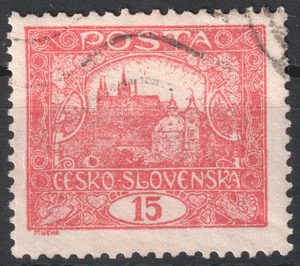
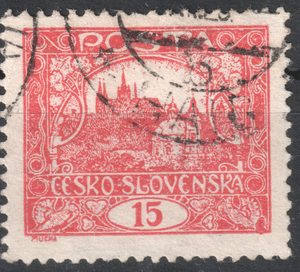 1
1V dolní ozdobě rámu vpravo od hodnotového oválu.In the lower ornament of the frame, right of the value oval.
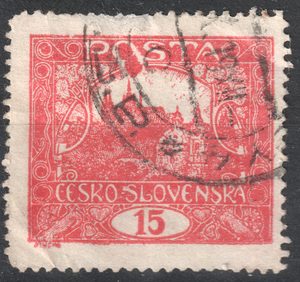
 2
2Pod siluetou hradu při levém okraji.Below the castle skyline, near the left edge.
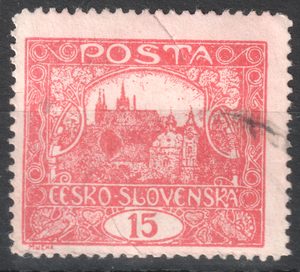
 3
3Uprostřed siluety Hradčan.In the middle of the Hradčany skyline.
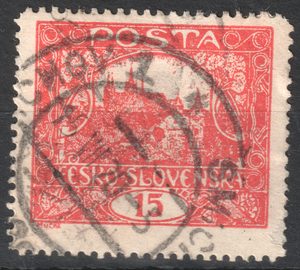
 4
4Uprostřed siluety Hradčan.In the middle of the Hradčany skyline.
 5
5Uprostřed siluety Hradčan.In the middle of the Hradčany skyline.
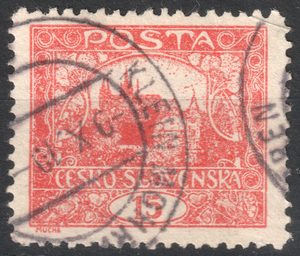 6
6Uprostřed siluety Hradčan.In the middle of the Hradčany skyline.
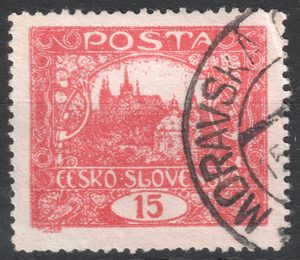 7
7U hodnotového oválu s číslicí 15.Near the value oval with the figure 15.
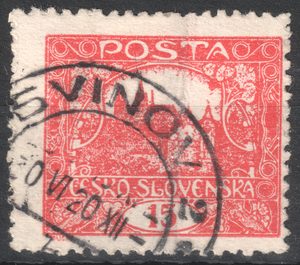 8
8V pravé části siluety Hradčan.In the right part of the Hradčany skyline.
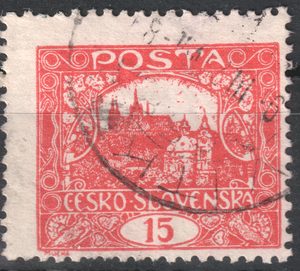 9
9Uprostřed siluety Hradčan.In the middle of the Hradčany skyline.
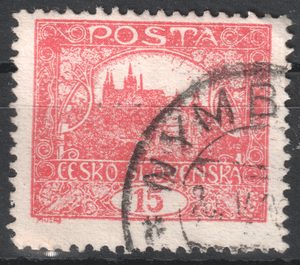 10
10V levé části siluety Hradčan.In the left part of the Hradčany skyline.
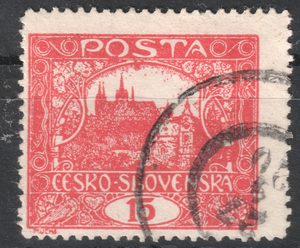 11
11Uprostřed siluety Hradčan.In the middle of the Hradčany skyline.
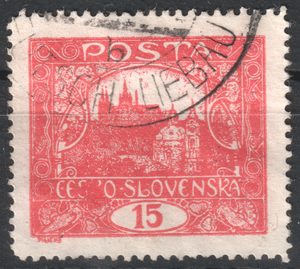 12
12V nápisu „ČESKO-SLOVENSKA“ vlevo.In the “ČESKO-SLOVENSKA” inscription, on the left.
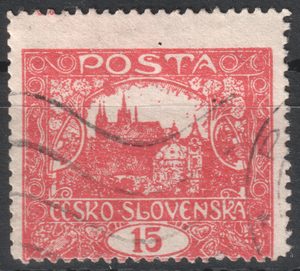 13
13Uprostřed siluety Hradčan.In the middle of the Hradčany skyline.
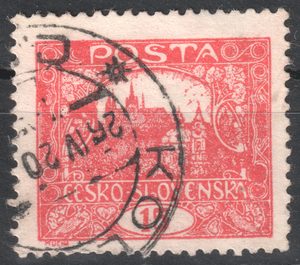 14
14V pravé části siluety Hradčan.In the right part of the Hradčany skyline.
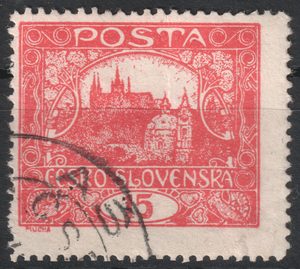 15
15U hodnotového oválu s číslicí 15.Near the value oval with the figure 15.
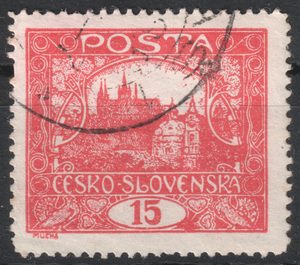 16
16U hodnotového oválu s číslicí 15.Near the value oval with the figure 15.
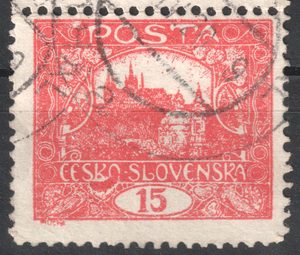 17
17V nápisu „ČESKO-SLOVENSKA“ vlevo.In the “ČESKO-SLOVENSKA” inscription, on the left.
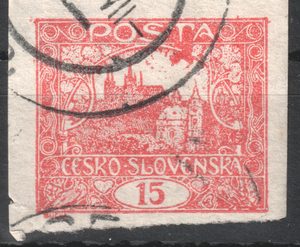 18
18Uprostřed siluety Hradčan.In the middle of the Hradčany skyline.
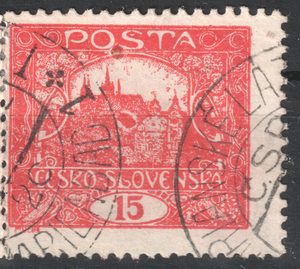 19
19Uprostřed siluety Hradčan.In the middle of the Hradčany skyline.
SvětlinyWhite spotsMístně zeslabený až chybějící tisk z poškozeného nebo zaneseného místa desky. Zpracováno na samostatné stránce —Locally weakened or missing print from a damaged or clogged place on the plate. Covered on its own page — světliny na TD Iwhite spots on plate I.
Slitý tiskFilled-in printPřebytek barvy uzavře jemné nepotištěné mezery kresby — zpracováno níže v této kapitole:An excess of ink closes the fine unprinted gaps of the design — covered below in this chapter: slitý tiskfilled-in print.
Slitý tiskFilled-in print
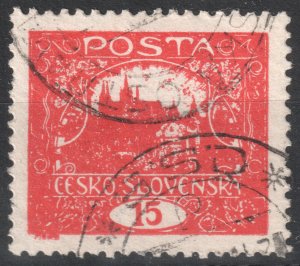
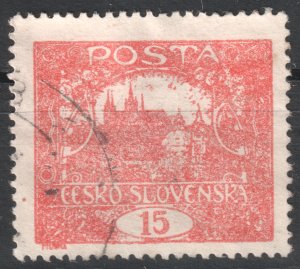
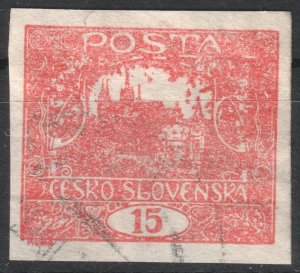
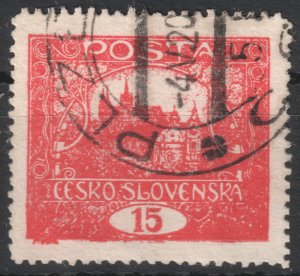
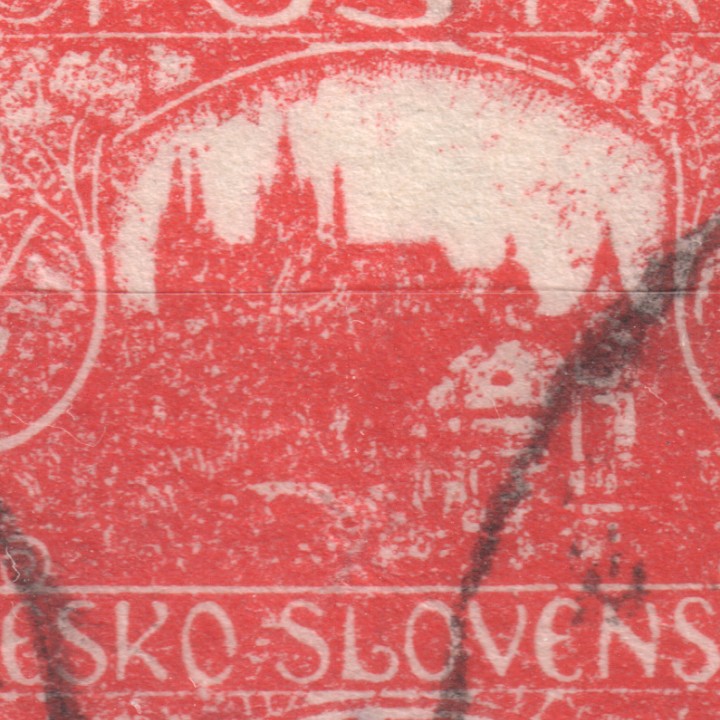
Tady je barvy naopak příliš. Otisk je sytý, ale kresba se v něm ztrácí: jemné vyzařující šrafování oblohy splývá v souvislou plochu, silueta Hradčan je jen tmavý obrys bez oken a věžiček, textura svahu pod hradem se mění v beztvarou masu, girlandy a spirály po stranách rámu se slévají do skvrn a písmena POSTA i ČESKO-SLOVENSKÁ jsou zesílená, s přivřenými vnitřními oky. Nechybí barva — chybí bílá místa mezi ní.Here there is too much ink, not too little. The impression is saturated, but the design drowns in it: the fine radiating hatching of the sky merges into a continuous field, the silhouette of Hradčany is a dark outline with no windows or turrets, the texture of the hillside below the castle turns into a shapeless mass, the garlands and spirals along the sides of the frame run together into blots, and the letters of POSTA and ČESKO-SLOVENSKÁ are thickened, their counters half closed. Nothing is missing but the white between the lines.
Jak vada vzniklaHow the flaw arose
Knihtisk tiskne z vyvýšených ploch desky; všechen detail kresby nese to, co mezi nimi zůstalo sníženo — úzké nepotištěné drážky, u nejjemnější rytiny široké jen zlomky milimetru. Když je na formě barvy víc, než unese, nebo když je tlak přítisku příliš velký a podložka příliš měkká, barva se z vyvýšených linek vytlačí do stran a část těchto drážek zaplní. Čím je drážka užší, tím dřív se uzavře — proto první mizí šrafování a vlasové linky, zatímco rám a číslice jen ztloustnou. Vada tedy nikde barvu neubírá, jen ji přidává tam, kam nepatří.Letterpress prints from the raised surfaces of the plate; all the detail of the design is carried by what was left recessed between them — narrow unprinted grooves, in the finest engraving only fractions of a millimetre wide. When the forme carries more ink than it can hold, or the impression pressure is too high and the packing too soft, the ink is squeezed sideways off the raised lines and fills part of those grooves. The narrower the groove, the sooner it closes — which is why hatching and hairlines go first, while the frame and the numerals merely thicken. The flaw therefore takes ink away nowhere; it only adds it where it does not belong.
Příčinou je nastavení stroje, ne deska. Postihuje celý otisk najednou a zpravidla celou sérii archů, dokud tiskař barvu nebo tlak neupraví; potom stejná deska tiskne zase normálně. Slitý tisk proto není katalogová varianta ani vlastnost známkového pole — je to stav tiskového nákladu.The cause is the setting of the press, not the plate. It affects the whole impression at once and usually a whole run of sheets, until the printer adjusts the ink or the pressure; after that the same plate prints normally again. Filled-in print is therefore neither a catalogue variety nor a property of a stamp field — it is a state of one print run.
Proč to není závojWhy this is not a smear (závoj)
Závoj je místní: přebytek barvy na jednom hustém, vyvýšeném prvku kresby — nejčastěji na srdíčkové ozdobě nebo na silné lince rámu — který se rozteče do okolní bílé plochy a má měkký, neostrý okraj. Zbytek známky přitom vypadá normálně. U slitého tisku není postiženo jedno místo, ale celá plocha otisku najednou, a barva nikam „nepřetéká“ — jen se uzavřou mezery uvnitř kresby.A smear is local: an excess of ink on one dense, raised element of the design — most often the little heart ornament or a heavy frame line — that spreads into the surrounding white and has a soft, blurred edge. The rest of the stamp looks normal. In filled-in print it is not one place that suffers but the whole impression at once, and the ink does not overflow anywhere — the gaps inside the design simply close.
Proč to není řídký tiskWhy this is not thin print
Řídký tisk je přesným opakem: barvy je málo a je příliš tekutá, otisk je bledý až narůžovělý a ztráty jsou tam, kde barva podle kresby ležet měla. Tady je barva plně sytá a přebývá — ztráty jsou v bílých místech, kde barva ležet neměla. Obě vady se přitom mohou potkat na jednom archu, protože obě vznikají u téhož místa výrobního procesu, jen na opačných koncích nastavení.Thin print is the exact opposite: too little ink, of too thin a consistency, the impression pale to pinkish, and the losses lie where the design calls for colour. Here the ink is fully saturated and in surplus — the losses are in the white areas, where there should have been no ink at all. The two can nevertheless meet on one sheet, since both arise at the same point of the process, merely at opposite ends of the setting.
Proč to není posunutý ani zdvojený tiskWhy this is not a slipped or doubled impression
Posunutý otisk má směr: linky jsou rozmazané do jedné strany a u zdvojeného tisku má každá linka svého slabšího dvojníka ve stejné vzdálenosti. Tady je zesílení symetrické — linka roste do všech stran stejně a druhý obrys nikde není.A slipped impression has a direction: the lines are smeared to one side, and in a doubled impression every line has a fainter twin at the same distance. Here the thickening is symmetrical — the line grows equally on every side and there is no second outline anywhere.
Ukázky ze sbírkySpecimens from the collection
 1
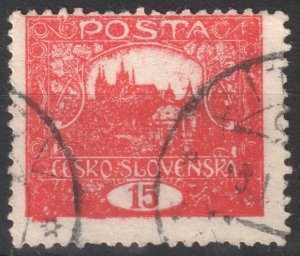
1Zoubkování B. Obloha i svah pod hradem jsou souvislá plocha, hrad jen obrys — nejsilnější kus série.Perforation B. The sky and the hillside below the castle are one continuous field, the castle a mere outline — the strongest piece of the group.
 2
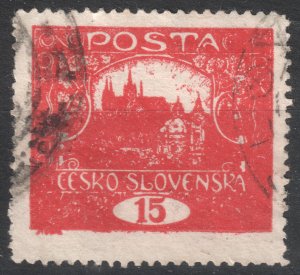
2Zoubkování C. Girlandy po stranách rámu se slily do skvrn, nápis ČESKO-SLOVENSKÁ má přivřená oka písmen.Perforation C. The garlands along the sides of the frame have run together into blots, the counters of the letters in ČESKO-SLOVENSKÁ are half closed.
 3
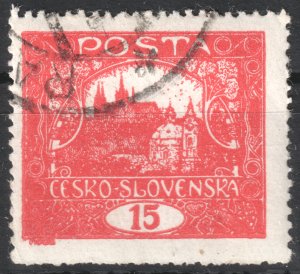
3Zoubkování A. Věže Hradčan splývají s oblohou, ozdoby v dolním pásu jsou beztvaré.Perforation A. The towers of Hradčany merge into the sky, the ornaments in the bottom band are shapeless.
 4
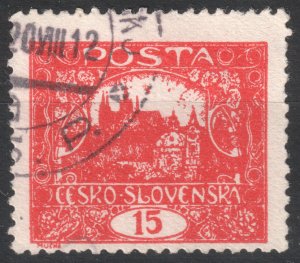
4Zoubkování B. Kus s výrazně ztloustlým rámem a nápisem; v obloze nezůstala žádná kresba.Perforation B. A copy with a markedly thickened frame and inscription; no drawing is left in the sky.
 5
5Zoubkování B. Spirály v okrajové ornamentice se stáhly do plných teček.Perforation B. The spirals in the border ornament have contracted into solid dots.
 6
6Zoubkování A. Otisk je světlejší, ale kresba je stejně zalitá — sytost barvy a slitost tisku spolu nesouvisí.Perforation A. The impression is lighter, yet the design is just as filled in — colour saturation and filling-in are independent of each other.
 7
7Nezoubkovaný kus. Rám je ztloustlý, kresba hradu i svahu splynula.An imperforate copy. The frame is thickened, the castle and the hillside have merged into one.
 8
8Zoubkování C. Ozdoby v horních rozích rámu jsou zalité do plných obrazců.Perforation C. The ornaments in the upper corners of the frame have filled in into solid shapes.
 9
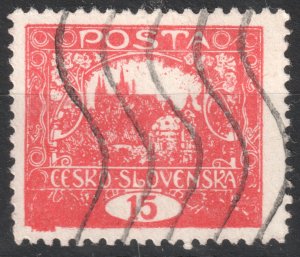
9Zoubkování B. Silueta Hradčan je bez detailu, ale číslice hodnoty zůstala čitelná — nejtlustší prvky odolávají nejdéle.Perforation B. The silhouette of Hradčany has no detail left, yet the value numeral is still legible — the heaviest elements hold out longest.
 10
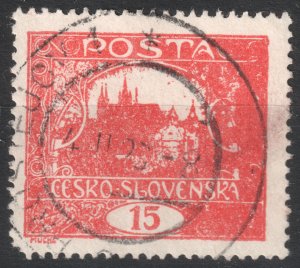
10Zoubkování A. Kus pod hustým razítkem; slitý tisk je přesto dobře patrný v dolním ozdobném pásu.Perforation A. A heavily cancelled copy; the filled-in print is nevertheless plain in the lower ornamental band.
 11
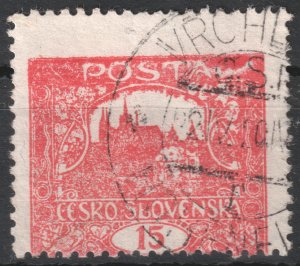
11Zoubkování B. Mírnější stupeň: v obloze je ještě znát náznak šrafování, ale jemná kresba svahu už zmizela.Perforation B. A milder degree: a hint of hatching can still be seen in the sky, but the fine drawing of the hillside is already gone.
 12
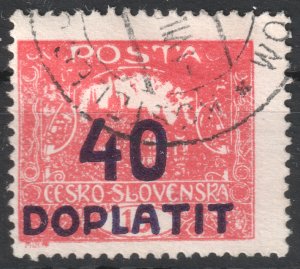
12Zoubkování B, přetisk 40 DOPLATIT. Doklad, že zalité archy se dostaly i do doplatní přetiskové emise.Perforation B, overprinted 40 DOPLATIT. Evidence that filled-in sheets also reached the postage-due overprint issue.
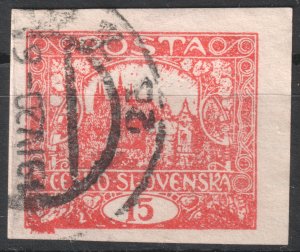 13
13Nezoubkovaný kus. Ze všech nejméně zalitý — dobře ukazuje, kde vada začíná: nejdřív v obloze a ve svahu, teprve pak v ornamentice.An imperforate copy. The least filled in of them all — a good illustration of where the flaw starts: first in the sky and the hillside, only then in the ornament.
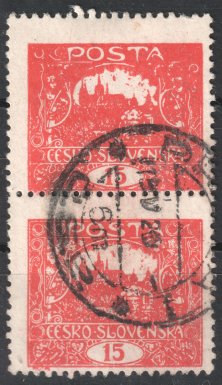 14
14Svislá dvoupáska, zoubkování B. Obě známky jsou zalité stejně — vada přišla s celým archem, ne s jedním polem.A vertical pair, perforation B. Both stamps are filled in to the same degree — the flaw came with the whole sheet, not with one field.
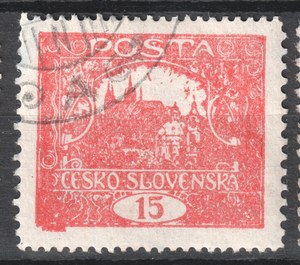 15
15Zoubkování F (13¾ : 11½), desky I–II. Silně zalitý otisk — levý ornamentální pruh je souvislá plocha, obloha a okna siluety zmizely.Perforation F (13¾ : 11½), plates I–II. A heavily filled-in impression — the left ornamental strip is a solid patch, the sky and the windows of the silhouette have vanished.
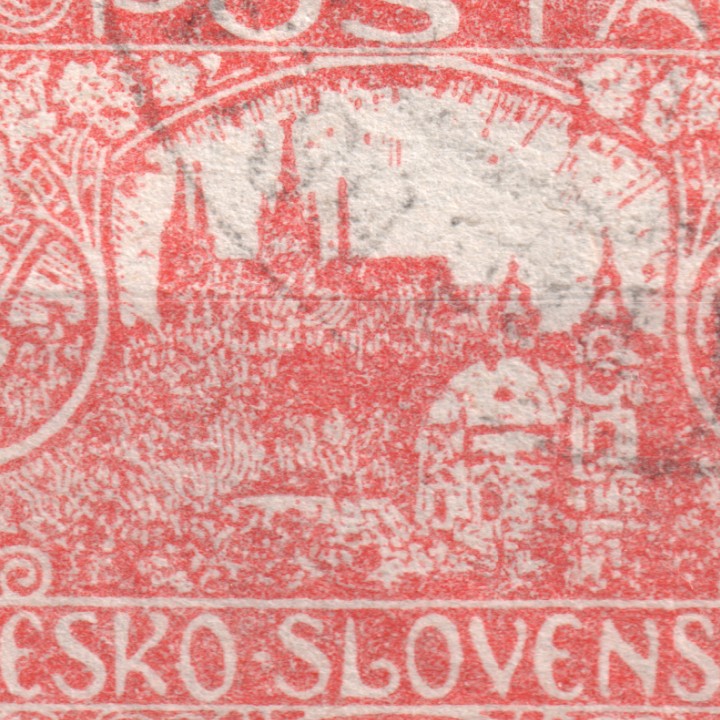
Zalité příčky — typ, který zmizel v barvěFilled-in crossbars — a type lost in the ink
Pátá kresba nese na některých známkových polích tzv. dlouhou příčku (typ IIp). Je to svislý nepotištěný tah hned vpravo od druhé spirály zdola v levé okrajové ornamentice: u typu Ip končí kus nad vodorovnou linkou nad nápisem ČESKO-SLOVENSKÁ, u typu IIp k ní doběhne až dolů. Rozdíl mezi oběma typy je tedy jen několik desetin milimetru bílého papíru — a je to jedna z nejužších bílých mezer na celé známce. Právě proto ji slitý tisk uzavře mezi prvními a kus z pole s dlouhou příčkou pak vypadá, jako by příčku neměl vůbec. Přitom jde o rozdíl, který u spirálových, příčkových a rámečkových typů zásadně mění cenu známky.On some stamp fields the fifth design carries a so-called long crossbar (type IIp). It is a vertical unprinted stroke immediately to the right of the second spiral from the bottom in the left border ornament: on type Ip it stops a little above the horizontal line over the inscription ČESKO-SLOVENSKÁ, on type IIp it runs all the way down to it. The whole difference between the two types is thus a few tenths of a millimetre of white paper — and it is one of the narrowest white gaps on the entire stamp. That is precisely why filled-in print closes it among the first, and a copy from a long-crossbar field then looks as though it had no crossbar at all. Yet on the spiral, crossbar and frame types this difference changes the value of a stamp fundamentally.
Šest kusů v galerii níže je přesně takový případ. Pět z nich pochází z polí 78/II a 5/I — obě jsou v katalogu vedena mezi poli s dlouhou příčkou (viz Typy páté kresbyFifth-design types). Příčka je v desce vyryta, na otisku z tohoto pole tedy chybět nemůže; co chybí, není příčka, ale bílý papír kolem ní. Šestý kus, z pole 83/I, je srovnávací: pole s krátkou příčkou (typ Ip) v normálně sytém tisku, kde ornament zůstal čitelný.The six copies in the gallery below are exactly such a case. Five of them come from fields 78/II and 5/I — both listed in the catalogue among the long-crossbar fields (see Typy páté kresbyFifth-design types). The crossbar is engraved in the plate, so it cannot be absent from an impression of that field; what is missing is not the crossbar but the white paper around it. The sixth copy, from field 83/I, is there for comparison: a short-crossbar field (type Ip) in a normally saturated print, where the ornament stayed legible.
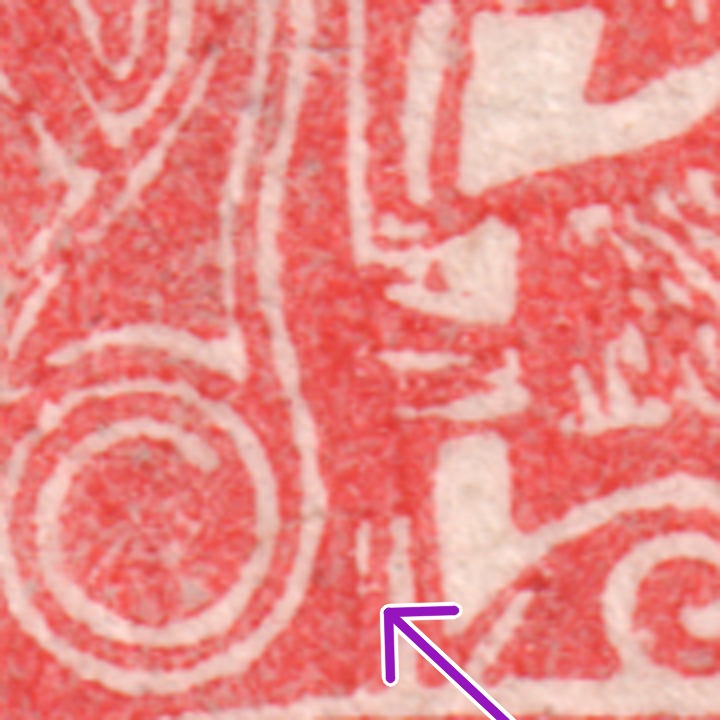
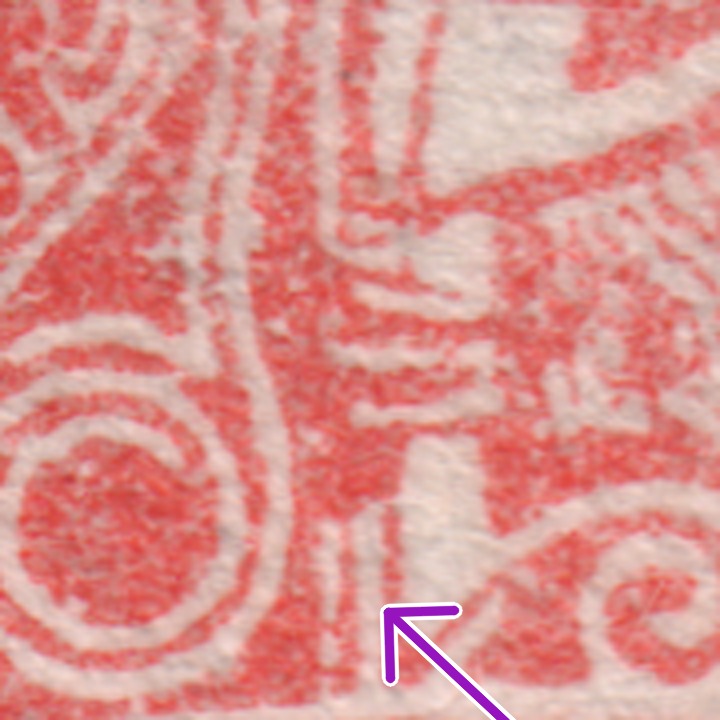
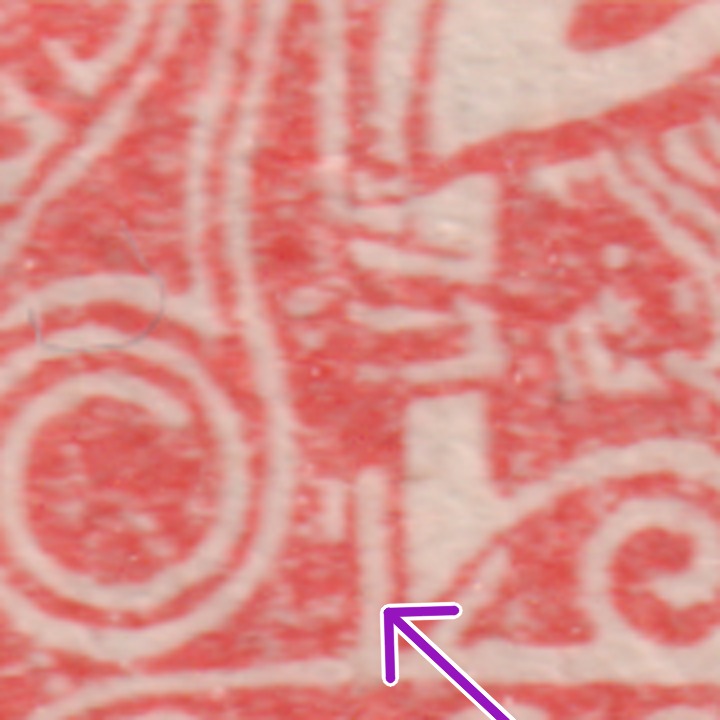
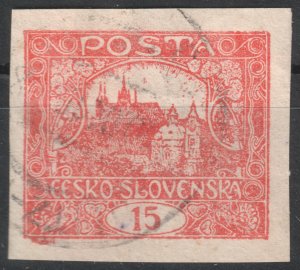 1
1ZP 5/I, nezoubkovaný. Pole s dlouhou příčkou (IIp), na tomto kusu po ní není v ornamentu stopa — proto byl uložen jako „bez příčky“. Nejsilněji zalitý kus z této sady.Field 5/I, imperforate. A long-crossbar field (IIp); on this copy there is no trace of the crossbar left in the ornament — hence it was filed as “without crossbar”. The most heavily filled-in copy of this group.
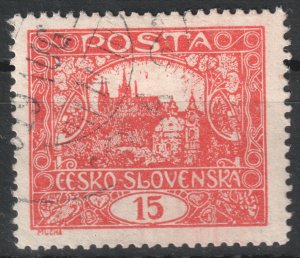 2
2ZP 78/II, zoubkování A. Rovněž pole s dlouhou příčkou; dvojjazyčné razítko nechalo čitelný jen měsíc srpen. Ornament vedle druhé spirály zdola je slitý do jedné plochy.Field 78/II, perforation A. Also a long-crossbar field; of the bilingual datestamp only the month August is legible. The ornament beside the second spiral from the bottom has run together into a single mass.
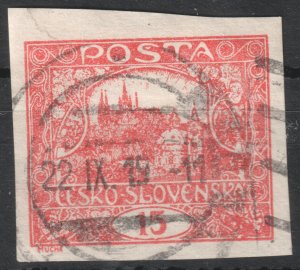 3
3ZP 78/II, nezoubkovaný, razítko 22. IX. 1919. Druhý kus téhož pole se stejným výsledkem — čtyři kusy 78/II v této sadě mluví pro jeden arch.Field 78/II, imperforate, cancelled 22 IX 1919. A second copy of the same field with the same result — the four copies of 78/II in this group point to a single sheet.
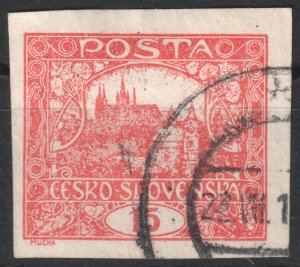 4
4ZP 78/II, nezoubkovaný, razítko 22. VII. (rok useknutý). Mírnější stupeň zalití: ornament je ještě členěný, příčka už ale čitelná není — detail ornamentu výše je z tohoto kusu.Field 78/II, imperforate, cancelled 22 VII (year cut off). A milder degree of filling-in: the ornament is still articulated, but the crossbar can no longer be read — the detail of the ornament above is taken from this copy.
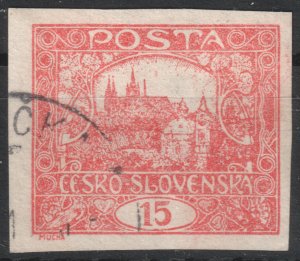 5
5ZP 78/II, nezoubkovaný. Čtvrtý kus tohoto pole; z razítka zbyl jen zlomek oblouku.Field 78/II, imperforate. The fourth copy of this field; only a fragment of the cancel arc survives.
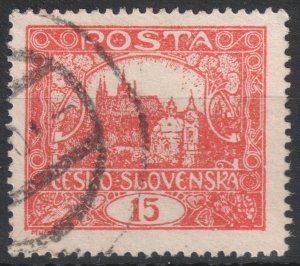 6
6ZP 83/I, zoubkování A, strojové vlnovkové razítko. Srovnávací kus v normálním tisku — pole s krátkou příčkou (Ip), kde je ornament čitelný a typ se dá bezpečně určit.Field 83/I, perforation A, machine wavy-line cancel. A comparison copy in a normal print — a short-crossbar field (Ip), where the ornament is legible and the type can be determined with confidence.
Praktické pravidlo: typ neurčujeme ze zalitého kusu. Slitý tisk umí příčku jen zkrátit nebo zcela skrýt, nikdy ji neprodlouží — zalitý kus se tedy může tvářit jako typ s krátkou příčkou (Ip) nebo jako kus bez příčky, ale dlouhou příčku nikdy nepředstírá. Chybějící příčka na poli, které ji podle rekonstrukce desky má, je proto vada tisku, ne varianta.Totéž platí o krok dál: na silně zalitém kusu často nelze s jistotou určit ani samotné známkové pole — konstantní deskové vady, podle kterých se pole rekonstruují, jsou zalité stejně jako zbytek kresby.A practical rule: never determine the type from a filled-in copy. Filled-in print can only shorten the crossbar or hide it altogether, never lengthen it — so a flooded copy may pass as a short-crossbar type (Ip) or as a copy with no crossbar, but it never fakes a long one. A missing crossbar on a field that carries one according to the plate reconstruction is therefore a printing flaw, not a variety.The same applies one step further: on a heavily filled-in copy even the stamp field itself often cannot be determined with certainty — the constant plate flaws by which fields are reconstructed are filled in along with the rest of the design.
Bílé skvrnyBlank spots
Na místě, kde měl být normální sytý tisk, chybí barva úplně — bílá skvrna má ostrou hranici a nenavazuje na žádnou tištěnou linku ani vyvýšený prvek kresby, jak je tomu u závoje. Poloha, velikost i tvar se u jednotlivých kusů liší a neváže se na jedno známkové pole.Where the print should be solidly inked, the colour is missing altogether — a blank spot has a sharp boundary and does not run on from any printed line or raised design element, the way a smear (závoj) does. Its position, size and shape differ from copy to copy and are not tied to one stamp field.
Jak vada vzniklaHow the flaw arose
Mezi obarvení formy a přítisk papíru se na už natřenou barvu položil cizí objekt — smítko prachu, vlákno, drobný odštěpek nebo třeba vlásek. Objekt je nenasákavý a sedí nad barvou o zlomek milimetru výš, takže se v tom místě papír s barvou vůbec nedotkne. Zbytek tisku zůstává beze změny; jakmile se objekt při dalším tisku posunul nebo setřel, mizí spolu s ním i vada — proto se skvrna neopakuje na stejném místě a u dalších kusů se objeví jinde, nebo vůbec.Between the inking of the forme and the impression of the paper, a foreign object settled on top of the already-applied ink — a speck of dust, a fibre, a small chip, or perhaps a hair. Being non-absorbent, the object sits a fraction of a millimetre above the ink, so at that one point the paper never actually touches it. The rest of the impression is unaffected; once the object shifted or was brushed away before the next impression, the flaw disappears with it — which is why the spot never repeats at the same place and turns up differently, or not at all, on other copies.
Proč to není světlinaWhy this is not a white spot (světlina)
Světlina vzniká trvalým poškozením nebo zanesením konkrétního místa desky a vrací se proto na stejném známkovém poli při každém tisku — hranice je navíc měkká, protože ubývání barvy se vyvíjí postupně. Bílá skvrna je naopak jednorázová: způsobil ji volný předmět, který mezi tisky zmizel, hranice je proto ostrá a poloha se u jednotlivých kusů mění.A světlina arises from permanent damage or clogging at one specific point of the plate, so it recurs at the same stamp field on every impression — and its edge is soft, because the loss of ink develops gradually. A blank spot, by contrast, is a one-off: it was caused by a loose object that was gone by the next impression, so its edge is sharp and its position changes from copy to copy.
Proč to není zvrásněníWhy this is not creasing
Zvrásnění vzniká přeložením vlhkého papíru ještě před tiskem: v ohybu chybí barva, ale hlavně se kresba na obou stranách přeložení navzájem posune a nenavazuje na sebe, protože se papír po rozložení „roztáhl". U bílé skvrny je papír zcela v pořádku — žádná rýha, žádné posunutí kresby, chybí jen barva na jednom ohraničeném místě.Creasing arises from a fold in the damp paper before printing: ink is missing in the fold, but above all the design is displaced on the two sides of the fold and fails to line up, because the paper "stretched" once it was unfolded. With a blank spot the paper is entirely sound — no crease, no displacement of the design; only the ink is missing at one bounded spot.
Proč to není dřívko nebo smítkoWhy this is not a splinter or a speck
Dřívko i smítko jsou cizí objekty zalisované přímo v papíru už při jeho výrobě, a proto jsou vidět z obou stran známky — na líci narušují tisk, na rubu je znát jejich obrys. Objekt, který způsobil bílou skvrnu, ležel jen na tiskové formě: rub je proto úplně čistý, bez jakékoli stopy.A splinter or a speck is a foreign object pressed directly into the paper while it was being made, so it shows on both sides of the stamp — on the face it disturbs the print, on the back its outline is visible. The object that caused a blank spot lay only on the printing forme: the back is therefore completely clean, without any trace at all.
Ukázky ze sbírkySpecimens from the collection
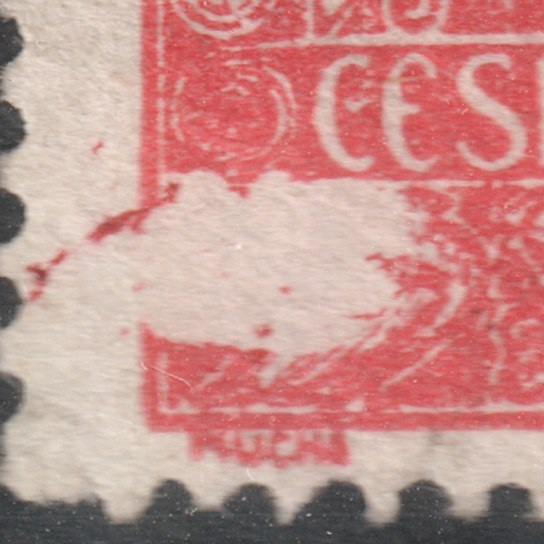
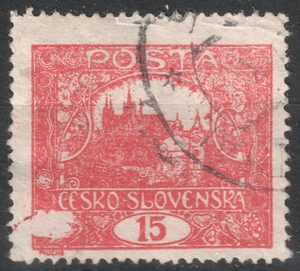 1
1Velká skvrna v levém dolním rohu, pod nápisem ČESKO-SLOVENSKA — nejvýraznější doložený kus.A large spot in the bottom left corner, below the ČESKO-SLOVENSKA inscription — the most pronounced copy recorded.
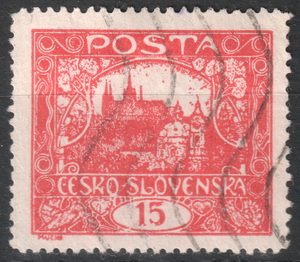 2
2Velmi jemná, sotva znatelná skvrna v nápisu ČESKO-SLOVENSKA a v ozdobě vlevo od hodnotového oválu — nejslabší doložený případ.A very faint, barely visible spot in the ČESKO-SLOVENSKA inscription and in the ornament to the left of the value oval — the faintest copy recorded.
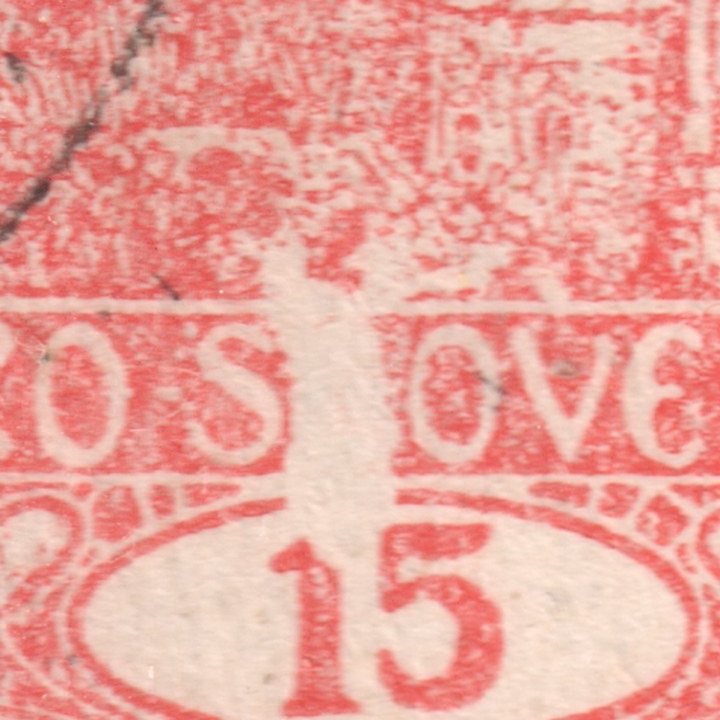
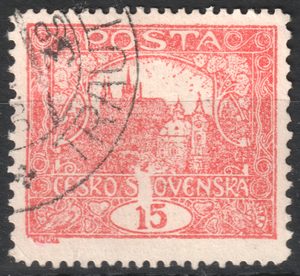 3
3Ostře ohraničená skvrna přes patu hradu a písmeno L v nápisu ČESKO-SLOVENSKA — písmeno úplně mizí.A sharply bounded spot across the base of the castle and the letter L of the ČESKO-SLOVENSKA inscription — the letter disappears completely.
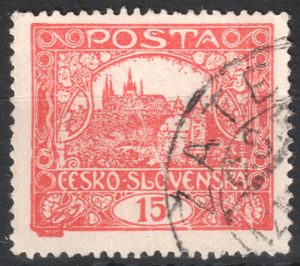 4
4Šikmá skvrna přes věže, nápis i hodnotový ovál, z části skrytá pod razítkem.A diagonal spot across the towers, the inscription and the value oval, partly hidden under the cancel.
 5
5Drobný bílý kroužek v levém ornamentálním pásu — na špičce listu se linka uzavírá do nepatrné smyčky, kterou kresba nemá.A tiny white ring in the left ornamental band — at the tip of the leaf the line closes into a minute loop that is not part of the design.


Řídký tisk se skvrnamiThin print with ink spots
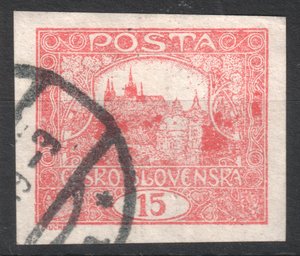
Na těchto známkách je otisk po celé kresbě neobvykle slabý a řídký — jemné rytiny, girlandy po stranách rámu, vyzařující šrafování oblohy i textura svahu pod hradem jsou skoro vytracené, barva je spíš narůžovělá než sytě červená. V týchž místech, kde má podle kresby ležet barva — nejnápadněji v jemném vyzařujícím šrafování oblohy nad hradem — se místy barva srazila do drobných sytě červených teček a skvrnek. Skvrny neleží v čistě bílých plochách kresby, ale přesně tam, kde má být tisk, jen v jiném množství.On these stamps the print is unusually weak across the whole design — the fine engraving, the garlands along the sides of the frame, the radiating hatching of the sky and the texture of the hillside below the castle are almost gone, the colour more pale pink than solid red. In the very same places where the design calls for colour — most noticeably in the fine radiating hatching of the sky above the castle — the ink has in places collected into small, solidly red dots and spots instead. The spots do not sit in the plain white areas of the design; they sit exactly where the print should be, only in a different amount.
Jak vada vzniklaHow the flaw arose
Příčinou není množství barvy na formě, ale její konzistence. Příliš řídká barva se po jemných liniích šrafování nerozprostře rovnoměrně — většinou jí na papír přejde jen tenká vrstva, ale v místech, kde se řídká barva srazí nebo nahromadí, ulpí jí najednou víc a otiskne se jako tmavší tečka nebo skvrnka. Světlý, řídký tisk a tmavší skvrny jsou tak dva projevy téže příčiny, ne dvě nezávislé vady — proto se na doložených kusech objevují společně.The cause is not the amount of ink on the forme, but its consistency. Ink that is too thin does not spread evenly along fine engraved lines — mostly only a thin film reaches the paper, but wherever the thin ink collects or pools, more of it lands at once and prints as a darker dot or spot. The weak, thin print and the darker spots are therefore two symptoms of the same cause, not two independent flaws — which is why they turn up together on every copy recorded so far.
Proč to není bílá skvrnaWhy this is not a blank spot
Bílá skvrna vzniká, když cizí objekt na formě zabrání barvě dostat se na papír v jinak normálně sytém tisku — jde o ostře ohraničenou ztrátu barvy v jedné izolované ploše. Tady je to obráceně: barva navíc se objevuje uprostřed celkově podprůměrně naneseného tisku, a to přímo na místech kresby, ne mimo ni.A blank spot arises when a foreign object on the forme keeps ink from reaching the paper within an otherwise normally saturated print — a sharply bounded loss of colour in one isolated area. Here it is the reverse: extra colour appears in the middle of an overall under-inked print, and it appears right on the design's own lines, not away from them.
Proč to není bludný kroužekWhy this is not a wandering ring
Bludný kroužek je jedno izolované smítko na inkovacím válci nebo formě, které se otiskne jako drobná skvrna nebo prstýnek v jinak čistě bílé ploše kresby, a to jen na jednom konkrétním archu. Tady se skvrny objevují napříč celou řadou — na jedenácti různých kusech — vždy společně s celkově slabým tiskem, a leží na jemných liniích kresby, ne izolovaně v bílé ploše.A wandering ring comes from one isolated speck on the inking roller or the forme, printing as a small spot or ring in an otherwise plain white area of the design, on just one particular sheet. Here the spots turn up across a whole series — on eleven different copies — always together with an overall weak print, and they sit on the design's own fine lines rather than in isolation in a white area.
Proč to není závojWhy this is not a smear (závoj)
Závoj vzniká přebytkem barvy na hustém, vyvýšeném prvku kresby (nejčastěji srdíčkové ozdobě nebo silné linii rámu) a má měkký, neostrý okraj, který plynule přechází do bílé. Skvrny u řídkého tisku jsou naproti tomu drobné a poměrně ostře ohraničené, neváží se na žádný konkrétní vyvýšený prvek a vznikají z nedostatku, ne z přebytku barvy na formě.A smear comes from an excess of ink on a dense, raised element of the design (most often the little heart ornament or a heavy frame line) and has a soft, blurred edge that fades gradually into white. The spots seen with thin print are, by contrast, small and fairly sharply bounded, are not tied to any particular raised element, and arise from a shortage of ink on the forme, not an excess.
Proč to není světlinaWhy this is not a white spot (světlina)
Světlina je místní, trvalé oslabení tisku vázané na jedno konkrétní pole desky — vrací se na stejném místě znovu a znovu, zatímco zbytek kresby zůstává normálně sytý. Tady je slabý celý otisk, na celé ploše známky, a doložené kusy zjevně pocházejí z různých archů či polí — jde tedy spíš o vlastnost tiskového nákladu nebo jedné dávky barvy, ne jednoho poškozeného místa desky.A světlina is a local, permanent weakening of the print tied to one particular field of the plate — it recurs at the same spot time after time, while the rest of the design stays normally saturated. Here the whole impression is weak, over the entire stamp, and the recorded copies evidently come from different sheets or fields — so this looks more like a property of a printing run or a batch of ink than of one damaged spot on the plate.
U prvních sedmi kusů není známo pole desky ani datum tisku. Čtyři nezoubkované kusy 8–11 se však podařilo zařadit: pole 26, 27, 28 a 97 desky II. Tři z nich leží v jedné řadě desky hned vedle sebe, čtvrtý na opačném konci téže desky — to mluví spíš pro vlastnost jednoho nákladu či jedné dávky barvy než pro vlastnost určitého místa desky. Zda se skvrny drží stejného místa u kusů ze stejného pole, zatím ověřit nelze — otázka zůstává otevřená.For the first seven copies neither the plate field nor the print date is known. The four imperforate copies 8–11, however, could be placed: fields 26, 27, 28 and 97 of plate II. Three of them sit side by side in one row of the plate, the fourth at the opposite end of the same plate — which points to a property of one print run or one batch of ink rather than of a particular spot on the plate. Whether the spots keep to the same place on copies from the same field cannot yet be checked — the question remains open.
Ukázky ze sbírkySpecimens from the collection
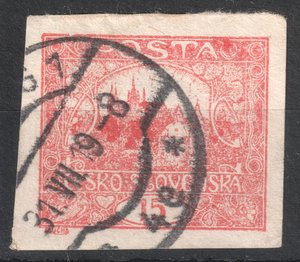 1
1Silně orazítkovaný kus; i ve volných místech mezi otisky razítka je znát bledý, řídký tisk.A heavily cancelled copy; even in the gaps between the cancel strikes the pale, thin print is evident.
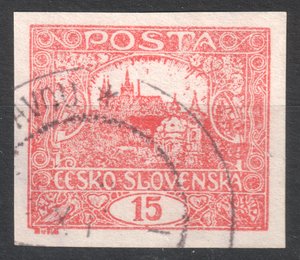 2
2Girlanda v levém rohu rámu je téměř vytracená a v obloze vpravo od věží je roztroušeno několik drobných skvrn — detail vytracené girlandy níže je z tohoto kusu.The garland in the left corner of the frame is almost gone, and a few small spots are scattered in the sky to the right of the towers — the detail of the faded garland below is taken from this copy.
 3
3Nejhustší doložený roj skvrn — v obloze vpravo od věží, u květinové ozdoby. Detail skvrn níže je z tohoto kusu.The densest cluster of spots recorded — in the sky to the right of the towers, near the floral ornament. The detail of the spots below is taken from this copy.
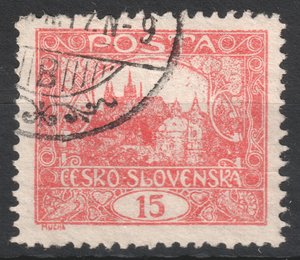 4
4Kus s hustým razítkem; v obloze nad hradem přesto prosvítá několik drobných skvrn.A heavily cancelled copy; a few small spots still show through in the sky above the castle.
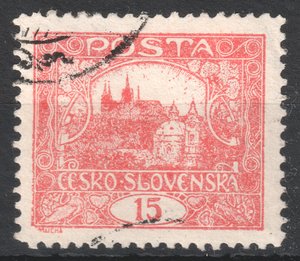 5
5Kromě drobných teček v obloze nese i výraznou souvislou skvrnu vpravo nahoře, pod nápisem POSTA — nejsilnější doložený případ.Besides fine dots in the sky it also carries a large solid spot in the upper right, below the POSTA inscription — the strongest case recorded.
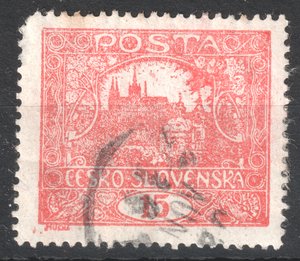 6
6Další zřetelný shluk drobných skvrn v obloze vpravo od věží, u květinové ozdoby.Another clear cluster of fine spots in the sky to the right of the towers, near the floral ornament.
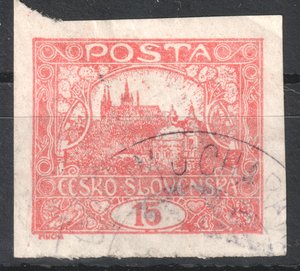 7
7Kus bez razítka přes horní část kresby — dobře patrný celkový dojem řídkého tisku i drobné skvrny v obloze.A copy with no cancel over the upper part of the design — clearly showing the overall thin print and the fine spots in the sky.
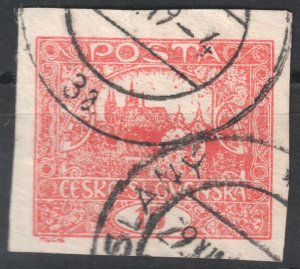 8
8ZP 28/II, nezoubkovaný. Kus pod několika otisky razítka Slaný; i mezi nimi je tisk bledý po celé ploše, šrafování oblohy skoro vytracené.Field 28/II, imperforate. A copy under several strikes of the Slaný cancel; even between them the print is pale over the whole surface, the sky hatching almost gone.
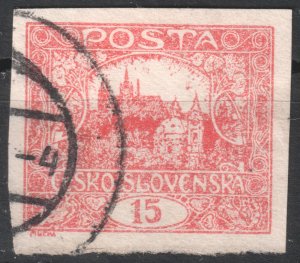 9
9ZP 26/II, nezoubkovaný. Jediný otisk razítka vlevo; bledý, řídký tisk v celé kresbě, girlandy po stranách rámu jen naznačené.Field 26/II, imperforate. A single cancel strike at the left; pale, thin print over the whole design, the garlands along the sides of the frame only hinted at.
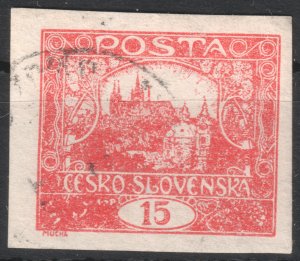 10
10ZP 97/II, nezoubkovaný. Téměř čistý kus — nejlépe ukazuje celkový dojem řídkého tisku: narůžovělá barva, vytracené šrafování oblohy i svahu pod hradem.Field 97/II, imperforate. An almost clean copy — it shows the overall look of thin print best: pinkish colour, the hatching of the sky and of the hillside below the castle faded away.
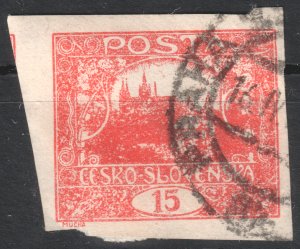 11
11ZP 27/II, nezoubkovaný. Razítko Praha vpravo; bledý tisk, jemná kresba svahu pod hradem téměř zmizela.Field 27/II, imperforate. Praha cancel at the right; pale print, the fine drawing of the hillside below the castle almost gone.
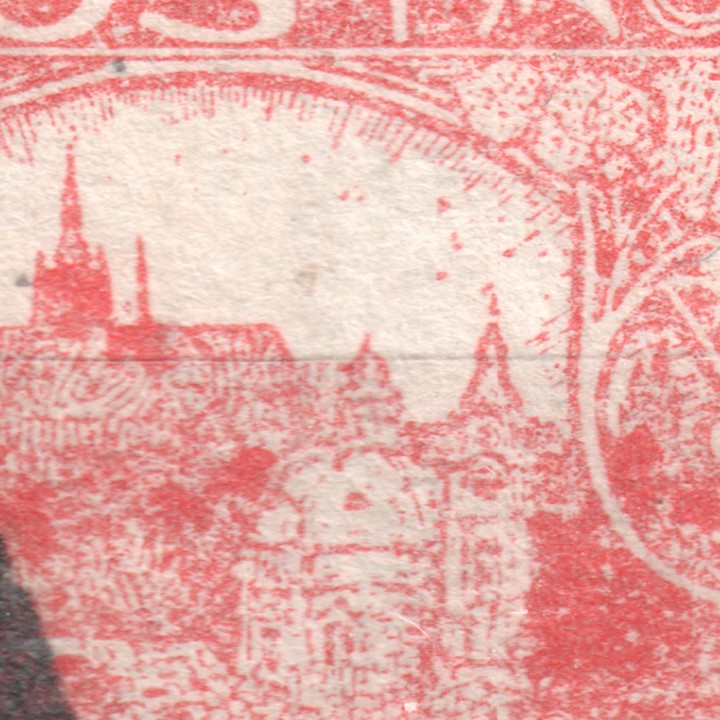
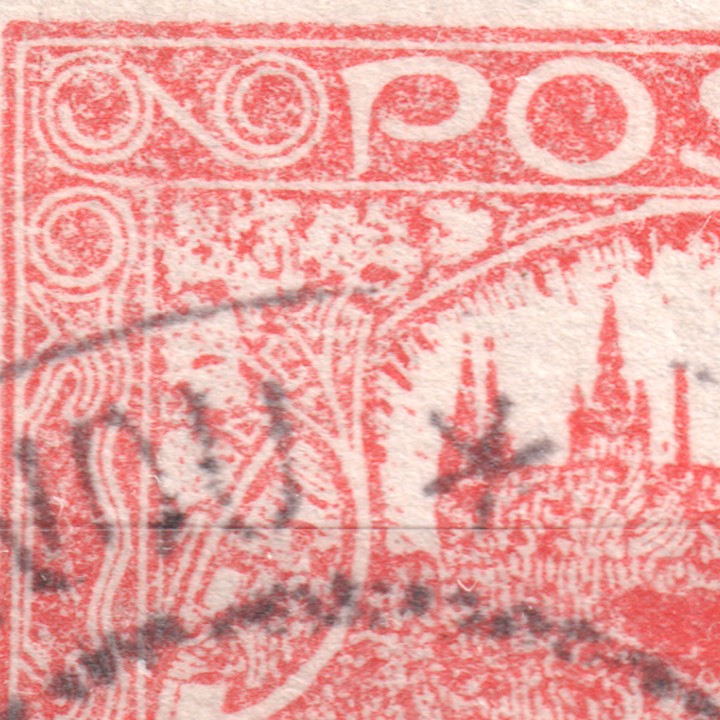
Tisk a obtisk na lepuPrint and set-off on the gum
Na rubu známky, tedy na lepu, je celá kresba. Vypadá to jako jedna vada, ale jsou to dvě různé — a rozezná je jediný pohled na nápis.The back of the stamp, the gummed side, carries the whole design. It looks like a single flaw, but it is two different ones — and a single glance at the inscription tells them apart.
Jak vada vzniklaHow the flaw arose
Tisk na lepu znamená, že arch šel do stroje obrácenou stranou a forma se otiskla přímo na lep. Že je to vůbec možné, samo o sobě dokládá, že se papír gumoval ještě před tiskem. Obtisk vzniká jinak: čerstvě potištěné archy se naskládaly na sebe dřív, než barva zaschla, a mokrá kresba se přenesla na lep archu, který ležel na ní.A print on the gum means the sheet went into the press the wrong way up and the forme printed straight onto the gum. That this is possible at all is in itself evidence that the paper was gummed before printing. A set-off arises differently: freshly printed sheets were stacked before the ink had dried, and the wet design transferred onto the gum of the sheet lying on top of it.
Zkouška zrcadlemThe mirror test
Tisk na lepu je přímý otisk formy, a proto se čte správně, zleva doprava, stejně jako na líci. Obtisk je přenos z jiného archu, tedy otisk otisku, a proto je zrcadlově obrácený. Pomáhá i sytost: přímý tisk má plnou barvu a drží i nejjemnější rytinu, kdežto obtisk je bledší a měkčí, protože se přenášel jen zbytek nezaschlé barvy.A print on the gum is a direct impression of the forme, and so it reads the right way round, left to right, just as on the face. A set-off is a transfer from another sheet — an impression of an impression — and is therefore mirrored. Saturation helps too: a direct print has full colour and holds even the finest engraving, whereas a set-off is paler and softer, because only the ink that had not yet dried was transferred.
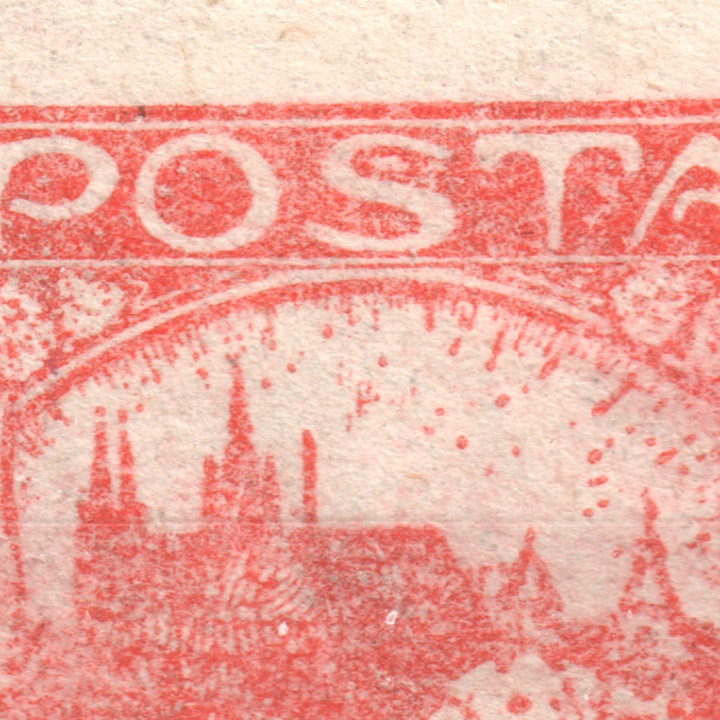
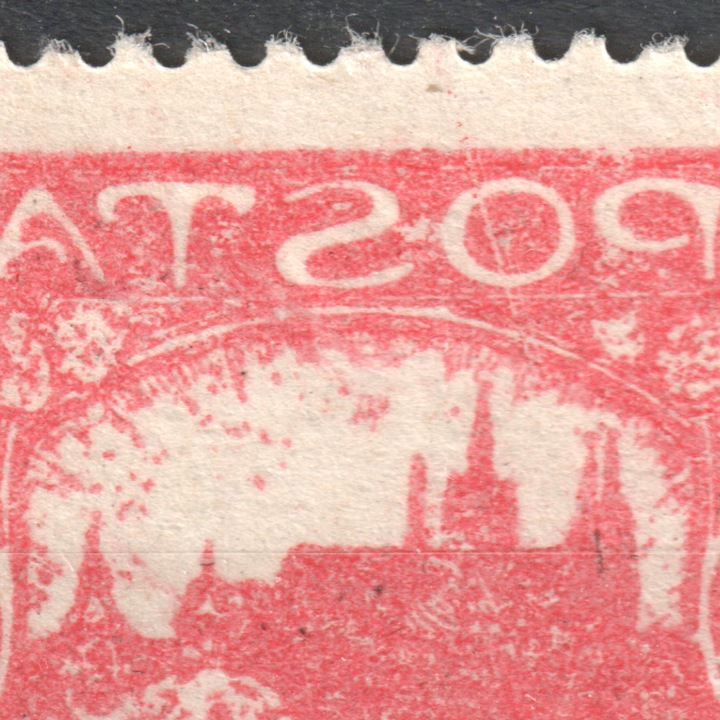
Proč to není prosvítající tisk z líceWhy this is not the face print showing through
Na tenkém papíru je z rubu vidět i řádný tisk z líce. Prosvítající kresba je ale bledá a rozplizlá, leží přesně proti kresbě na líci a mizí, díváme-li se na známku proti světlu z druhé strany. Tisk i obtisk na lepu leží na povrchu, mají vlastní ostrost a s lícem se nekryjí.On thin paper even a proper face print shows through from the back. But a show-through image is pale and diffuse, lies exactly opposite the design on the face, and disappears when the stamp is viewed against the light from the other side. A print or a set-off on the gum lies on the surface, has a sharpness of its own and does not register with the face.
Ukázky ze sbírkySpecimens from the collection
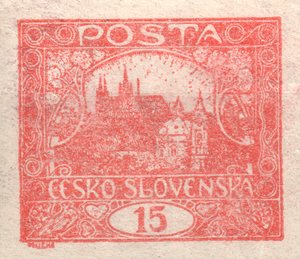 1
1Tisk na lepu. Kresba je na lepové straně a čte se správně — arch šel do stroje obrácenou stranou.Print on the gum. The design is on the gummed side and reads the right way round — the sheet went into the press the wrong way up.
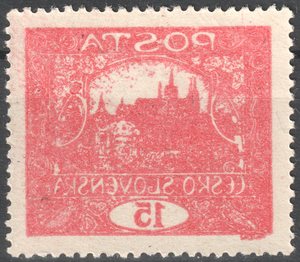 2
2Obtisk na lepu. Kresba je zrcadlově obrácená — přenesla se z čerstvě potištěného archu, který ležel pod ním.Set-off on the gum. The design is mirrored — it transferred from a freshly printed sheet lying beneath.
Obě vady se dochovají jen na známkách s lepem. Odmočením použité známky zmizí lep a s ním i kresba na něm; proto se tisk i obtisk na lepu vyskytují prakticky výhradně na nepoužitých kusech a nálepka nebo nešetrné čištění je mohou nenávratně poškodit.Both flaws survive only on stamps that still have their gum. Soaking a used stamp removes the gum and with it the design on it; a print or a set-off on the gum therefore occurs almost exclusively on unused copies, and a hinge or careless cleaning can damage it beyond repair.
Odtržená barva — archy slepené za mokraTorn-off ink — sheets stuck together while wet
Známka na první pohled působí jako hrubě zrnitý, „prosetý" tisk: po celé kresbě jsou stovky drobných bílých míst, souvislé linky spirál jsou na několika místech přerušené a i nejsilnější prvky — rám a písmena nápisu POSTA — mají díry. Tam, kde barva zůstala, je přitom plně sytá. Vada tedy nevznikla při nanášení barvy, ale až po otisku: část čerstvé barvy byla z papíru stržena.At first glance the stamp looks like a coarsely grained, "sieved" print: hundreds of small white specks cover the whole design, the continuous lines of the spirals are broken in several places, and even the heaviest elements — the frame and the letters of POSTA — have holes. Where the ink remains, it is fully saturated. So the flaw did not arise while the ink was being applied, but after the impression: part of the fresh ink was pulled off the paper.
Jak vada vzniklaHow the flaw arose
Hradčany se tiskly na papír gumovaný před tiskem (dokládá to tisk na lepuprint on the gum). Na vykládce lisu se potištěné archy kladly na sebe, takže mokrá kresba každého archu ležela proti lepu archu následujícího. Stačilo, aby barva ještě neoschla nebo aby v tiskárně bylo vlhko, lep změkl a oba archy se k sobě přilepily. Při rozlepení pak barva zůstala zčásti tam, kam se přichytila silněji — na lepu horního archu — a na potištěném archu po ní zůstaly bílé fleky. Tenhle kus je spodní arch téhle příhody; horní arch by měl na lepu zrcadlově obrácený obtisk, jaký ukazuje předchozí kapitola. Jsou to dva konce jedné události.The Hradčany stamps were printed on paper gummed before printing (the tisk na lepuprint on the gum proves it). At the delivery end of the press the printed sheets were laid on top of one another, so the wet design of each sheet lay against the gum of the next. It was enough for the ink not to have dried, or for the pressroom to be humid, for the gum to soften and the two sheets to stick together. When they were pulled apart, the ink partly stayed where it had gripped more strongly — on the gum of the upper sheet — and white patches were left behind on the printed sheet. This copy is the lower sheet of that incident; the upper sheet would carry a mirrored set-off on its gum, of the kind shown in the previous chapter. They are the two ends of one and the same event.
Proč to není slabý tisk na hrubém papířeWhy this is not a weak impression on rough paper
Při nedotisku vypadávají nejdřív jemné prvky kresby — tenké linky a tečky — zatímco nejvyšší reliéf desky, tedy rám a silná písmena, se otiskne vždy, protože se papíru dotýká první a s největším tlakem. Tady mají díry i rám a písmena, a to bez ohledu na sílu prvku. Ztráty navíc nejsou pravidelný jemný „písek" kopírující texturu papíru, ale nepravidelné fleky s roztřepenými, vláknitými okraji, které přetínají souvislé linky. Přesně tak vypadá barva stržená i s povrchem papíru.In a weak impression the fine elements of the design go first — thin lines and dots — while the highest relief of the plate, the frame and the heavy letters, always prints, because it touches the paper first and with the greatest pressure. Here even the frame and the letters have holes, regardless of the strength of the element. Nor are the losses a regular fine "sand" following the texture of the paper: they are irregular patches with ragged, fibrous edges that cut across continuous lines. That is exactly what ink torn away together with the surface of the paper looks like.
Proč to není řídký tisk ani světlinaWhy this is neither thin print nor a světlina
U řídkého tiskuthin print je slabý celý otisk a barva je bledá; zde je barva všude, kde zůstala, normálně sytá a ztráta je náhlá, ne postupná. SvětlinaA světlina je místní, trvalé oslabení vázané na jedno pole desky, které se na témž poli vrací; tady je postižena celá plocha známky najednou a jiné kusy z téhož pole jsou v pořádku — jde o příhodu jednoho archu, ne o vlastnost desky.In řídký tiskthin print the whole impression is weak and the colour pale; here the ink is normally saturated wherever it remains and the loss is abrupt, not gradual. SvětlinaA světlina is a local, permanent weakening tied to one field of the plate, recurring on that field; here the whole surface of the stamp is affected at once and other copies of the same field are fine — it is the incident of one sheet, not a property of the plate.
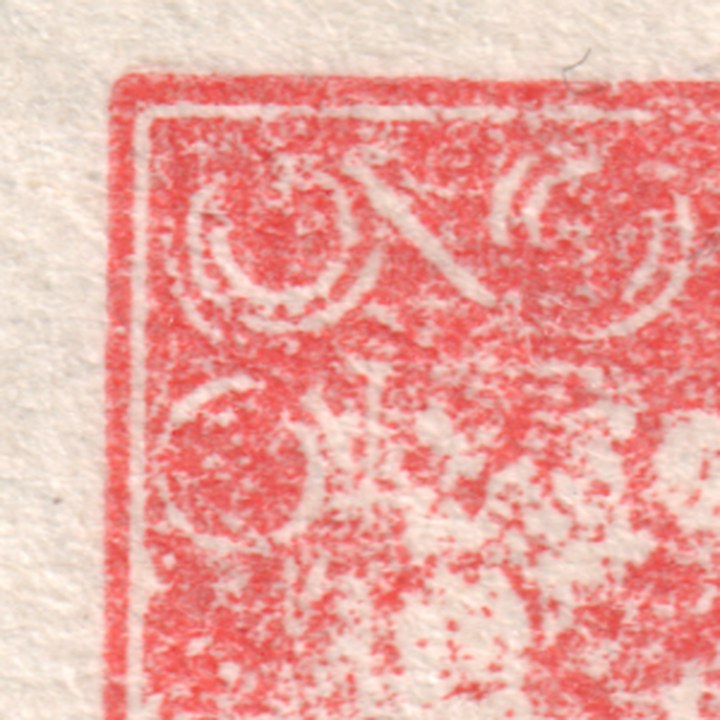
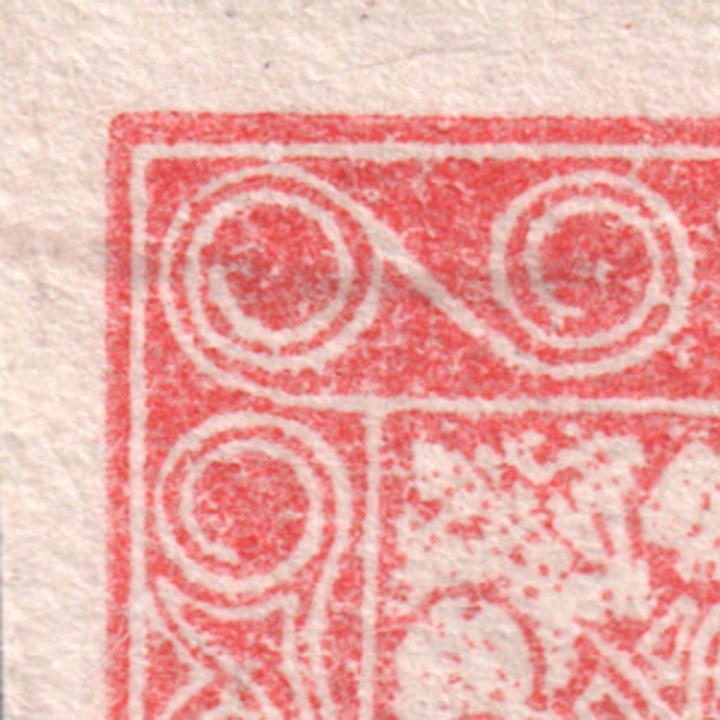
Ukázky ze sbírkySpecimens from the collection
 1
1ZP 23/II. Stovky bílých míst po celé kresbě včetně rámu a nápisu, barva mezi nimi plně sytá.Field 23/II. Hundreds of white specks over the whole design, frame and inscription included, the ink between them fully saturated.
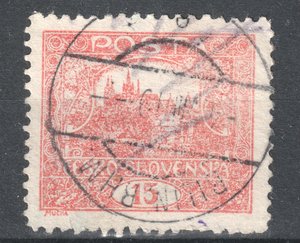 2
2ZP 45/II. Táž podoba vady na jiném poli téže desky: fleky bez barvy v rámu, v písmenech i v kresbě, zbylá barva sytá.Field 45/II. The same form of the flaw on another field of the same plate: ink-free patches in the frame, the letters and the design, the remaining ink saturated.
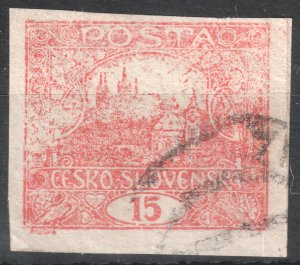 3
3ZP 55/I, nezoubkovaný. Zatím nejrozsáhlejší doložená ztráta: bílá místa pokrývají většinu kresby, rám i oba nápisy jsou proděravělé, zbylá barva plně sytá.Field 55/I, imperforate. The most extensive loss recorded so far: white patches cover most of the design, the frame and both inscriptions are riddled with holes, the remaining ink fully saturated.
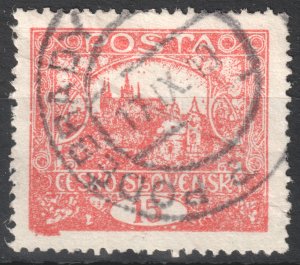 4
4ZP 92/II, zoubkování A, razítko Poděbrady 17. IX. 1919. Fleky bez barvy hlavně v dolní polovině — v nápisu ČESKO-SLOVENSKÁ, v číslici i v ozdobách pod ní; horní část kresby zůstala téměř nedotčená.Field 92/II, perforation A, cancelled Poděbrady 17 IX 1919. Ink-free patches mainly in the lower half — in the inscription ČESKO-SLOVENSKÁ, the numeral and the ornaments below it; the upper part of the design is almost untouched.
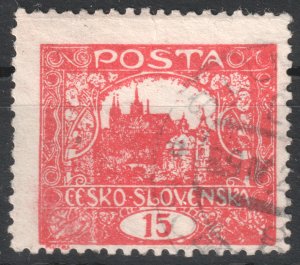 5
5ZP 11/II, zoubkování B, razítko Šluknov 29. IV. (rok nečitelný). Mírnější podoba vady: bílé fleky roztroušené po pravé polovině kresby a v dolních rozích, jinak sytý tisk.Field 11/II, perforation B, cancelled Šluknov 29 IV (year illegible). A milder form of the flaw: white patches scattered over the right half of the design and in the lower corners, otherwise a saturated print.
Druhý kus, z pole 45 téže desky, má vadu ve stejné podobě — nepravidelné fleky s vláknitými okraji přes rám, písmena i kresbu, mezi nimi plně sytá barva.The second copy, from field 45 of the same plate, shows the flaw in the same form — irregular patches with fibrous edges across the frame, the letters and the design, fully saturated ink between them.
Tři další kusy rozšiřují doklad na obě desky. Nezoubkovaný kus z pole 55/I je zatím nejsilnější případ — ztráta barvy zasahuje téměř celou kresbu. Zoubkované kusy z polí 92/II a 11/II ukazují tutéž vadu v mírnější podobě, soustředěnou jen do části známky; kus z pole 92/II nese navíc čitelné razítko Poděbrady ze 17. září 1919, takže archy se slepovaly už v prvním roce tisku.Three further copies extend the record to both plates. The imperforate copy from field 55/I is the strongest case so far — the loss of ink affects almost the whole design. The perforated copies from fields 92/II and 11/II show the same flaw in a milder form, confined to part of the stamp; the copy from field 92/II also carries a legible Poděbrady cancel of 17 September 1919, so sheets were already sticking together in the first year of printing.
Pod lupou stojí za to ověřit dvě věci: zda je papír v bílých místech zdrsněný a „chlupatý" (barva odešla i s povrchem papíru — archy se skutečně slepily) a zda lep na rubu nenese stopy cizí červené barvy (tento arch sám ležel na jiném mokrém archu). Obojí by hypotézu slepených archů potvrdilo.Two things are worth checking under a glass: whether the paper in the white spots is roughened and "furry" (the ink came away with the surface of the paper — the sheets really did stick together), and whether the gum on the back carries traces of foreign red ink (this sheet itself lay on another wet sheet). Either would confirm the stuck-sheets explanation.
Poškození tiskové deskyDamage to the printing plate
Zvláštní případ mezi výrobními vadami. Běžná konstantní desková vada je v desce od začátku a patří k rekonstrukci desek — najdete ji v galerii pozic. Sem patří jen ty případy, kdy se deska poškodila až během používání, nejčastěji při čištění. Takové poškození se v čase vyvíjí, takže se dá rozfázovat — a fáze pak pomáhají zařadit jednotlivé kusy chronologicky. U hodnoty 15h jsou takto zpracovány dva případy.A special case among production flaws. An ordinary constant plate flaw is in the plate from the outset and belongs to plate reconstruction — you will find those in the position gallery. This part covers only cases where the plate was damaged during use, most often while being cleaned. Such damage develops over time, so it can be divided into phases — and the phases then help to place individual copies chronologically. Two such cases are documented on the 15h.
15h – prasklá tisková deska na 11/II
Doplněno 24. 6. 2017
Praskliny na tiskové desce se u několika hodnot této emise vyskytují zejména u krajových známkových polí, kde je riziko mechanického poškození přirozeně větší. Při rekonstrukci první a druhé tiskové desky 15h hodnoty (POFIS č. 7) jsem narazil na velmi zajímavý příklad prasklé tiskové desky.
Výrazná prasklina levého horního rohu se vyskytuje na 11. známkovém poli 2. tiskové desky. Domnívám se, že vznikla poškozením tiskové desky při pravidelném čištění. Výskyt známek s tímto poškozením je z mého pohledu vzácný.
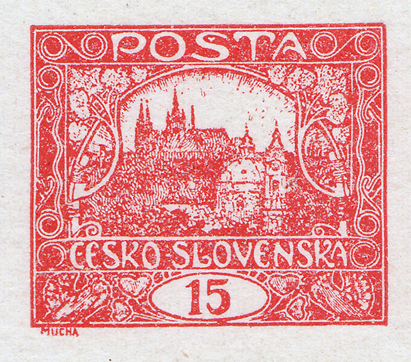
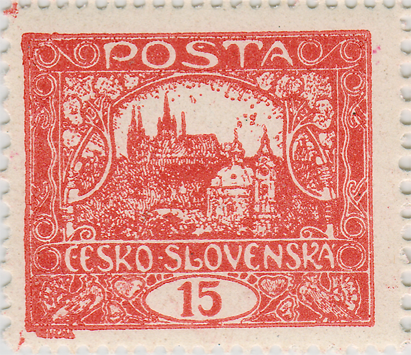
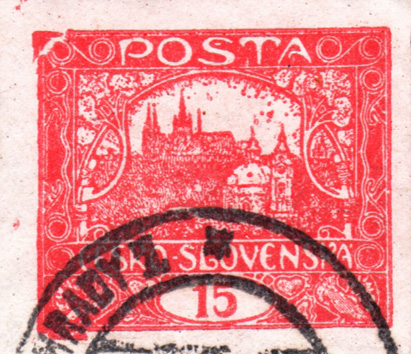
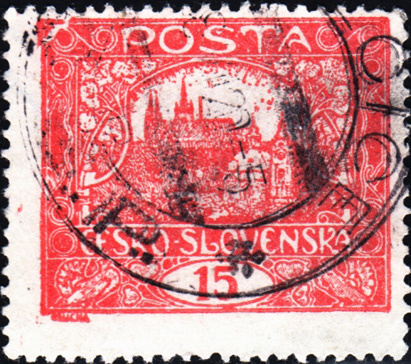
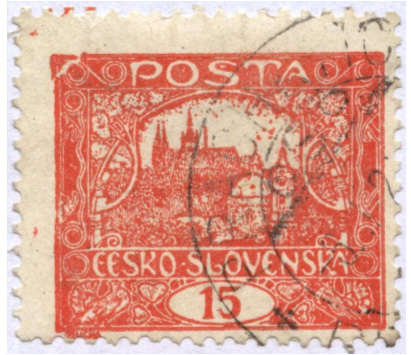
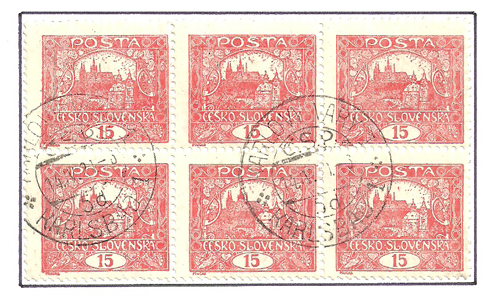
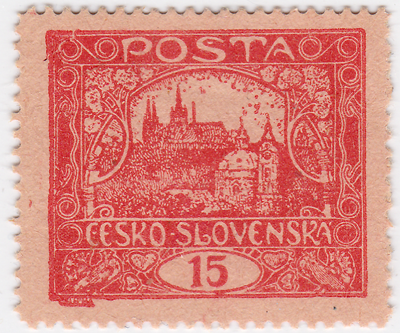
Vývoj praskliny
Prasklina se vyvíjela postupně, jak je patrné z obrázků jednotlivých fází:
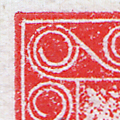
Fáze 0 – neporušená TD · Fáze 1 – slabá deformace · Fáze 2 – TD vykazuje prasklinu · Fáze 3 – prasklina se zvětšuje · Fáze 4 – konečná fáze
| Zoubkování | Fáze 0 neporušená TD | Fáze 1 TD ještě není prasklá, ale vykazuje deformaci | Fáze 2 TD vykazuje prasklinu | Fáze 3 prasklina se zvětšuje | Fáze 4 konečná fáze praskliny |
|---|---|---|---|---|---|
| nezoubkovaná | ✓ | ✓ | ✓ | ✓ | |
| A | ✓ | ✓ | ✓ | ||
| B | ✓ | ||||
| C | ✓ | ✓ | |||
| D | ✓ | ✓ | ✓ | ||
| E | ✓ | ✓ | |||
| F | ✓ | ✓ | ✓ |
Doplnění: na serveru infofila.cz publikoval k této problematice zajímavý článek kolega Jaroslav Michalík: infofila.cz – Hradčany: prasklé tiskové desky.
15h – cracked printing plate at 11/II
Updated 24 June 2017
Plate cracks occur on several values of this issue, especially at marginal stamp fields where the risk of mechanical damage is naturally higher. While reconstructing the first and second plates of the 15h (POFIS no. 7) I came across a very interesting example of a cracked printing plate.
A pronounced crack of the upper-left corner occurs at field 11 of plate II. I believe it arose from damage to the plate during routine cleaning. Stamps with this damage are, in my view, scarce.
Development of the crack
The crack developed gradually, as the images of the individual phases show:
Phase 0 – intact plate · Phase 1 – faint deformation · Phase 2 – the plate shows a crack · Phase 3 – the crack grows · Phase 4 – final phase
| Perforation | Phase 0 intact plate | Phase 1 plate not yet cracked, but shows deformation | Phase 2 plate shows the crack | Phase 3 the crack grows | Phase 4 final phase of the crack |
|---|---|---|---|---|---|
| imperforate | ✓ | ✓ | ✓ | ✓ | |
| A | ✓ | ✓ | ✓ | ||
| B | ✓ | ||||
| C | ✓ | ✓ | |||
| D | ✓ | ✓ | ✓ | ||
| E | ✓ | ✓ | |||
| F | ✓ | ✓ | ✓ |
Addendum: an interesting article on this subject by Jaroslav Michalík was published on infofila.cz: infofila.cz – Hradčany: cracked printing plates.
15h – poškozený rám na 60/VI
15h hodnota z emise Hradčany patří mezi nejoblíbenější pro svou variabilitu – jak odstínů, které jsou stále předmětem seriózních diskusí, tak počtem tiskových desek a rozměrů zoubkování.
Ti, kteří se zabývali rekonstrukcí či studiem tiskových desek 15h nebo se zaměřují na deskové vady, mohli narazit na zajímavý objekt na pravém okraji rámu kresby na známkovém poli 60 ze VI. tiskové desky. Monografie československých známek č. 1 popisuje toto pole jako jedno s vybranou deskovou vadou – právě kvůli tomuto objektu.
Během rekonstrukcí jsem narazil na fakt, že se objekt vyvíjí. Takto vypadá 60/VI na zkusmém tisku, který ještě nemá opracované okraje (jeden z prvních zkusmých tisků desky):
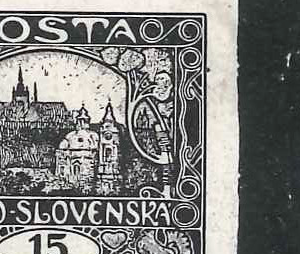
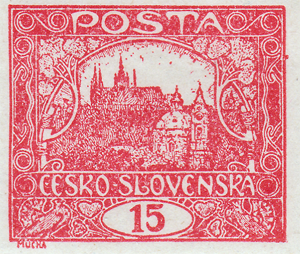
Během tisku a zejména údržby tiskových desek (čištění?) mohlo dojít k poškození, které původní výběžek se znatelnými následky zdeformovalo:
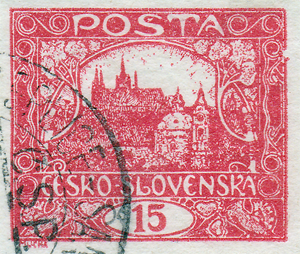
Rozlišujeme tedy dva typy: variantu rámu s původním výběžkem označujeme typ I, variantu s vylomeným (deformovaným) rámem typ II.
Z dostupných exemplářů není znatelné další rozšiřování vady – navzdory tomu, že VI. deska byla použita k tisku velkého množství archů a ke konci byla velmi opotřebovaná. Výskyt obou typů v mém materiálu shrnuje následující tabulka:
| Zoubkování | Typ I (výběžek) | Typ II (vylomený rám) | Celkem |
|---|---|---|---|
| A (13¾:13½) | 2 (100 %) | 0 (0 %) | 2 |
| B (11¾) | 3 (20 %) | 12 (80 %) | 15 |
| C (13¾) | 9 (82 %) | 2 (18 %) | 11 |
| Celkem | 14 (50 %) | 14 (50 %) | 28 |
Typ I (výběžek) je jediný doložený u zoubkování A a výrazně převažuje u řádkového zoubkování C (82 %). Naopak u hřebenového zoubkování B dominuje typ II s vylomeným rámem (80 %). Rozdílné poměry v jednotlivých zoubkováních naznačují, že se archy s oběma stavy desky dostávaly do perforace v různém pořadí. V celkovém součtu vychází poměr obou typů přesně 1:1 (14:14) — nejedná se tedy o vzácnou vadu.
Detail oblasti v obou variantách:
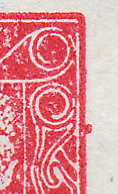
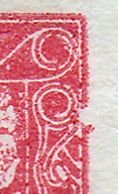
15h – damaged frame at 60/VI
The 15h is among the most popular values of the Hradčany issue for its variability – of shades, still the subject of serious debate, as well as of the number of plates and perforation gauges.
Anyone who has reconstructed or studied the 15h plates, or focuses on plate flaws, may have come across an interesting object on the right edge of the design frame at field 60 of plate VI. The Monograph of Czechoslovak Stamps No. 1 lists this field as one with a selected plate flaw – precisely because of this object.
During reconstructions I found that the object develops. This is what 60/VI looks like on a trial print that does not yet have finished margins (one of the first trial prints of this plate):
During printing, and especially during plate maintenance (cleaning?), damage may have occurred which deformed the original protrusion with noticeable consequences:
We therefore distinguish two types: the frame variant with the original protrusion is designated type I, the variant with the broken-out (deformed) frame type II.
The copies available show no further growth of the flaw – despite plate VI having printed a large number of sheets and being heavily worn towards the end. The occurrence of both types in my material is summarised in the following table:
| Perforation | Type I (protrusion) | Type II (broken-out frame) | Total |
|---|---|---|---|
| A (13¾:13½) | 2 (100 %) | 0 (0 %) | 2 |
| B (11¾) | 3 (20 %) | 12 (80 %) | 15 |
| C (13¾) | 9 (82 %) | 2 (18 %) | 11 |
| Total | 14 (50 %) | 14 (50 %) | 28 |
Type I (the protrusion) is the only one documented in perforation A and clearly prevails in line perforation C (82 %). In comb perforation B, by contrast, type II with the broken-out frame dominates (80 %). The differing ratios in the individual perforations suggest that sheets with both states of the plate reached perforation in varying order. Overall the two types come out at exactly 1:1 (14:14) — so it is not a rare flaw.
Detail of the area in both states:
Vady papíruPaper flaws
Zvrásnění papíruCreased paper
Známky emise se tiskly na navlhčený papír. Vlhký list je měkký a snadno se zvlní, a když se do stroje nedostal dokonale napnutý, shrnul se pod tlakem a v místě přeložení zůstala vráska. Tisk pak proběhl přes zmačkaný povrch: v samotném ohybu se barva nedotiskla a papír po rozložení kresbu „roztáhne“. Na hotové známce je proto vidět světlý pruh bez tisku a obě jeho strany na sebe nenavazují — kresba je v tom místě přerušená a posunutá.The Hradčany stamps were printed on dampened paper. A damp sheet is soft and ripples easily, and if it did not enter the press perfectly taut it gathered under pressure and a crease was left where it folded. Printing then took place over a wrinkled surface: no ink reached the fold itself, and once the sheet was flattened out the design was pulled apart. The finished stamp therefore shows a light unprinted line whose two sides do not meet — the design is interrupted and displaced there.
Proč zvrásnění vznikáWhy creasing happens
- Papír se před tiskem navlhčoval, aby lépe přijímal barvu. Vlhký arch ztrácí tuhost, vlní se a shrnuje se snáz než suchý.The paper was dampened before printing so that it would take the ink better. A damp sheet loses its stiffness, ripples and gathers far more readily than a dry one.
- Archy se do stroje zakládaly ručně. Stačilo, aby list nedosedl rovně nebo aby se okraj podvinul, a vráska byla na světě dřív, než forma dosedla.Sheets were laid into the press by hand. It was enough for one not to lie flat, or for an edge to tuck under, and the crease was there before the forme came down.
- Emise vznikala v roce 1919 ve spěchu a na provizorním vybavení — z téhož důvodu, z jakého jsou u této emise běžné i ostatní výrobní vady.The issue was produced in 1919 in haste and on makeshift equipment — the same reason why the other production flaws are common on the Hradčany stamps too.
- Po tisku arch uschl a smrštil se. Vráska se tím zafixovala a zůstala v papíru i po rozdělení archu na jednotlivé známky.After printing the sheet dried and shrank. The crease was fixed by that and stayed in the paper even after the sheet was divided into single stamps.
Stupně zvrásněníDegrees of creasing
- Zvlnění — papír je jen zvlněný, kresba zůstává souvislá a pouze se mírně vlní. Nejméně nápadný stav.Rippling — the paper is merely undulating, the design stays continuous and only waves slightly. The least conspicuous state.
- Vráska — v kresbě je tenký světlý pruh bez tisku; obě strany kresby jsou vůči sobě posunuté jen nepatrně.Crease — a thin light unprinted line crosses the design; the two sides of the design are displaced only slightly.
- Záhyb — papír byl přeložený přes sebe. Nepotištěný pruh je široký, kresba na sebe zjevně nenavazuje a známka působí deformovaně. Nejnázornější a sběratelsky nejžádanější stupeň.Fold — the paper was laid over on itself. The unprinted band is wide, the design plainly fails to meet and the stamp looks distorted. The most telling degree and the one collectors seek.
Jak odlišit výrobní vadu od pozdějšího poškození. Rozhoduje, zda kresba přes vrásku pokračuje. Vznikla-li vráska před tiskem, chybí v ní barva a kresba na sebe po obou stranách nenavazuje — to je výrobní vada. Zmačkal-li se papír až po tisku, kresba přes ohyb plynule pokračuje a jen papír je přeložený; pak jde o poškození, které hodnotu naopak snižuje. U vícenásobků je důkaz nejsilnější: vráska, která přechází z jedné známky na druhou přes mezeru, musela být v archu už při tisku.Telling a production flaw from later damage. What decides is whether the design continues across the crease. If the crease arose before printing, ink is missing in it and the design does not meet on either side — that is a production flaw. If the paper was crumpled after printing, the design runs smoothly across the fold and only the paper is bent; that is damage, and it lowers the value instead. On multiples the evidence is strongest: a crease that passes from one stamp to the next across the gutter must have been in the sheet at the time of printing.
Ukázky ze sbírkySpecimens from the collection
Šestadvacet známek na dvaceti čtyřech kusech — dvacet dva jednotlivých, jeden nezoubkovaný vodorovný pár (kus 1) a jeden svislý pár (kus 23). Kliknutím se ukázka zvětší.Twenty-six stamps on twenty-four items — twenty-two singles, one imperforate horizontal pair (item 1) and one vertical pair (item 23). Click a specimen to enlarge it.
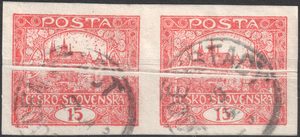 1
1Nezoubkovaný vodorovný pár. Vráska běží přes obě známky ve stejné výšce a pokračuje i přes mezeru mezi nimi — vznikla tedy v archu, ještě než byly známky rozděleny.Imperforate horizontal pair. The crease runs across both stamps at the same height and continues over the gutter between them — it was therefore in the sheet before the stamps were separated.
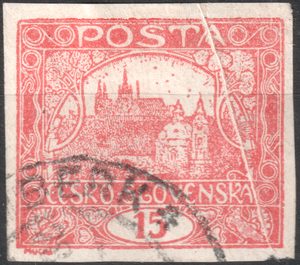 2
2Výrazný šikmý záhyb od horního okraje k dolnímu. Podél něj je kresba světlejší a obě strany záhybu na sebe nenavazují.A pronounced diagonal fold from the top edge to the bottom. The design is lighter along it and the two sides of the fold do not line up.
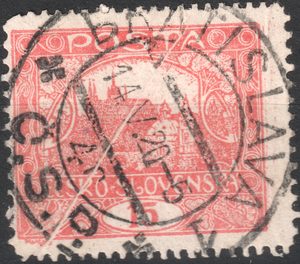 3
3Šikmá vráska přes střed kresby; pod hustým razítkem ji prozrazuje především světlý pruh bez tisku.A diagonal crease across the middle of the design; under the heavy cancel it is betrayed above all by a light unprinted line.
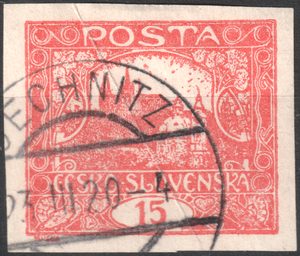 4
4Vráska prochází vodorovně středem kresby a u levého okraje se stáčí vzhůru.The crease runs horizontally through the middle of the design and turns upwards at the left edge.
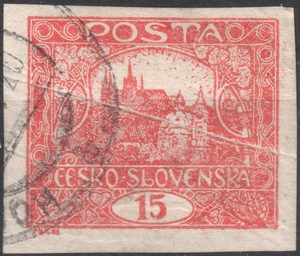 5
5Dlouhá šikmá vráska přes celou kresbu, od horního levého rohu k dolnímu pravému.A long diagonal crease across the whole design, from the top left corner to the bottom right.
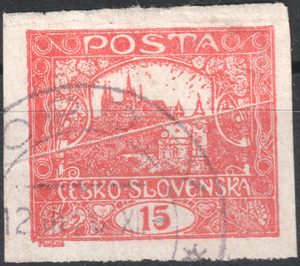 6
6Vráska přes celou známku — od levého okraje mírně stoupá doprava a přerušuje kresbu i nápis.A crease across the whole stamp — it rises slightly to the right from the left edge and interrupts both the design and the inscription.
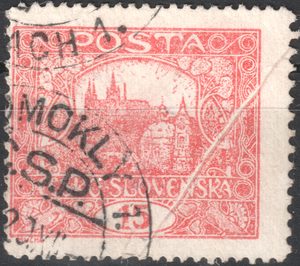 7
7Šikmá vráska v pravé polovině známky, od horního okraje dolů k nápisu.A diagonal crease in the right half of the stamp, from the top edge down to the inscription.
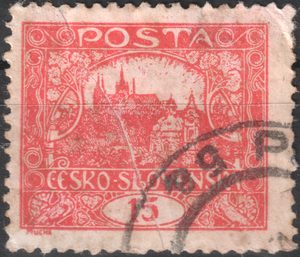 8
8Vodorovná vráska přes horní část kresby, souběžná s rámečkem.A horizontal crease across the upper part of the design, parallel with the frame.
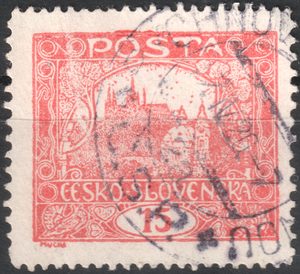 9
9Vodorovná vráska přes střed kresby.A horizontal crease across the middle of the design.
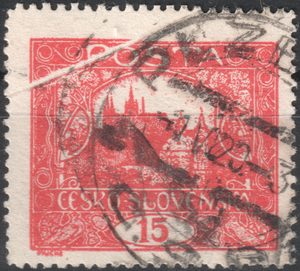 10
10Vodorovná vráska přes střed známky; pod ní je tisk znatelně světlejší.A horizontal crease across the middle of the stamp; below it the print is noticeably lighter.
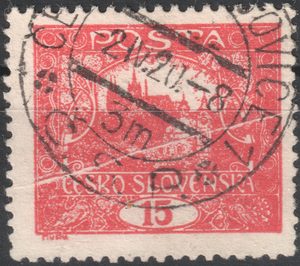 11
11Svislá vráska při levém okraji, prochází rámečkem i zoubkováním.A vertical crease along the left edge, passing through the frame and the perforation.
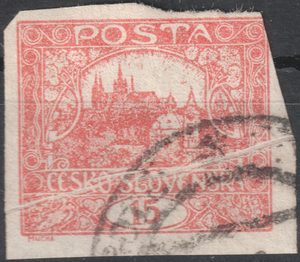 12
12Střižený kus. Šikmá vráska vede od pravého okraje šikmo dolů přes kresbu.A cut copy. A diagonal crease runs down across the design from the right edge.
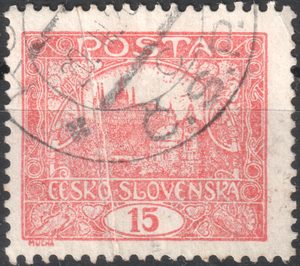 13
13Vodorovná vráska přes horní polovinu kresby.A horizontal crease across the upper half of the design.
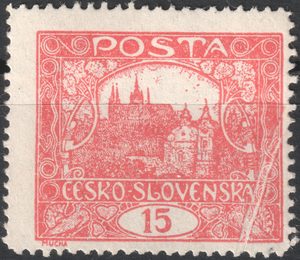 14
14Svislá vráska při pravém okraji; prochází i zoubkováním.A vertical crease along the right edge; it passes through the perforation as well.
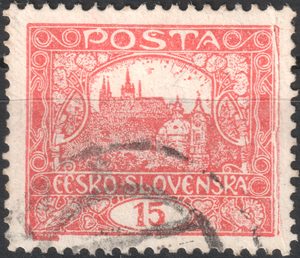 15
15Svislá vráska při pravém okraji a slabší vodorovná v horní části známky.A vertical crease along the right edge and a fainter horizontal one in the upper part of the stamp.
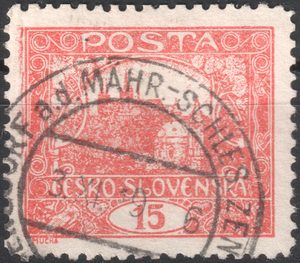 16
16Vodorovná vráska přes střed kresby, po celé šířce známky.A horizontal crease across the middle of the design, over the whole width of the stamp.
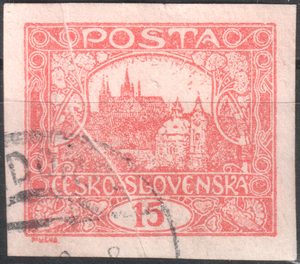 17
17Střižený kus se svislou vráskou při levém okraji.A cut copy with a vertical crease along the left edge.
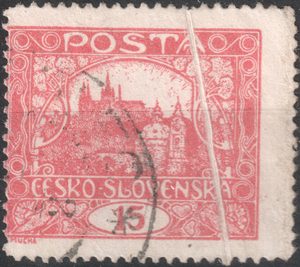 18
18Dvě souběžné svislé vrásky v pravé části známky.Two parallel vertical creases in the right-hand part of the stamp.
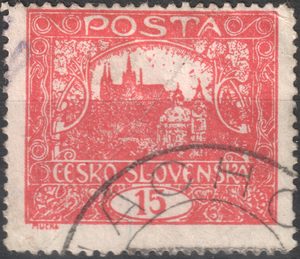 19
19Vodorovná vráska nad nápisem ČESKO-SLOVENSKA.A horizontal crease above the ČESKO-SLOVENSKA inscription.
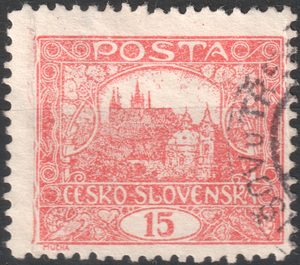 20
20Jemná šikmá vráska v pravé horní části kresby.A fine diagonal crease in the upper right part of the design.
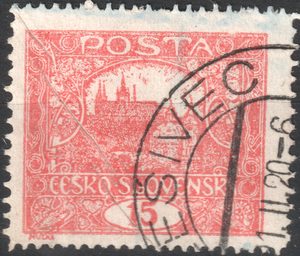 21
21Šikmá vráska od levého okraje ke středu kresby.A diagonal crease from the left edge towards the middle of the design.
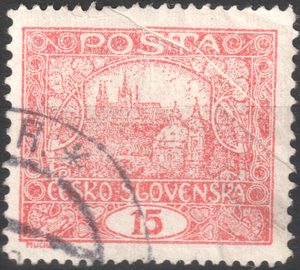 22
22Svislá vráska v pravé části známky a kratší šikmá v horním rohu.A vertical crease in the right-hand part of the stamp and a shorter diagonal one in the top corner.
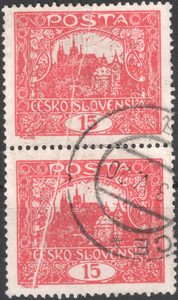 23
23Svislý pár. Vráska prochází oběma známkami i zoubkovanou mezerou mezi nimi — další doklad, že zvrásnění vzniklo už v archu.A vertical pair. The crease passes through both stamps and through the perforated gutter between them — further evidence that the creasing was already there in the sheet.
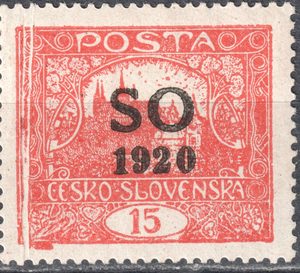 24
24Svislá vráska při levém okraji, na kusu s přetiskem SO 1920 (pole 92/I).A vertical crease along the left edge, on a copy with the SO 1920 overprint (field 92/I).
Dřívko a smítko — cizí objekt v papíruSplinters and specks — a foreign object in the paper
Do papíru se už při jeho výrobě dostal cizí objekt — úlomek dřeva, kousek kůry nebo neprovařené vlákno, které přežilo rozvlákňování. Sběratelé pro něj mají dvě jména podle tvaru: protáhlé třísce se říká dřívko, drobné kompaktní částici smítko. Objekt zůstal zalisovaný v tloušťce archu a známka ho nese dodnes.A foreign object found its way into the paper while it was being made — a fragment of wood, a piece of bark, or an unpulped fibre that survived the beating. Collectors have two names for it according to its shape: an elongated sliver is a dřívko (splinter), a small compact particle a smítko (speck). The object stayed pressed into the thickness of the sheet, and the stamp carries it to this day.
Poznávacím znamením je, že je vidět z obou stran. Nečistota, která na známku sedla později, leží na povrchu jedné strany. Dřívko je uzavřené v papíru, a hlásí se proto z líce i z rubu — na témže místě, jen zrcadlově obráceném.The mark of identification is that it is visible from both sides. Dirt that settled on the stamp later lies on the surface of one side. A splinter is enclosed within the paper, and so shows on the face and on the back alike — at the same place, merely mirrored.
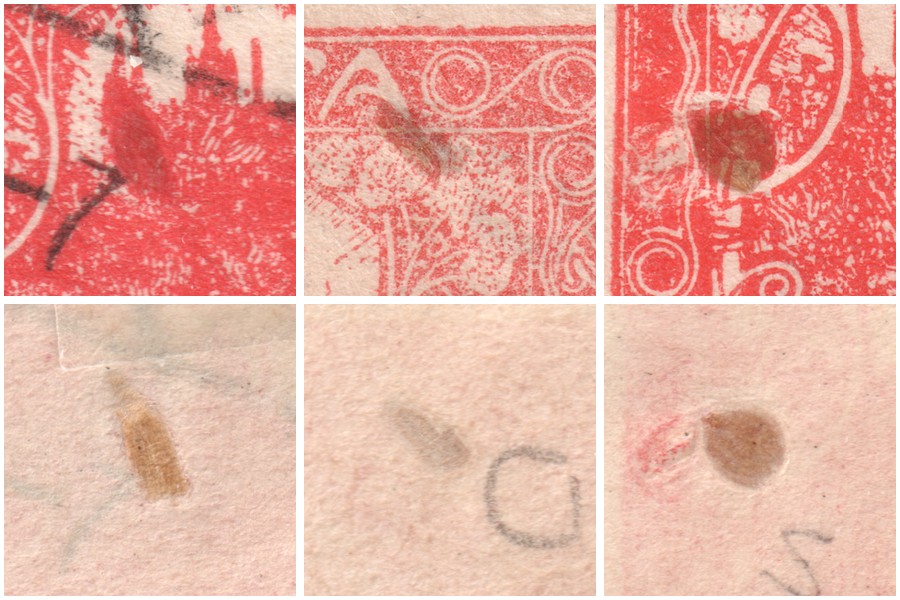
Jak vada vzniklaHow the flaw arose
Objekt se do papíru dostal v papírně, dávno před tiskem — s tiskovou formou nemá nic společného a na téže známkové pozici se neopakuje. Emise se tiskla na papír, jaký byl v roce 1919 k mání; kvalita kolísala a kontrola suroviny nepatřila k tomu, na čem tehdy nejvíc záleželo. Objekty v papíru jsou proto u této emise poměrně časté.The object entered the paper at the paper mill, long before printing — it has nothing to do with the printing forme and does not recur at the same stamp position. The issue was printed on whatever paper could be had in 1919; quality varied, and checking the raw material was not among the things that mattered most at the time. Objects in the paper are therefore fairly frequent on this issue.
Protože tam objekt byl už při tisku, reaguje na něj i tisk. Povrch v tom místě není rovný a je jinak savý, takže se barva nepřenese, jak má: kolem částice bývá světlý dvorec bez tisku nebo je kresba přerušená. Na rubu je kolem ní někdy vidět prosvětlený lem — vlákna papíru se kolem objektu rozestoupila a papír je tam řidší.Because the object was already there when the sheet was printed, the printing reacts to it. The surface is not level there and takes ink differently, so the ink does not transfer as it should: a pale halo without print tends to surround the particle, or the design is interrupted. On the back a lightened ring is sometimes visible around it — the fibres parted about the object and the paper is thinner there.
Jak odlišit od pozdější nečistoty. Rozhoduje, jestli je objekt v papíru, nebo na něm. Zalisovaná částice je vidět z obou stran, nedá se seškrábnout a tisk kolem ní je porušený — barva se k ní nedostala. Nečistota nalepená později leží jen na jedné straně, kresba pod ní pokračuje nepřerušeně a při šikmém světle vystupuje nad povrch. Větší dřívko navíc papír oslabuje: v tom místě je arch tenčí a snáz se trhá, takže s takovým kusem je namístě zacházet opatrně.Telling it from later dirt. What decides is whether the object is in the paper or on it. An embedded particle is visible from both sides, cannot be scraped off, and the print around it is disturbed — the ink never reached it. Dirt stuck on afterwards lies on one side only, the design continues unbroken beneath it, and in raking light it stands above the surface. A larger splinter also weakens the paper: the sheet is thinner there and tears more easily, so such a copy deserves careful handling.
Ukázky ze sbírkySpecimens from the collection
U každého kusu je vlevo líc a vpravo rub téže známky. Kliknutím se ukázka zvětší.For each item the face is on the left and the back of the same stamp on the right. Click a specimen to enlarge it.
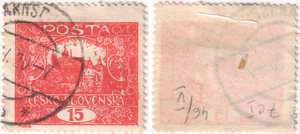 1
1Nejvýraznější kus. Tříska necelé 2 mm dlouhá, s patrnou vláknitou strukturou. Z líce leží v ploše Hradčan a tisk kolem ní ztrácí kresbu; z rubu je hnědá a mírně vystupuje nad povrch.The most pronounced item. A splinter not quite 2 mm long, with a visible fibrous structure. On the face it lies in the area of the Castle and the print loses its detail around it; from the back it is brown and stands slightly proud of the surface.
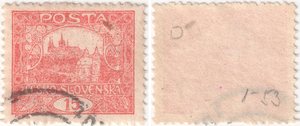 2
2Drobnější protáhlé smítko při horním okraji kresby, vpravo. Prochází rámečkem, který je v tom místě zeslabený; z rubu je světlejší, šedohnědé.A smaller elongated speck at the upper edge of the design, to the right. It crosses the frame line, which is weakened where it passes; from the back it is paler, greyish brown.
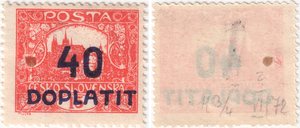 3
3Kus s přetiskem 40 DOPLATIT. Kompaktní smítko asi 1,5 mm velké v levé části kresby, se zřetelným světlým dvorcem — červená barva se k objektu nedostala. Z rubu je hnědé, s prosvětleným lemem.A copy with the 40 DOPLATIT surcharge. A compact speck about 1.5 mm across in the left-hand part of the design, with a distinct pale halo — the red ink never reached the object. From the back it is brown, with a lightened ring around it.
Složky papíruPaper foldsPřipravuje se.In preparation.
Sekce roste postupně. Každý druh vady dostane vlastní oddíl s popisem, jak vznikla, a s vlastními vzorky; když oddíl přeroste stránku, odštěpí se do samostatné stránky a tady zůstane shrnutí s odkazem — tak jako u světlin.This section grows step by step. Every kind of flaw gets its own part with a description of how it arose and with its own specimens; when a part outgrows the page it is split off into a page of its own and a summary with a link remains here — as with the white spots.