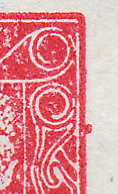
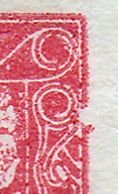
15h – damaged frame at 60/VI
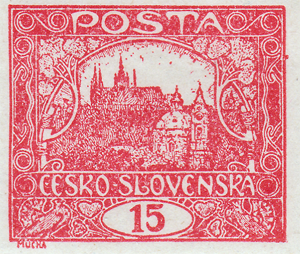
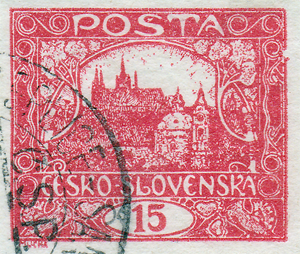
The 15h is among the most popular values of the Hradčany issue for its variability – of shades, still the subject of serious debate, as well as of the number of plates and perforation gauges.
Anyone who has reconstructed or studied the 15h plates, or focuses on plate flaws, may have come across an interesting object on the right edge of the design frame at field 60 of plate VI. The Monograph of Czechoslovak Stamps No. 1 lists this field as one with a selected plate flaw – precisely because of this object.
During reconstructions I found that the object develops. This is what 60/VI looks like on a trial print that does not yet have finished margins (one of the first trial prints of this plate):
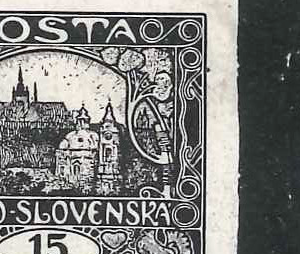
During printing, and especially during plate maintenance (cleaning?), damage may have occurred which deformed the original protrusion with noticeable consequences:
We therefore distinguish two types: the frame variant with the original protrusion is designated type I, the variant with the broken-out (deformed) frame type II.
The copies available show no further growth of the flaw – despite plate VI having printed a large number of sheets and being heavily worn towards the end. The occurrence of both types in my material is summarised in the following table:
| Perforation | Type I (protrusion) | Type II (broken-out frame) | Total |
|---|---|---|---|
| A (13¾:13½) | 2 (100 %) | 0 (0 %) | 2 |
| B (11¾) | 3 (20 %) | 12 (80 %) | 15 |
| C (13¾) | 9 (82 %) | 2 (18 %) | 11 |
| Total | 14 (50 %) | 14 (50 %) | 28 |
Type I (the protrusion) is the only one documented in perforation A and clearly prevails in line perforation C (82 %). In comb perforation B, by contrast, type II with the broken-out frame dominates (80 %). The differing ratios in the individual perforations suggest that sheets with both states of the plate reached perforation in varying order. Overall the two types come out at exactly 1:1 (14:14) — so it is not a rare flaw.
Detail of the area in both states: